
 Worksheets
Taxonomy & Classification
Total questions: 40
Worksheet time: 51mins
Name
Class
Date
1.
Which of the following organisms are LEAST closely related?
a)
organisms that share a domain
b)
organisms that share a family
c)
organisms that share a genus
d)
organisms that share a species
2.
The scientific name for an organism is made from the:
a)
class and family name
b)
genus and species name
c)
domain and kingdom name
d)
kingdom and phylum name
3.
The 8 levels of classification, most broad to most specific.
a)
Domain, Genus, Family, Order, Class, Phylum, Kingdom, Species
b)
Domain, Species, Kingdom, Genus, Phylum, Family, Class, Order
c)
Domain, Kingdom, Phylum, Class, Order, Family, Genus, Species
d)
Order, Kingdom, Species, Domain, Phylum, Family, Class, Genus
4.
Term given to describe the 2 name naming system is:
a)
dichotomous key
b)
binomial nomenclature
c)
cladogram
d)
phylogenic tree
5.
Cells that do not have a true nucleus are called....
a)
eukaryote
b)
prokaryote
c)
unicellular
d)
multicellular
6.
Cells that have a true nucleus are called....
a)
eukaryotes
b)
prokaryotes
c)
unicellular
d)
multicellular
7.
Organisms are the same ___________ when they can have offspring, then those offspring can have more offspring.
a)
Class
b)
Family
c)
Species
d)
Phylum
8.

Which organisms are closely related?
a)
American badger and leopard
b)
coyote and gray wolf
c)
european otter and leopard
d)
coyote and american badger
9.
Hermit crab is a scientific name.
a)
TRUE
b)
FALSE
10.
In a dichotomous key, each question contains four choices.
a)
TRUE
b)
FALSE
11.
The science of classifying is called
a)
Biology
b)
Taxonomy
c)
Sortology
d)
Phylogeny
12.
The written set of choices leading to an organism's name is a(n)
a)
Cladogram
b)
Phylogenic tree
c)
Dichotomous key
d)
Binomial nomenclature
13.
Who developed the method of classification in the 18th century?
a)
Aristotle
b)
Key
c)
Linnaeus
d)
Darwin
14.
Which of the following scientific names is written correctly? Assume all are in italics!
a)
Homo Sapien
b)
Homo sapien
c)
homo sapien
d)
Homosapien
15.
Which taxon is broader (more organisms included)?
a)
Phylum
b)
Family
c)
Order
d)
Class
16.

Which trait do only humans have, according to the cladogram?
a)
jaws
b)
mammary glands & hair
c)
terrestrial during all life stages
d)
bipedal & opposable thumbs
17.

On the cladogram, which organism is the closest relative of the human?
a)
Frog
b)
Hare
c)
Caiman
d)
Parrot
18.

According to this cladogram, birds are LEAST related to:
a)
Amphibians
b)
Sharks
c)
Ray Finned Fish
d)
Crocodiles
19.

Which two species are the most closely related?
a)
I and II
b)
II and V
c)
I and V
d)
V and VI
20.

According to the phylogenetic tree,, which two groups of organisms have the most genetic differences?
a)
rotifers and nematodes
b)
mollusks and annelids
c)
mollusks and arthropods
d)
echinoderms and jellyfish
21.
What is the best way to determine the classification of an organism?
a)
Compare DNA sequences
b)
Examine what the organism eats
c)
Compare fur patterns
d)
Examine migration trends
22.

An illustration and a dichotomous key are given. What is the correct classification for this organism?
a)
Class Insecta
b)
Order Amblygygi
c)
Order Araneae
d)
Order Scorpiones
23.

A dichotomous key for trees is provided. Hikers found a tree that has large brown cones and single sharp needles. What species of tree have the hikers found?
a)
Juniper
b)
Pine
c)
Spruce
d)
Fir
24.

Which organism is most related to species E?
a)
D
b)
I
c)
G
d)
B
25.
The scientific name given to the white oak in Quercus alba. What genus does this tree belong to?
a)
Quercus
b)
Canis
c)
Alba
d)
Plantae
26.

Use the dichotomous key to identify the organism
a)
Cornus florida
b)
Ulmus americana
c)
Albizia julibrissin
d)
Juglans nigra
27.
If two species share the same class, they also share the same______.
a)
phylum
b)
order
c)
genus
d)
species
28.
Which 2 organisms would be able to reproduce and produce fertile offspring?
a)
2 organisms in the same class
b)
2 organisms in the same family
c)
2 organisms in the same genus
d)
2 organisms in the same species
29.
An organism made up of more than one cell would be called:
a)
multicellular
b)
unicellular
c)
heterotroph
d)
autotroph
30.
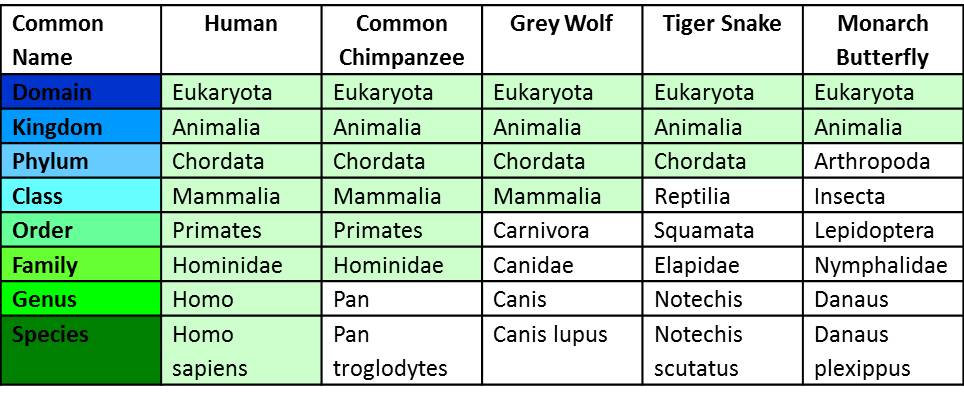
Which organism in the table is least closely related to the chimpanzee?
a)
human
b)
grey wolf
c)
tiger snake
d)
monarch butterfly
31.
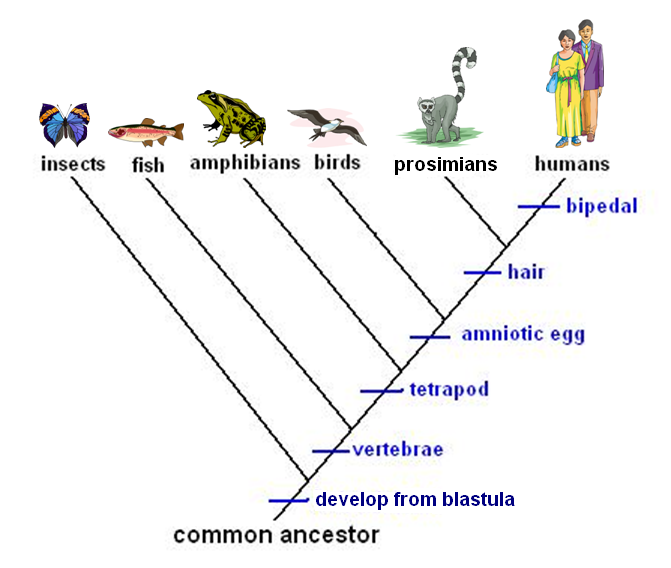
Which organisms pictured on the cladogram have hair?
a)
prosimians only
b)
prosimians and humans
c)
humans only
d)
prosimians and birds
32.
Any living things is called:
a)
organism
b)
animal
c)
cell
d)
plant
33.

A student discovers an arachnid with a segmented abdomen, long legs, and a tail with no stinger. The student uses the dichotomous key below to identify it. Which arachnid has the student found?
a)
Whip Scorpion
b)
Wind Scorpion
c)
Daddy long legs
d)
Scorpion
34.
This domain is characterized by ancient bacteria that can live in extreme environments, such as volcanoes.
a)
Archaea
b)
Bacteria
c)
Eukarya
d)
Prokarya
35.
I am single celled, and I only have one parent. My cell does not have an organized nucleus. Sometimes I cause diseases. Other times I am a decomposer.
a)
Bacteria
b)
Archaea
c)
Eukarya
d)
Prokarya
36.
I am made of many cells. My cells have an organized nucleus. I have two parents and eat food.
a)
Eukarya
b)
Bacteria
c)
Archaea
37.
I am made of many cells. My cells have an organized nucleus. I mostly have two parents, but sometimes one. I make my own food.
a)
Archaea
b)
Bacteria
c)
Eukarya
38.
I am only made of one cell. My cell does not have an organized nucleus. I only have one parent. Sometimes I make my own food, but other times, I eat food. I like to live in volcano vents, salt water of deep oceans, or the freezing cold Arctic.
a)
Bacteria
b)
Archaea
c)
Eukarya
39.
What do the domains Bacteria and Archaea have in common?
a)
They both have a nucelus
b)
They are both lacking a nucleus
c)
They are both made of many cells
d)
They are both dead
40.
What do all living things have in common?
a)
They are all made up of 1 or more cells
b)
They all have a nucleus where the DNA is stored
c)
They all rely on other organisms to feed themselves
d)
They all reproduce asexually
100 %

