
 Worksheets
Midterm Review
Total questions: 53
Worksheet time: 3hrs 26mins
Name
Class
Date
1.
what is the definition of chemical change?
a)
any change that results in the formation of new chemical substances.
b)
changing clothes
c)
matter cannot be created or destroyed, only change form
d)
changes affecting the form of a chemical substance, but not its chemical composition.
2.
what happens when water freezes?
a)
ice is formed; chemical property
b)
cold water is formed; physical change
c)
ice is formed; physical change
d)
cold water is formed; chemical change
3.
Kim puts an ice cube in a beaker and it melts. This is a good example of:
a)
a physical change.
b)
a chemical change.
c)
an experiment.
d)
an analysis.
4.
Which is an example of a chemical change?
a)
coloring a paper
b)
rusting steel wool
c)
bending steel wool
d)
freezing water
5.
Which of the following is a physical characteristic of a metalloid?
a)
texture
b)
malleable
c)
brittle
d)
semi-conductor
6.
Which of the following is a physical characteristic of a metal?
a)
texture
b)
malleable
c)
brittle
d)
semi-conductor
7.

Look at the periodic table that is provided. Where would metals be located?
a)
to the left of the table in blue
b)
to the right of the table in pink
c)
in the zigzag line in yellow
8.
A pure substance that cannot be broken down into anything simpler is a/an-
a)
atom
b)
element
c)
cell
d)
compound
9.

What is the volume of Object X?
a)
10.0 cm3
b)
15.0 cm3
c)
20.0 cm3
d)
25.0 cm3
10.
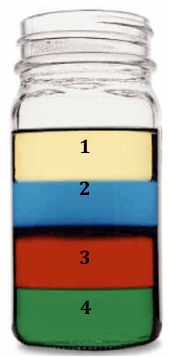
Put the liquids in order from most dense to least dense?
a)
4, 3, 2, 1
b)
1, 2, 3, 4
c)
3, 4, 2, 1,
d)
4, 3, 1, 2
11.
Is salt (NaCI) a compound or a element
a)
Compound
b)
element
13.
How many elements are represented in the compound?
Na2CO3
Na2CO3
a)
1
b)
2
c)
3
d)
4
13.
How many elements are represented in the compound?
Na2CO3
Na2CO3
a)
1
b)
2
c)
3
d)
4
14.

This picture represents which of the following?
a)
element
b)
compound
c)
mixture
15.
A combination of substances that are not chemically combined is called a(n)____________.
a)
mixture
b)
compound
c)
physical
16.
Ionic Bonding involves...
a)
The transfer of protons
b)
The transfer of nuetrons
c)
The transfer of electrons
d)
None Of the above
17.
What do atoms that form positive ions tend to do?
a)
Tend to lose electrons
b)
Tend to lose protons
c)
Tend to gain electrons
d)
Tend to gain protons
18.
What happens when the sodium atom loses an electron?
a)
It become negatively charged
b)
It become positively charged
c)
none
19.
Covalent compounds
a)
Share electrons
b)
transfer electrons
c)
contain a sea of electrons
d)
conduct electricity
20.

What elements generally make an ionic bond?
a)
metal and nonmetal
b)
2 or more nonmetals
c)
metal
d)
none of the above
21.

What elements generally make a covalent bond?
a)
metal and nonmetal
b)
2 or more nonmetals
c)
metal
d)
none of the above
22.
What is a valence electron?
a)
an electron that is found in the outermost shell of an atom.
b)
an electron found in the innermost shell of an atom.
c)
an electron found in the middle shell.
23.
What is the number of valence electrons for Oxygen?
a)
8
b)
6
c)
2
d)
1
24.

How many valence electrons in this structure?
a)
6
b)
5
c)
4
d)
7
25.

What is letter A?
a)
coefficient
b)
subscript
c)
superscript
26.
What is letter C?
a)
coefficient
b)
subscript
c)
superscript
27.
According to the conservation of mass in a chemical reaction, the total amount of atoms
a)
can increase.
b)
can decrease.
c)
stays the same.
d)
doesn’t matter.
28.
What are the coefficients for the following balanced equation:
____Mg+____O2→____MgO
____Mg+____O2→____MgO
a)
2,1,2
b)
3,2,1
c)
1,2,1
d)
3,2,3
29.
What are the coefficients for the following balanced equation:
____Na2S+____MgO→____Na2O+____MgS
____Na2S+____MgO→____Na2O+____MgS
a)
1,1,1,1
b)
1,2,2,1
c)
2,1,2,1
d)
2,1,1,2
30.
What type of equation is the following:
C2H4 + 2O2 → CO2 + 2H2O
C2H4 + 2O2 → CO2 + 2H2O
a)
synthesis
b)
decomposition
c)
combustion
d)
single replacement
31.
What type of equation is the following:
HNO3+Zn→Zn(NO3)2+H2
HNO3+Zn→Zn(NO3)2+H2
a)
synthesis
b)
decomposition
c)
combustion
d)
single replacement
32.
What type of equation is the following:
2H2+O2→2H2O
2H2+O2→2H2O
a)
synthesis
b)
decomposition
c)
combustion
d)
single replacement
33.
Where are the reactants in a chemical equation?
a)
all over
b)
in front of the arrow
c)
after the arrow
34.
Which number represents the coefficient? 5Mg3(PO4)2
a)
5
b)
4
c)
3
d)
2
35.
How many sulfur atoms are in 4Al(SO4)3?
a)
4
b)
12
c)
3
d)
1
36.
What compound results in the bond between potassium and oxygen?
a)
K2O
b)
KO
c)
PO
d)
KO2
37.
Metallic bonds occur when
a)
nonmetals bond with nonmetals
b)
metals bond with metals
c)
metals bond with nonmetals
d)
depends on the molecule
38.
Unstable isotopes undergo radioactive decay. What occurs during radioactive decay?
a)
Unstable isotopes collapse in on themselves.
b)
The electrons in unstable isotopes constantly move to higher energy levels within the electron cloud.
c)
Unstable isotopes release charged particles.
d)
Unstable isotopes capture charged particles from other atoms
39.
A saturated solution is______
a)
No more solute can be dissolved
b)
More solute can be dissolved
c)
The solvent and solution
40.
What is the only type of mixture that has particles that are as small as molecules.
a)
Solutions
b)
Suspensions
c)
Colloids
d)
water
41.
Substance dissolved in a solution
a)
concentration
b)
solute
c)
solvent
d)
solution
42.
Capable of being dissolved
a)
Soluble
b)
concentration
c)
colloid
d)
molarity
43.
Solution that contains less solute than a saturated solution under the same conditions
a)
Saturated
b)
unsaturated
c)
supersaturated
d)
solution
44.
This type of mixture contains two or more substances that are visibly distinguishable.
a)
homogeneous
b)
heterogeneous
c)
solution
d)
colloid
45.
7,000 g = ____ kg
a)
70
b)
700
c)
7
d)
0.07
46.
Is 55,000 mg greater than, less than, or equal to 5 kg?
a)
greater than
b)
equal to
c)
less than
47.
Is 20 g greater than, less than, or equal to 2 kg?
a)
greater than
b)
less than
c)
equal to
48.
7,000 g = ____ kg
a)
70
b)
700
c)
7
d)
0.07
49.
Ed fills his sports bottle with 1 liter of water. After his bike ride, he drinks 200 milliliters of the water. How much water is left in Ed's sports bottle?
(1 liter = 1000 ml)
(1 liter = 1000 ml)
a)
800 mm
b)
8000 ml
c)
80 ml
d)
800 ml
50.
Jack has a rock. The rock has a mass of 14g and a volume of 2cm3. What is the density of the rock?
a)
7 mL
b)
7 g/cm3
c)
28 g/cm3
d)
1/7 g/cm3
51.
Which units of measurement are used for volume?
a)
grams
b)
centimeters
c)
grams/milliliter
d)
milliliter
52.
True or False: The density of a specific type of material never changes.
a)
True
b)
False
53.
What is the formula for density?
a)
density = mass x volume
b)
density = mass / volume
c)
density = mass + volume
d)
density = mass - volume
100 %

