
 Worksheets
CBA 3 Review
Total questions: 50
Worksheet time: 39mins
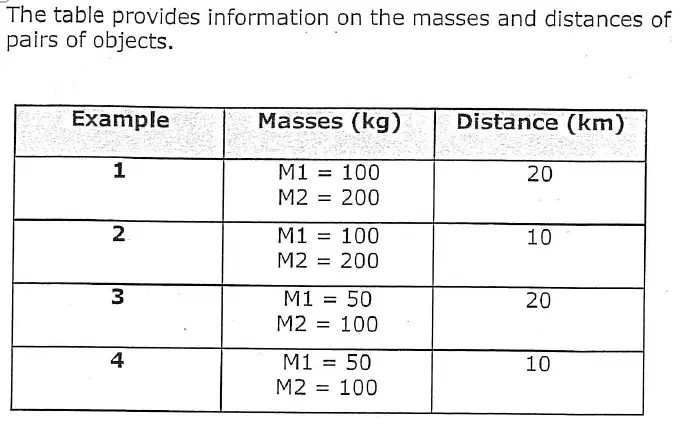
In which example is the gravitational force of attraction between the two objects the smallest?
Example 1
Example 2
Example 3
Which of the following would have the greatest gravitational attraction between the two masses?


The orbital paths of objects in our solar system are the result of which of the following?
The shape of the bodies and their chemical compositions.
The balance between inertia and gravity.
The relative age of the bodies and their chemical compositions.
The frictional forces acting on the bodies when they hit space debris.
The gravitational attraction between two objects is reduced most when -
the masses are increased, and the distance between them is increased.
the masses are increased, and the distance between them is decreased.
the masses are decreased, and the distance between them is decreased.
the masses are decreased, and the distance between them is increased.
The force of gravitational attraction between the Sun and Jupiter could be increased by reducing which of the following?
The mass of the Sun and Jupiter
The distance between the Sun and Jupiter
The speed of rotation of Jupiter
The amount of radiation put out by the Sun
Which two factors affect the strength of the gravitational pull on two objects?
Mass and density
Weight and density
Weight and distance
Mass and distance
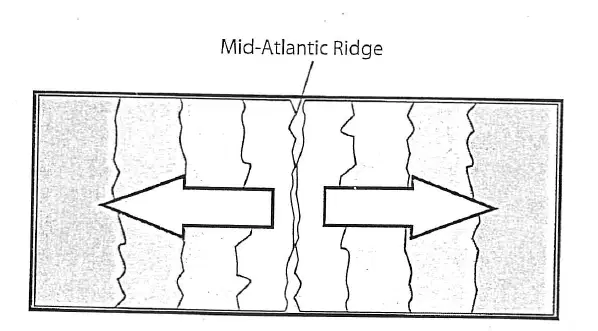
One piece of evidence that supports the Theory of Plate Tectonics is found in the observation of rocks on either side of the Mid-Atlantic Ridge, shown in the picture provided. Plate Tectonic theory is supported because, as you move out from the Mid-Atlantic Ridge, the rocks –
have higher iron content.
become thicker and thicker.
are increasingly older.
are made of smaller particles.
Scientists theorized that the continents were once joined together even before they had modern evidence from rocks and fossils. Using only maps, they observed that –
continents with the most temperate climates were found near the Equator.
the oceans have become smaller throughout the history of Earth.
the shapes of continents appeared to allow them to fit together.
most of the larger land masses are in the Northern Hemisphere.
Which of the following features is likely to form where two tectonic plates push toward each other?
Ocean shoreline
Mountain range
Mid-ocean ridge
Rift valley
The border between two tectonic plates lies below the state of California. The interaction of these two plates, which slide past each other, results in which of the following?
Mild climate
Rich, fertile soil
Frequent earthquakes
Occasional wildfires
Which of the following characteristics of the planet, Earth, is essential to the survival of every living organism?
Earth has abundant available water.
Earth has just one orbiting moon.
Earth orbits the Sun once every 365 days.
Earth rotates on its axis once every 24 hours.
The layer of ozone in the upper atmosphere of Earth is important to life because it shields Earth from -
impacts from meteors.
solar winds.
ultraviolet radiation.
changes in temperature.
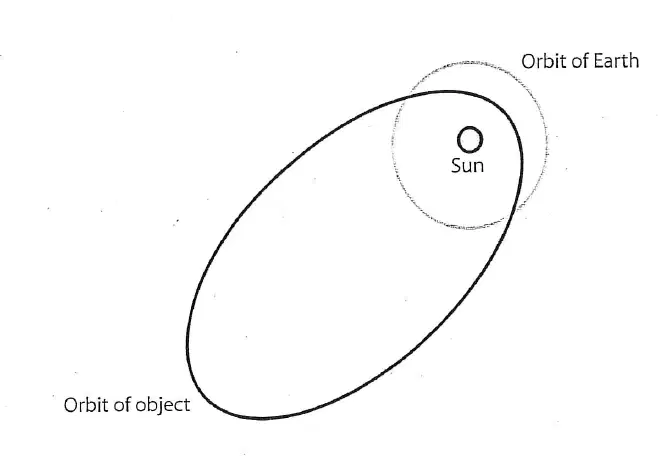
Scientists discover a relatively small object in an orbital path around the Sun, as shown in the diagram. The object is composed of ice and dust. Based on this information, the object is most likely which of the following?
Comet
Star
Planet
Moon
The most recently formed crust on Earth would be found where -
plates are moving sideways past each other.
one plate is sliding under another plate.
two plates are pushing directly towards each other.
two plates are moving apart from each other.
Which type of tectonic plate movement results in the formation of mid-ocean ridges?
Sliding past each other
Pulling away from each other
Pushing together and upwards
One plate sliding under another
The four planets that orbit closest to the Sun are best described as-
mostly made up of gases.
having rings similar to Saturn's.
having a rocky and terrestrial surface.
being composed entirely of water.
Millions of pieces of rocky material of various sizes orbit the Sun between the orbits of Mars and Jupiter. These objects are known as-
asteroids.
meteors.
comets.
planets.
What is the most important factor that determines Earth's temperature?
Amount of water on the planet
Proximity to the Sun
Gas composition of the atmosphere
Distance to the Moon
Earth is currently 150 million km away from the Sun. If Earth was 200 million km away from the Sun, it would no longer support life because -
the surface water would evaporate.
the temperature would be too cold.
the oxygen would leave the atmosphere.
there would be less exposure to solar wind.
Planets in our solar system orbit the Sun because it –
has the greatest magnetic field.
is the celestial body with the greatest mass.
is the brightest object in our solar system.
formed millions of years before the planets.
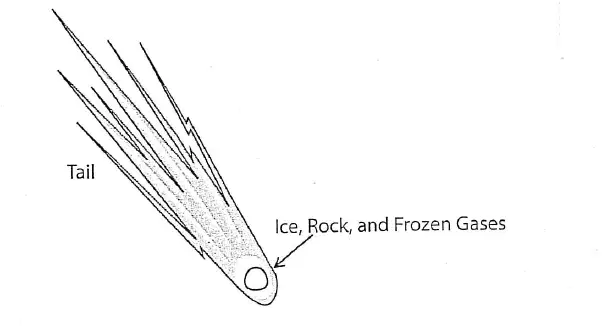
What celestial body does the picture represent?
Comet
Asteroid
Moon
Meteor
Which motion does Earth make once every 24 hours?
Rotates once on its axis
Makes one orbit of the Sun
Revolves once around the Moon
Passes by Mars in its path
Which of the following diagrams is the most accurate representation of Earth's relationship with the Sun and the Moon?
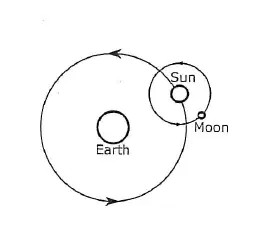
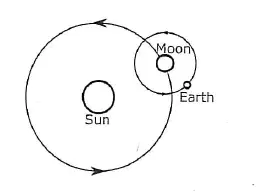

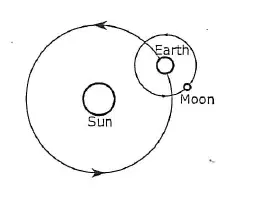
A moon orbits which celestial object?
Planet
Asteroid
Comet
Meteor
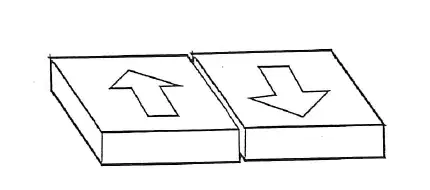
What event will occur at the boundary shown?
Mountain formation
An earthquake
Trench formation
Volcanic island formation
The composition of the Sun is best described as—
liquid nitrogen and solid magnesium.
molten rock, primarily iron.
dense and composed of hot gases.
lightweight particles of dust.
All the planets in our solar system have more or less the same—
diameter.
composition.
shape.
mass.
Where tectonic plates pull away from each other, which of the following geologic features is most likely to result?
Mid-Ocean Ridge
Plateau
Mountain
Beach
Which of the following geologic events would most likely occur where two continental plates converge?
Tsunami
Earthquake
Mountain formation
Trench formation
A visible streak of light that shows the path of a rocky object which has entered Earth's atmosphere is–
a meteor.
an asteroid.
a moon.
a comet.
Which of the following governs the motion of our solar system?
Magnetism
Gravity
Sunlight
Friction
What event will most likely occur when 2 oceanic plates move away from each other at a plate boundary?
The plates will form a mountain chain.
One plate will subduct under the other.
Seafloor spreading
A fault line will form and earthquakes will result.
At which type of boundary illustrated below is a trench most likely to form?
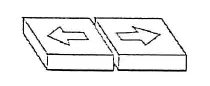
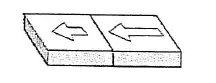
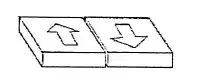
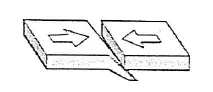
[Fourth
[Fourth
A planet's ability to support life is partly determined by its orbit around the Sun, which is a result of the combination of the planet's momentum, and the Sun's ________
absolute luminosity.
gaseous composition.
high temperature.
gravitational pull.
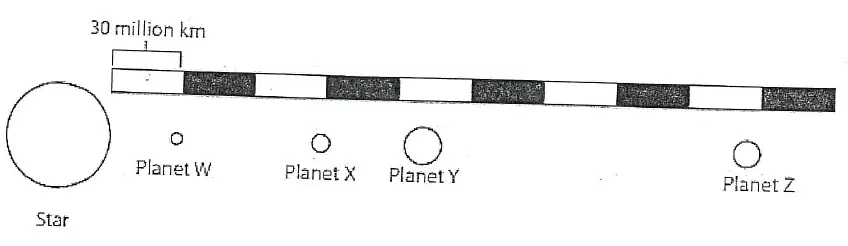
A hypothetical solar system is shown in the diagram provided. In this solar system, the habitable zone is between 120 and 180 million km away from the star. Which of these planets could support life?
Planet W
Planet X
Planet Y
Planet Z
If Neptune's mass was reduced, which of the following could be done to maintain the same force of gravitational attraction between Neptune and the Sun?
Increase the distance between Neptune and the Sun.
Decrease the distance between Neptune and the Sun.
Increase the amount of energy the Sun puts out.
Decrease the speed of rotation of Neptune.
Life on Earth depends on energy from -
the Sun.
the Moon.
volcanoes.
comets.
Scientists are constantly exploring the universe, looking for new planets that support life similar to the life on Earth. A new planet that supports life would be expected to have all of the following characteristics EXCEPT -
a gaseous atmosphere.
an orbiting moon.
liquid water.
protection from radiation.
Earth's atmosphere contains water vapor and carbon dioxide. These greenhouse gases are important because they -
are substances animals need to breathe.
trap thermal energy in the atmosphere.
protect against magnetic particles.
create Earth's gravitational field.
One piece of evidence that supports the Theory of Plate Tectonics is the discovery of what in both South America and Africa?
Insects on both continents have similar feeding habits.
The rates of sedimentary rock formation are similar.
The ancient atmosphere in both places was identical.
Fossil remains of the same land-dwelling animal were found on each continent.
The ozone layer is degraded by certain chemicals that create holes in the ozone layer. If the presence of these chemicals significantly increases, it is reasonable to predict that organisms would -
have a difficult time breathing.
experience colder temperatures.
be more exposed to ultraviolet radiation.
run out of drinking water.
A hot spot is located at the boundary of a plate
true
false
A prime example of an area over a hot spot is :
Japan
the Andes Mountains
the East African Rift
the Hawaiian Islands

Which of the following orders the rock layers accurately from oldest to youngest?
1, 2, 3, 4, 5
5, 4, 3, 2, 1
2, 3, 4, 5, 1
1, 2, 3, 5, 4

These types of volcanoes often produce the most violent and strongest volcanic eruptions on Earth.
Shield volcanoes
Cinder cones
Supervolcanoes
Subglacial volcanoes
Scientists think that the continents once formed a giant landmass that broke apart, and then slowly drifted apart. What is the name given to this hypothesis?
sea-floor Spreading
plate tectonics
continental drift
Pangaea

Similar fossils of giant, land-dwelling reptiles are found on continents separated by oceans.

