
 Worksheets
Space Final Review
Total questions: 75
Worksheet time: 1hrs 8mins
Name
Class
Date
1.
The largest planet in our solar system is
a)
Uranus
b)
Neptune
c)
Pluto
d)
Jupiter
2.
The ____________ of an object effects its gravitational pull.
a)
Atmosphere
b)
Escape Velocity
c)
Mass
d)
Light
3.
An object's weight is a result of the force of __________ at work.
a)
Velocity
b)
Centrifugal Force
c)
Gravity
d)
Orbital Velocity
4.
When it is summer in the northern hemisphere, what season is it in the southern hemisphere?
a)
winter
b)
spring
c)
summer
d)
fall
5.
Which statement is true?
a)
A. Earth rotates around the sun and revolves on its axis.
b)
A. The sun revolves around Earth over a 24-hour time period.
c)
A. Earth rotates on its axis, and revolves around the sun.
d)
A. Earth revolves around the sun and the moon.
6.
What the galaxy are the Earth and the rest of the solar system are located in?
a)
Milky Way
b)
star
c)
Andromeda
7.
A __________________________ is a huge collection of stars, gases, and dust that is classified by shape.
a)
galaxy
b)
Big Bang Theory
c)
light-year
8.

What type of galaxy is this?
a)
Spiral
b)
Elliptical
c)
Irregular
d)
Irrational
9.
Earth ____________ around the sun. It is a process that takes 365 days.
a)
rotates
b)
revolves
c)
phases
d)
spins
10.
What do stars produce?
a)
Heat
b)
light
c)
both heat and light
11.
Which body in our solar system is classified as a star?
a)
Haleys Comet
b)
Pluto
c)
The Sun
d)
Mars
12.

What season is letter A?
a)
Winter
b)
Summer
c)
Spring
d)
Fall
13.
What are the reasons for the seasons?
a)
Earth's tilt and rotation.
b)
Earth's rotation and revolution.
c)
Earth's tilt and revolution.
d)
Earth's tilt and resolution
14.

Which season is taking place in the Northern Hemisphere in Position 2?
a)
Winter
b)
Spring
c)
Summer
d)
Fall
15.

Which season is taking place in the Northern Hemisphere in Position 3?
a)
Winter
b)
Spring
c)
Summer
d)
Fall
16.

Which season is taking place in the Southern Hemisphere in Position 4?
a)
Winter
b)
Spring
c)
Summer
d)
Fall
17.

In the summer many people enjoy going to the beach. There is a beautiful beach in Argentina, which is located in the Southern Hemisphere. Which diagram shows the position of Earth when it is summer in Argentina?
a)
A
b)
B
c)
C
d)
D
18.

A small space rock that makes it into Earth’s surface without burning up is called a ...
a)
Meteor
b)
Meteoroid
c)
Asteroid
d)
Meteorite
19.
Which space object is larger?
a)
Asteroid
b)
Meteoroid
20.
Which choice shows the correct order of the planets?
a)
Mars, Venus, Earth, Mercury, Jupiter, Saturn, Uranus, Neptune
b)
Earth, Venus, Mars, Mercury, Jupiter, Saturn, Uranus, Pluto
c)
Mercury, Venus, Earth, Mars, Jupiter, Saturn, Uranus, Neptune
d)
Saturn, Venus, Mars, Mercury, Jupiter, Neptune Mercury, Uranus
21.
These objects that orbit the sun are nicknamed, "dirty snowballs."
a)
Comets
b)
Asteroids
c)
Meteors
d)
Meteroids
22.
Asteroids "hang out" in the Asteroid Belt between the planets of:
a)
Earth and Mars
b)
Mercury and Venus
c)
Saturn and Neptune
d)
Mars and Jupiter
23.
Huge chunks of rock and metal (some measuring miles wide) and are believed to be left-over pieces of planets and moons are called:
a)
Comets
b)
Meteors
c)
Asteroids
d)
Meteroids
24.

Objects made of ice, gas and dust and orbit our sun are called:
a)
Asteroids
b)
Comets
c)
Meteroids
d)
Meteors
25.
Day and night is caused by the _____________ of earth on its axis.
a)
revolution
b)
orbit
c)
rotation
26.
How long does it take the Earth to make one REVOLUTION around the Sun?
a)
12 hours
b)
24 hours
c)
365 1/4 days
d)
29.5 days
27.
The reason we have seasons is because we get closer and farther to the sun.
a)
True
b)
False
28.
How long does earth's rotation last?
a)
90 hours
b)
about 1 hour
c)
24 hours
d)
48 hours
29.
Sunlight hits Earth’s surface most directly at the _______. Because of this, this particular area doesn't experience seasons.
a)
north pole
b)
south pole
c)
equator
30.

What is the name of the model in which the Earth is at the center of the Solar System?
a)
Geocentric
b)
Heliocentric
c)
Earthcentric
d)
Landcentric
31.

What is the name of the model in which the Sun is in the middle of the Solar System?
a)
Solarcentric
b)
Suncentric
c)
Geocentric
d)
Heliocentric
32.

What shape are the orbits of most comets?
a)
Circle
b)
Square
c)
Ellipse
d)
Triangle
33.

What two factors combine to keep the planets moving in orbit?
a)
Gravity and Mass
b)
Gravity and Weight
c)
Inertia and Gravity
d)
Inertia and Mass
34.
What is a terrestrial planet?
a)
Mars
b)
Mercury
c)
Venus
d)
All of the Above
35.

Inner planets are __________.
a)
made of gas
b)
far from the sun
c)
large compared to outer planets
d)
made of rocks
36.

The Sun is a ____________.
a)
planet
b)
star
37.

Outer planets have _________.
a)
no moons
b)
no rings
c)
gas instead of rock
d)
suns of their own
38.

Which of the following is a rocky planet?
a)
Pluto
b)
Neptune
c)
Mars
d)
Saturn
39.

Which of the following is the HOTTEST planet?
a)
Uranus
b)
Mars
c)
Venus
d)
Earth
40.
Pluto is a
a)
dwarf planet
b)
star
c)
comet
d)
giant planet
41.
The rise and fall of the surface level of the oceans, bays, gulfs, inlets, and estuaries, caused by gravitational attraction of the moon and the sun.
a)
Tide
b)
crater
c)
gravity
d)
quarter
42.
One celestial body is blocked out by another. Can be Lunar or Solar.
a)
Tide
b)
Eclipse
c)
Full
d)
satellite
43.
A bowl-shaped depression in a surface
a)
crater
b)
new
c)
waning
d)
quarter
44.
Large dark areas on the moon
a)
crater
b)
Maria
c)
Gravity
d)
Tide
45.
A celestial body that orbits a planet.
a)
Maria
b)
Satellite
c)
Waning
d)
Eclispe
46.

What type of Moon?
a)
New Moon
b)
Full Moon
c)
Crescent
d)
Quarter
47.

What type of Moon?
a)
New Moon
b)
Full Moon
c)
Cresent
d)
Quarter
48.
Without the sun's gravity, Earth would....
a)
drift into space
b)
crash into the sun
c)
stay in the same location
d)
none of the above
49.
Scientist measure distances in space in
a)
light-years
b)
yards
c)
feet
d)
kelvin
50.
a light year is the distance
a)
light travels in two years
b)
light travels in one year
c)
humans can travel in one year in space
d)
none of the above
51.
The _______________ of a star is a measure of how bright it looks from Earth
a)
sun ray
b)
light year
c)
apparent brightness
52.
Which color of stars are the hottest in temperature?
a)
blue
b)
red
c)
gray
d)
yellow
53.
A star is born in a huge cloud of gas and dust called a nebula
a)
true
b)
false
54.
Scientist use what to determine how how hot and bright a star are?
a)
grids
b)
color
c)
computers
d)
telescopes
55.
A red star is?
a)
hotter
b)
dryer
c)
wetter
d)
cooler
56.
A yellow star is?
a)
hot
b)
medium
c)
cold
d)
light
57.
Our sun is a _____ star
a)
blue
b)
orange
c)
yellow
d)
red
58.
a group of stars in the sky whos patterns form a picture is a
a)
constellation
b)
cave painting
c)
milky way
d)
sun
59.
The color of the star tells us its
a)
composition
b)
Temperature
c)
Luminosity
d)
Mass
60.
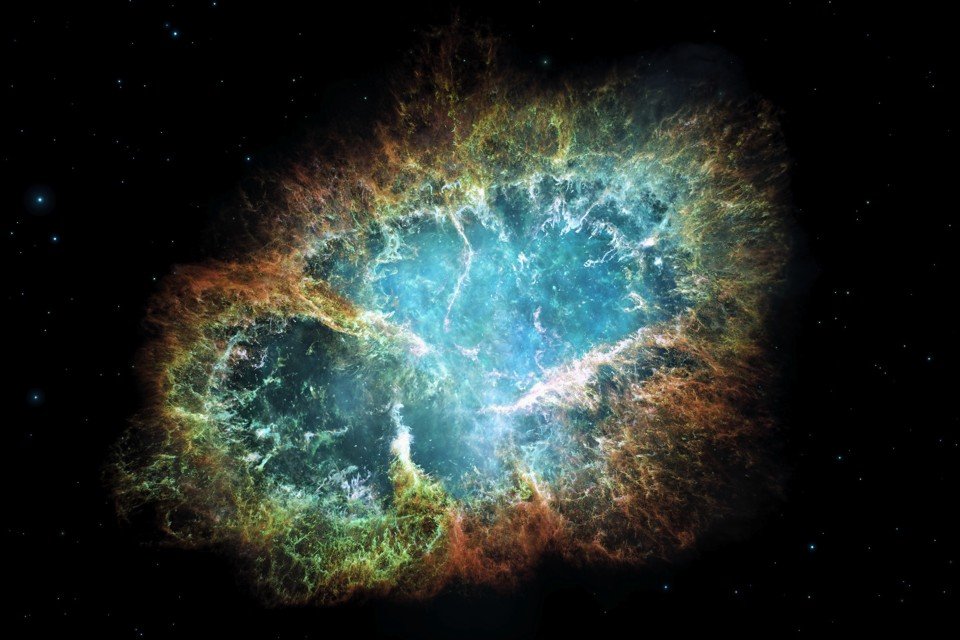
What is the name of the explosion at the death of a massive star?
a)
Supergiant
b)
Supernova
c)
Black Hole
d)
Nebula
61.
What determines if a star becomes a white dwarf, neutron star, or a black hole?
a)
Its age
b)
Its mass
c)
Its brightness
d)
Its temperature
62.
A black hole could be the result of the death of what type of star?
a)
medium-mass star
b)
high-mass star
c)
protostar
d)
low mass star
63.
Why does Mercury have more craters from asteroids than earth?
a)
Earth has an atmosphere that destroys asteroids, Mercury does not.
b)
Mercury smaller, so the craters look bigger than they are
c)
Earth actually has more craters than Mercury
64.
As planets move around the sun, where are they moving the fastest?
a)
When they are farthest from the sun
b)
Where they are closest to the sun
c)
During the summer months
d)
During the winter months
65.
Which is the smallest of the following: Planets; Solar System; Galaxy; Universe
a)
Universe
b)
Solar System
c)
Planets
d)
Galaxy
66.
Our planets in the solar system orbits the:
a)
Moon
b)
Sun
c)
Sky
d)
Earth
67.
Which is the fourth planet from the sun?
a)
Mars
b)
Saturn
c)
Earth
d)
Jupiter
68.
Which is the second closest planet to the sun?
a)
Earth
b)
Saturn
c)
Venus
d)
Mercury
69.

Which planet is Earth's sister planet?
a)
Mercury
b)
Venus
c)
Earth
d)
Mars
70.

What is in between the inner planets and the outer planets?
a)
Asteroid belt
b)
Kuiper belt
c)
Sun
d)
Moon
71.

Which planet has the biggest rings?
a)
Jupiter
b)
Saturn
c)
Uranus
d)
Neptune
72.

Which planet rotates on its side?
a)
Jupiter
b)
Saturn
c)
Uranus
d)
Neptune
73.

These "cool" areas of increased magnetic activity on the surface of the Sun are known as _______.
a)
Prominences
b)
Coronal Mass Ejections
c)
Solar Flares
d)
Sun Spots
74.
The Sun gives _____ and _____ energy to Earth.
a)
temperature and star
b)
heat and light
c)
sun and star
d)
heat and star
75.

What does #1 on the diagram represent?
a)
Photosphere
b)
Solar Flare
c)
Core
d)
Radiative Zone
100 %

