
 Worksheets
US History ACP Semester 1 Review
Total questions: 125
Worksheet time: 1hrs 26mins
Name
Class
Date
1.
Who benefited the most from Jane Addams's work?
a)
Middle class citizens
b)
Poor immigrants.
c)
Business owners.
d)
Homeless toddlers.
2.
Why did Jane Addams establish her project where she did?
a)
It was a huge house with tons of resources.
b)
It was surrounded by the poor she wanted to help.
c)
The federal government offered full payment.
d)
It was the worst city in all of the United States.
3.
The Federal Reserve System is responsible for which of the following:
a)
Controlling the ability of banks to lend money
b)
Ensuring the gold standard
c)
Ensuring the fiat standard
d)
Reserving judges for the Supreme Court
4.
Unreasonable searches & seizures are prohibited by the:
a)
equality statute
b)
protection clause
c)
fifth amendment
d)
fourth amendment
5.

How did New Deal programs like the Civilian Conservation Corps and the Works Progress Administration provide relief to the needy?
a)
by giving loans to the needy
b)
by creating jobs for the needy
c)
by distributing food to the needy
d)
by providing pensions to the needy
6.

Which of the following statements BEST describes what happened on Black Tuesday?
a)
Stock prices fell and the stock market crashed.
b)
Bank runs forced many banks to close their doors.
c)
Federal troops attacked the Bonus Army marchers.
d)
The Supreme Court ruled that the NRA was unconstitutional.
7.
What happened to Roosevelt's court-packing plan?
a)
It was rejected by Congress.
b)
It was signed into law by the president.
c)
It was ratified as a constitutional amendment.
d)
It was declared unconstitutional by the Supreme Court.
8.
What was the right-wing (Republican) criticism over the New Deal?
a)
It did not provide enough money and aid to the poor people.
b)
It had expanded the role of the federal government too much.
c)
It was focused too much on helping banks and businesses.
d)
none of the above
9.
How did Congress contribute to the cause of the Great Depression?
a)
They made policies that favored global trade over local trade.
b)
They passed a law that raised the taxes of imported goods (set high tariffs)
c)
They implemented an extremely high discount rate.
d)
They kept interest rates low to make borrowing money easier.
10.
What was one objective of the Social Security Act?
a)
to ban child labor
b)
to protect workers' rights
c)
to supervise union elections
d)
to lessen poverty in retirement
11.

How did the Agricultural Adjustment Administration try to help farmers?
a)
by increasing competition among farmers
b)
by reducing production to raise crop prices
c)
by asking banks to lower interest rates for farmers
d)
by increasing production to boost crop surpluses
12.

Which New Deal program was chiefly designed to correct abuses in the stock market?
a)
Civilian Conservation Corps
b)
Federal Deposit Insurance Corporation
c)
Securities and Exchange Commission
d)
National Recovery Administration
13.

During the New Deal, how did the government attempt to improve conditions for farmers?
a)
By ending the practice of sharecropping
b)
By raising tariffs on farm imports
c)
By paying farmers to grow fewer crops
d)
By training farmers for jobs in a new field
14.

A major reason for creating the Tennessee Valley Authority in 1933 was to-
a)
Provide health care benefits to
southerners
b)
Encourage African-Americans to settle in
the valley
c)
Improve economic conditions in a poor
rural region
d)
Evacuate farmers from the impoverished region
15.
One difference between the administrations of President Roosevelt and President Hoover was that Franklin Roosevelt was-
a)
more willing to use government intervention to solve economic problems
b)
unwilling to allow government agencies to establish jobs
c)
able to ignore economic issues for most of his first term in office
d)
opposed to any type of government regulation of financial institutions
16.
What weather condition led to extreme dust storms in the Midwest region also nicknamed the "Dust Bowl"?
a)
flooding
b)
tornados
c)
drought
d)
earthquakes
17.
Who was the President of the United States in 1929, when the stock market crashed leading to the Great Depression?
a)
Franklin D. Roosevelt
b)
Harry S. Truman
c)
Dwight D. Eisenhower
d)
Herbert Hoover
18.
What was the unemployment rate at the height of the Great Depression?
a)
25%
b)
50%
c)
75%
d)
100%
19.
Which New Deal program put in place a 40-hour work week and set a standard minimum wage?
a)
Fair Labor Standards Act
b)
Civilian Conservation Corps
c)
Rural Electrification Act
d)
Agricultural Adjustment Act
20.
Buying stock without knowing the risks and assuming it will just go up is known as ________.
a)
speculation
b)
buying on margin (credit)
c)
market capitalization
d)
hammering the market
21.
Why did "repatriation" efforts during the 1930s result in the deportation of thousands of Mexican Americans, many of which were legal citizens?
a)
They wanted to enslave Mexican Americans.
b)
There was tension between immigrant groups that was causing issues in local schools.
c)
Unions, with a majority of white members, pushed for deportation to lessen job competition.
d)
none of the above
22.
Why did FDR propose the Supreme Court Packing Plan?
a)
to influence the Supreme Court by adding Justices that favored his policies
b)
to make it more conservative
c)
to make the Supreme Court more efficient
d)
to make the Supreme Court more diverse
23.
What were the major goals of the New Deal?
a)
no gold standard and free coinage of silver
b)
abolition and suffrage
c)
relief, recovery, and reform
d)
expanding the size and economic influence of the United States
24.
What was the purpose of FDR's fireside chats?
a)
He wanted to attack the critics of the New Deal
b)
He used them to criticize President Hoover's handling of the Great Depression
c)
He explained the ideas behind his New Deal programs and encouraged Americans
d)
none of the above
25.
Shantytowns built by homeless people during the Great Depression were called--
a)
Hoovervilles
b)
Whatvilles
c)
Hobovilles
d)
Whovilles
26.

What was the economic purpose of the Hoover Dam?
a)
to create jobs and provide energy for southwestern states
b)
to increase tourism to the Grand Canyon
c)
to negatively affect the environment
d)
none of the above
27.
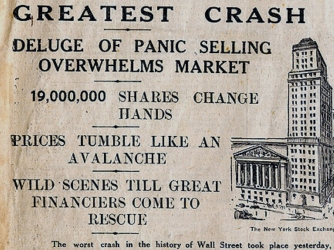
What year did the Great Stock Crash occur?
a)
1919
b)
1925
c)
1929
d)
1932
28.

Who was the U.S. President during the Stock Market Crash of 1929?
a)
Herbert Hoover
b)
Franklin Delano Roosevelt
c)
Warren G. Harding
d)
Woodrow Wilson
29.

What were the World War I vets called that marched on Washington, D.C. in 1932?
a)
The Bonus Army
b)
The American Legion
c)
The G.I. Billers
d)
The Military Marchers
30.

What was the event formerly called when dust storms carried topsoil from the Midwest to the Atlantic coast?
a)
The Dust Bowl
b)
The Tornado
c)
The Drought
d)
The Black Cloud
31.

Which headline provides the best example of a civic duty?
a)
A. Jurors Return Verdict in Robbery Case
b)
B. Company Donates $1 million to Japan Relief Effort
c)
C. Flight Attendants to Vote Next Month on Strike
d)
D. Parents Boycott City Public Schools
32.

the constitutional amendment excerpted above protects people in the United States from --
a)
excessive fines for traffic violations
b)
imprisonment for life without a jury trial
c)
excessive surveillance by the government
d)
conscription by the armed forces
33.

Which of the following is NOT a branch of the government?
a)
Legislative
b)
Judicial
c)
Executive
d)
Constitutional
34.
Which one of the following is not a guaranteed freedom found in the First Amendment?
a)
Right to own a gun
b)
Right to freedom of Speech
c)
Right to petition the government
d)
Right to assemble peacefully
35.

______ is the belief that the government gets its power from the people.
a)
Rule of Law
b)
Popular Sovereignity
c)
Checks and balances
d)
Federalism
36.
The first ten Amendment to the Constitution are called the _______.
a)
Bill of Rights
b)
Preamble
c)
Articles
d)
Naturalization
37.
The _______ is the opening paragraph of the Constitution.
a)
Article 1
b)
Preamble
c)
Bill of Rights
d)
Prelude
38.

Which branch interprets the laws?
a)
Executive
b)
Judicial
c)
Appellate
d)
Legislative
39.

Which branch makes the laws?
a)
Executive
b)
Judicial
c)
Appellate
d)
Legislative
40.

Which branch executes the laws?
a)
Executive
b)
Judicial
c)
Appellate
d)
Legislative
41.
citizens elect representatives to carry out their will
a)
popular sovereignty
b)
federalism
c)
individual rights
d)
republicanism
42.
What are the first three words of the Constitution?
a)
In order to
b)
We the people
c)
Once upon a
d)
The United States
43.

What amendment protects freedom of speech?
a)
1st
b)
2nd
c)
3rd
d)
4th
44.
What term refers to the system that gives each government branch some power over the others?
a)
Articles of Confederation
b)
Ratification
c)
Federalism
d)
Checks and Balances
45.

What amendment protects people from having to testify against themselves in court?
a)
5th
b)
6th
c)
8th
d)
9th
46.

Which of the following powers are shared by the National and the State governments?
a)
Maintain law and order
b)
Establish post office
c)
establish local governments
d)
declare war
47.

Which of the following powers are shared by the national and the state governments?
a)
Levy Taxes
b)
Declare War
c)
Establish schools
d)
Admit new states
48.

How many principles of the constitution are there?
a)
7
b)
8
c)
3
d)
10
49.

Which branch of government has Congress, Senate and the House of Represenatives
a)
Legislative
b)
Executive
c)
Judicial
50.

What was the purpose of the Temperance Movement?
a)
Support immigrant rights
b)
Oppose the consumption of alcohol
c)
Gain women the right to vote
d)
Prevent unsafe working conditions
51.
The 19th Amendment dealt with what?
a)
Prohibition of alcohol
b)
Women’s right to vote
c)
Naturalization laws
d)
Abolition of slavery
52.
Which movement provided workplace reforms?
a)
Suffrage movement
b)
Temperance movement
c)
Westward expansion
d)
Progressive movement
53.

Which group was not considered American citizens until 1924?
a)
African Americans
b)
American Indians
c)
Irish immigrants
d)
Chinese women
54.

The picture shows which negative effect of industrialization?
a)
High wages were earned
b)
Short working hours
c)
Safe working conditions
d)
Child labor was used
55.

Which of the following believed equality could be achieved through vocational education and accepted social segregation?
a)
W.E.B. DuBois
b)
Frederick Douglass
c)
Booker T. Washington
d)
Ida B. Wells-Barnett
56.

Which African American leader believed in full political, civil and social rights rather than to accept social segregation?
a)
Booker T. Washington
b)
J.P. Morgan
c)
W.E.B. DuBois
d)
Frederick Douglass
57.

Which provided an absolute 10-year moratorium on Chinese labor immigration?
a)
Political Machine
b)
Chinese Exclusion Act
c)
Chinese Inclusion Act
d)
Organized labor
58.

Which inventor created lighting and new uses of electricity?
a)
Samuel Morse
b)
Thomas Edison
c)
Cyrus McCormick
d)
Robert Fulton
59.

Which persons founded the National Association for the Advancement of Colored People (NAACP)?
a)
Booker T. Washington & Frederick Douglass
b)
Frederick Douglass & Abraham Lincoln
c)
Booker T. Washington & W.E.B. DuBois
d)
W.E.B. DuBois & Ida Wells-Barnett
60.
John D. Rockefeller was a captain of which industry?
a)
Oil
b)
Banking
c)
Steel
d)
Automobile
61.
J.P. Morgan was a captain of which industry?
a)
Railroads
b)
Steel
c)
Banking
d)
Oil
62.
John D. Rockefeller used this method; when companies that produce a similar product merges together
a)
horizontal integration
b)
vertical integration
c)
scientific management
d)
time-study analysis
63.
Andrew Carnegie used this method; when a company owns the raw materials & transportation systems of a product
a)
vertical integration
b)
horizontal integration
c)
time-study analysis
d)
taylorism
64.
Complete control over an industry's production, wages, & prices
a)
monopoly
b)
capitalism
c)
socialism
d)
concentration of wealth
65.
What was the first permanent labor union; it used strikes as a tactic?
a)
American Federation of Labor
b)
Knights of Labor
c)
International Workers of the World
d)
Knights of Columbus
66.
The law created to prevent monopolies, and break up large companies like Standard Oil
a)
Interstate Commerce Act
b)
Homestead Act
c)
Dawes Act
d)
Sherman Anti-Trust Act
67.
The leader of the union known as the American Federation of Labor
a)
Samuel Gompers
b)
Terrence Powderly
c)
John P. Morgan
d)
Henry Bessemer
68.
Name for entrepreneurs who use ruthless tactics to destroy competition or to keep wages low
a)
Captain of Industry
b)
Robber Baron
c)
Philanthropist
d)
Consolidator
69.
The innovation of this transportation help open up the national market?
a)
boats
b)
railroads
c)
autombils
d)
horse drawn carriages
70.
Technological development most revolutionized US steel industry?
a)
Electrification
b)
Vulcanization
c)
Steam power
d)
Bessemer Process
71.

Who was the "captain of industry" who created the Standard Oil Trust?
a)
Andrew Carnegie
b)
John D. Rockefeller
c)
Henry Ford
d)
Cornelius Vanderbilt
72.
The Interstate Commerce Act and the Sherman Antitrust Act were efforts by the federal government to –
a)
regulate aspects of business
b)
expand the positive features of the trusts
c)
favor big businesses over small companies
d)
move toward government ownership of key industries
73.
The law where settlers got 160 acres of land free if they agreed to live on it for 5 years was called _________________________.
a)
Acting Act
b)
Homestead Act
c)
Dawes Act
d)
Farming Act
74.
The Dawes Act benefited __________and hurt __________
a)
Africans; Native Americans
b)
Native Americans; White Settlers
c)
White Settlers; Native Americans
d)
Colonists; White Settlers
75.
What is the type of sensational reporting where writers exaggerated or even invented stories?
a)
muckraking
b)
yellow journalism
c)
journalism
d)
reporting
76.
What was the purpose of the Open Door Policy in China?
a)
End the Boxer Rebellion
b)
Ensure trading rights with China
c)
Win leaseholds in China
d)
Establish a sphere of influence
77.
Economic motives for imperialism include _________.
a)
a desire to spread Christianity
b)
a need for military bases around the world
c)
a need for raw materials to be used in factories
d)
a desire to gain glory
78.
For what reason did the US imperialize?
a)
to gain raw materials for industry
b)
to create military bases around the globe
c)
to develop markets to sell goods
d)
all of these
79.
Why was the Spanish-American War fought?
a)
The US wanted to help Cuba gain independence from Spain so that the US could have access to Cuba's natural resources
b)
The US blamed to sinking of the USS Maine on Spain
c)
The Spanish Ambassador wrote a letter criticizing the president
d)
All of these
80.
What was the event that ignited the Spanish-American War?
a)
Explosion of the USS Arizona
b)
Sinking of the USS Maine
c)
Sinking of the Lusitania
d)
Russia
81.
Alfred T. Mahan expressed what opinion in his book "The Influence of Sea Power Upon History"?
a)
Nation benefited from a strong navy and overseas bases
b)
Panama Canal construction increased naval traffic and benefited all Central American countries
c)
US government increased foreign trade by providing businesses more incentives to build ships
d)
US government placed too much emphasis on modernizing navy instead army
82.
Why was the Panama Canal so essential to the growing strength of the United States?
a)
It made the slave trade move more easily from It made the slave trade move more easily from the Atlantic to the Pacific Ocean.
b)
It helped the United States take over Japan.
c)
It allowed the United States to transport navy and merchant ships between the Atlantic and Pacific Oceans.
d)
It made Panama a U.S. territory and eventually a state.
83.

Where is this event taking place?
a)
Maine
b)
Cuba
c)
Spain
d)
Hawaii
84.
Which statement of policy called for America to exercise an "international police power?"
a)
Monroe Doctrine
b)
Moral Diplomacy
c)
Platt Amendment
d)
Roosevelt Corollary
85.

What is depicted in this image
a)
Jose Marti's rebellion against Spain in Cuba
b)
Emilio Aguinaldo's war against American in the Philippines
c)
Buffalo Soldiers capturing Puerto Rico for America
d)
Rough Riders charging up San Juan Hill in Cuba
86.
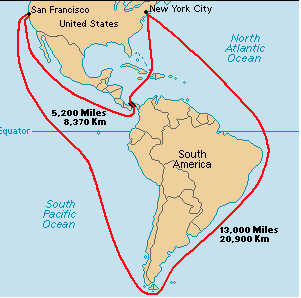
What does this map support?
a)
US fought the Spanish navy in Atlantic and Pacific
b)
Spanish-American War led to new US territories
c)
America became a colonial power in South America by surrounding it
d)
Panama Canal is critical to US trade
87.

What is being depicted in this cartoon?
a)
President Roosevelt's foreign policy
b)
President Taft's diplomacy
c)
Panama Canal policy
d)
Treaty of Paris 1898 acquisitions
88.

This is the door to...
a)
China
b)
Japan
c)
Russia
d)
India
89.
What prompted US government to participate in 1893 overthrow of Hawaiian monarchy?
a)
Colonization of Pacific islands near Hawaii by European nations
b)
Kidnapping of Christian missionaries by Hawaiian nationalists
c)
Queen Liliuokalani's attempt to reduce political influence of American sugar planters
d)
King Kalakaua's discussions with Japanese government to lease Pearl Harbor
90.
The Anti-Imperialist League was a group that
a)
fought in both World Wars
b)
opposed the creation of an American colonial empire
c)
died in battle while fighting for America
d)
signed a petition in favor of a law that would ban all treaties
91.

Direct election of Senators
a)
14th Amendment
b)
16th Amendment
c)
17th Amendment
d)
18th amendment
92.

Women's suffrage was established by the
a)
19th Amendment
b)
17th Amendment
c)
16th Amendment
d)
21st Amendment
93.

prohibited the manufacture and sale of alcohol
a)
16th Amendment
b)
17th Amendment
c)
18th amendment
d)
19th amendment
94.

gave the federal government authority to collect an income tax
a)
17th amendment
b)
16th Amendment
c)
18th Amendment
d)
19th Amendment
95.

Power to remove elected officials from office prior to the end of their term
a)
recall
b)
referendum
c)
initiative
d)
referral
96.

gives power to the people by allowing them to approve or reject laws passed by legislative body
a)
recall
b)
referendum
c)
initiative
d)
prohibition
97.

Leader of the settlement house movement; Hull House; part of the Social Gospel Movement; help others
a)
Jane Addams
b)
Susan B. Anthony
c)
Frances Willard
d)
Ida B Wells
98.

Leader of the Woman's Christian Temperance Union, supported Prohibition
a)
Frances Willard
b)
Susan B. Anthony
c)
Jane Addams
d)
Ida B. Wells
99.

African American journalist who wrote and spoke against lynching and other injustices suffered by African Americans.
a)
Ida B Wells
b)
Jane Addams
c)
Frances Willard
d)
Susan B. Anthony
100.

A leader of the women's suffrage movement. Arrested and fined $100 for attempting to vote.
a)
Jane Addams
b)
Susan B. Anthony
c)
Frances Willard
101.

Author of The Jungle in which he hoped to expose the poor working conditions in the U.S. meat packing industry.
a)
Woodrow Wilson
b)
W.E.B. Dubois
c)
Upton Sinclair
d)
Booker T. Washington
102.

Formed in 1912, also known as the “Bull Moose Party;the party advocated for workers’ rights and an end to corrupt business and political alliances
a)
Democrat Party
b)
Progressive Party
c)
Republican Party
d)
Green Party
103.

Promised Americans a "Square Deal" passed laws to protect consumer health and conserve natural resources
a)
Theodore Roosevelt
b)
William Howard Taft
c)
Woodrow Wilson
d)
Franklin D. Roosevelt
104.

"New Freedom Program", National Park Service, Federal Reserve Act, 16th Amendment
a)
Woodrow Wilson
b)
William Howard Taft
c)
Russell Wilson
d)
Owen Wilson
105.

Supported "Square Deal" policy of attempting to strike a balance between employers and employees and conservatives and Progressives. Lost re-election in 1912 election because of a split in the Republican Party
a)
William Howard Taft
b)
Woodrow Wilson
c)
William Mckinley
d)
Franklin D. Roosevelt
106.
What best describes government regulation of business during the Roaring Twenties?
a)
Heavy government regulation
b)
Laissez-Faire
c)
Hands-on economics
d)
New laws regulating business
107.
This term describes buying new products--refrigerators, washing machines, and cars--throughout the 1920s
a)
Consumerism
b)
Productism
c)
Creditism
d)
Nativism
108.
The rebirth of black culture took place where?
a)
Detroit
b)
Cleveland
c)
Harlem
d)
Louisville
109.
This man was the first to fly solo across the Atlantic Ocean
a)
Charles Lindbergh
b)
Charles Darwin
c)
Amelia Earhart
d)
Mr. Zell
110.
Who was the president that was elected with the slogan "Return to Normalcy"
a)
Warren Harding
b)
Woodrow Wilson
c)
Herbert Hoover
d)
Calvin Coolidge
111.
This word means pride in one's country; it was a cause of WWI.
a)
Militarism
b)
Alliances
c)
Nationalism
d)
Imperialism
112.
This word means strengthening a country's military; it's a cause of World War I.
a)
Nationalism
b)
Militarism
c)
Alliances
d)
Imperialism
113.
This word means seeking other colonies; it was a cause of World War I.
a)
Militarism
b)
Imperialism
c)
Alliances
d)
Nationalism
114.
This word means support for different sides during war; there were the Allied and Central powers during WWI.
a)
Nationalism
b)
Imperialism
c)
Alliances
d)
Militarism
115.
World War I began in ____ and ended in _____.
a)
1914, 1917
b)
1917, 1918
c)
1914, 1918
116.

Which of the following advances in weaponry caused enemies to be horribly disfigured and burned?
a)
Tank
b)
Submarine
c)
Mustard Gas
d)
Machine Gun
117.

Which of the following advances in weaponry allowed one soldier to kill many enemy soldiers at once?
a)
Tank
b)
Submarine
c)
Mustard Gas
d)
Machine Gun
118.

Which of the following advances in weaponry allowed combatants to sink warships from beneath the surface of the water?
a)
Tanks
b)
Submarines
c)
Mustard Gas
d)
Machine Gun
119.

Which of the following is NOT a reason the United States joined the war?
a)
Intercepted the Zimmermann Telegram note stating Germany would help Mexico if the Mexicans attacked the United States
b)
Central Powers attacked the United States
c)
Friendship and history with England
d)
Felt sympathy towards France
120.

Which of the following BEST describes the Treaty of Versailles
a)
Signed agreement ending the war
b)
Treaty ending the war putting full blame on and severely punishing Germany
c)
Allies' victory celebration
d)
A promise among combatants to never use Total War again
121.
The U.S. sent in the AEF that was led by
a)
Theodore Roosevelt
b)
Alvin York
c)
John J. Pershing
d)
George Washington
122.
The final battle of the German army was located in
a)
Berlin
b)
Paris
c)
Argonne Forest
d)
Black Forest
123.
Who was awarded the Medal of Honor for his duty in the Argonne Forest
a)
Alvin York
b)
John Pershing
c)
Theodore Roosevelt
d)
G.I. Joe
124.
What policy does America go to at the end of the war
a)
Imperialism
b)
isolationism
c)
militarism
d)
nativism
125.

The fear of a communist takeover of the US during the 1920s became known as the
a)
Bad Times
b)
Red Scare
c)
Bolshevik Doom
d)
Communist Wave
100 %

