
Font size
S
M
L
XL
 Worksheets
Anatomy/Physiology Midterm Review
Total questions: 120
Worksheet time: 2hrs 32mins
Name
Class
Date
1.
Epithelium is
a)
Bone, cartilage,dense connective tissue, loose connective tissue, and blood
b)
Highly specialized tissue that contracts or shortens to produce movement
c)
Lining, covering, and glandular tissue of the body
2.
Which of the following is a function of epithelial tissue?
a)
Protection
b)
Absorption
c)
Secretion
d)
All the the above
3.

Name the tissue
a)
Simple squamous
b)
Simple cuboidal
c)
Simple columnar
d)
Pseudo stratified columnar
4.
A blister is caused by a burn or friction between the epidermis and dermis resulting in a build up of interstitial fluid.
a)
True
b)
False
5.
What section would be used to amputate a patient's leg at the knee?
a)
coronal
b)
transverse
c)
frontal
d)
sagittal
6.

Superior vs. Inferior
a)
Superior : means the part is above another or closer to head (cranial ). Vs.
Inferior: means the part is below another or towards the feet (caudal).
Inferior: means the part is below another or towards the feet (caudal).
b)
Superior : means the part is below another or towards the feet (caudal).
Vs.
Inferior: means the part is above another or closer to head (cranial ).
Vs.
Inferior: means the part is above another or closer to head (cranial ).
7.
Osteo- means...
a)
Bones
b)
Muscles
c)
Blood
d)
Nerves
8.
What is the carpal?
a)
The wrist
b)
The neck
c)
The ankle
d)
The elbow
9.
Select the correct cavity for each choice-
Thoracic
Thoracic
a)
Ventral
b)
Dorsal
10.

Identify the tissue.
a)
Nervous tissue
b)
Muscle tissue
c)
Osseous
d)
Areolar
11.
The study of body functions is known as...
a)
anatomy
b)
physiology
c)
biology
d)
paleontology
12.
This is a group of cells that perform a specific function:
a)
tissue
b)
organ
c)
organ system
d)
histology
13.
Tattoo ink would be injected into which layer of the skin?
a)
epidermis
b)
subdermis
c)
dermis
d)
prodermis
14.
How many bones are in the human body?
a)
300
b)
206
c)
200
d)
306
15.
Which organ system produces hormones?
a)
digestive
b)
immune
c)
integumentary
d)
endocrine
16.
These soft spots may be present long after one year of age:
a)
fontanels
b)
sutures
c)
adipose deposits
d)
hyoids
17.
Which layer of the skin is avascular?
a)
epidermis
b)
dermis
c)
subdermis
d)
pseudodermis
18.
Which bone has a glenoid fossa?
a)
clavicle
b)
radius
c)
scapula
d)
fibula
19.
Which body system offers defense against disease?
a)
endocrine
b)
lymphatic
c)
cardiovascular
d)
integumentary
20.
Electrical impulses are conducted by this type of tissue:
a)
muscular
b)
epithelial
c)
connective
d)
nervous
21.
Anatomically, the armpit would be referred to as the _______________ region.
a)
abdominal
b)
fibular
c)
olecranal
d)
axillary
22.
Yellow bone marrow stores...
a)
blood cells
b)
trabeculae
c)
calcium
d)
lipids
23.
Ceruminous glands produce what?
a)
earwax
b)
milk
c)
sweat
d)
oil
24.
Which type of feedback system returns the body to normal by the use of effectors?
a)
negative feedback loop
b)
positive feedback loop
c)
homeostatic loop
d)
effector loop
25.
This type of tissue is non-striated and would be found lining the digestive tract.
a)
skeletal muscle
b)
cardiac muscle
c)
smooth muscle
d)
pseudostratified
26.
Oil is secreted by which gland?
a)
ceruminous
b)
sebaceous
c)
apocrine
d)
eccrine
27.
What do we call the shaft of a long bone?
a)
diaphysis
b)
ephiphysis
c)
trabeculae
d)
foramen
28.
A coronal cut would reveal the femur to be __________to the humerus.
a)
superior
b)
inferior
c)
anterior
d)
posterior
29.
What is the plane that dissects the human body into left and right sides?
a)
transverse
b)
sagittal
c)
coronal
d)
frontal
30.
What is the plane that divides the body into anterior and posterior sections.
a)
coronal
b)
transverse
c)
sagittal
d)
lineal
31.
What is "B" in the ABCD Rule?
a)
Burning Sensation
b)
Blackened/Darkened Skin
c)
Bruising
d)
Border Irregularity
32.
Which of the following is NOT a type of connective tissue?
a)
Bone
b)
Cartilage
c)
Skin
d)
Blood
33.
This type of epithelium has only one layer of cells
a)
Stratified epithelium
b)
Simple epithelium
34.
The organ system comprised of hair, skin and nails is the:
a)
INTEGUMENTARY SYSTEM
b)
MUSCULAR SYSTEM
c)
SKELETAL SYSTEM
d)
NERVOUS SYSTEM
35.
Abdominal region
a)
Region between the thorax and pelvis
b)
The ribs
c)
The area between the pod and the pelvis
d)
What even?
36.
What is lateral?
a)
away from the midline of the body; on the outer side of
b)
closer to the origin of the body part or the point of attachment of a limb to the body trunk
c)
farther from the origin of a body part or the point of attachment of a limb to the body trunk
d)
toward or at the body surface
37.
What is the definition of Distal?
a)
Closer to the point of attachment
b)
Further from the point of attachment
38.
Where is the Femur located
a)
The thigh
b)
Lumbar region
c)
Orbital
d)
The chest
39.
What is the sole of the foot named?
a)
Instep of the foot
b)
Sternal
c)
Plantar
40.
What is the depressed area of the abdominal wall near the thigh (groin)?
a)
Inguinal region
b)
Otic
c)
Pedal
d)
Popliteal
41.

Which bone is indicated
by # 15
by # 15
a)
Femur
b)
Tibia
c)
Patella
d)
Metatarsal
42.

Which bone is indicated
by # 19
by # 19
a)
Femur
b)
Tibia
c)
Patella
d)
Metatarsal
43.

Which bone is indicated
by # 5
by # 5
a)
Femur
b)
Radius
c)
Humerus
d)
Metatarsal
44.

Which bone is indicated
by # 18
by # 18
a)
Femur
b)
Tarsal
c)
Patella
d)
Metatarsal
45.

Which system supports and protects the body by providing stability?
a)
Muscular & Skeletal
b)
Skeletal only
c)
Muscular
d)
Nervous System
46.
Under a microscope a specific type of tissue exhibits, MULTI NUCLEATE cells, branching and intercalated discs. Where would this muscle be found?
a)
Attached to the skeleton
b)
The heart
c)
Blood vessels
d)
Smooth intestines
47.
The areas of muscle from SMALLEST to largest are:
a)
Fascicle,Myofilament, Myofiber, Sarcomere
b)
Sarcomere, Myofilament, Myocardium, Sarcoplasm
c)
Myofilament, Myofibril, Fiber, Fascicle
d)
Fascicle, Myofibril, Myofilament, Fiber
48.
Antecubital:
a)
front of elbow
b)
back of knee
c)
medial thigh
d)
foot
49.
Brachial:
a)
forearm
b)
shoulder
c)
knee
d)
arm
50.
Otic:
a)
ear
b)
mouth
c)
hand
d)
thigh
51.

Identify the tissue.
a)
blood
b)
simple squamous
c)
areolar
d)
adipose
52.

Identify the tissue.
a)
elastic cartilage
b)
adipose
c)
fibrocartilage
d)
hyaline cartilage
53.

Structure B
a)
epiphysis
b)
diaphysis
c)
articular cartilage
d)
periosteum
54.

What is the place where two bones meet?
a)
hinge
b)
bone
c)
spot
d)
joint
55.

The bones in your back are made up of what?
a)
fingers
b)
phalanges
c)
vertebrate
d)
toes
56.
Which of the following is true about cardiac muscles
a)
They are found in the heart and voluntary
b)
They are found in the heart and involuntary
c)
They are found in the heart and stomach
d)
None of the above
57.
All of the following are types of joints except:
a)
Smooth
b)
Hinge
c)
Ball and socket
d)
Gliding
58.

How many types of muscles are there in the body?
a)
5
b)
3
c)
6
d)
8
59.

What joint is in the picture?
a)
pivot
b)
hinge
c)
ball-and-socket
d)
gliding
60.
Which muscle type found in internal organ of our body?
a)
Skeletal
b)
Smooth
c)
Cardiac
d)
Strigth
61.
Flexion...
a)
Decreases angle of the joint
b)
Increases angle at the joint
c)
Moves limb away from midline
d)
Moves limb toward midline
62.
Extension...
a)
Increases angle of joint
b)
Decreases angle of joint
c)
Standing on tiptoe
d)
Rotating limb at proximal joint
63.
Moving a limb away from midline
a)
Pronation
b)
Abduction
c)
Adduction
d)
Flexion
64.
Movement of a limb toward the body midline
a)
Abduction
b)
Flexion
c)
Adduction
d)
Pronation
65.
Where are the thoracic vertebrae?
a)
From the shoulders to the rib cage
b)
From the top of the shoulders to the neck
c)
From below the ribs to the butt
d)
The tailbone
66.
What type of joint is your hip?
a)
Pivot
b)
Ball and socket
c)
Condylar
d)
Saddle
67.
Where would you find a long bone
a)
arm
b)
hip
c)
neck
d)
finger
68.
Where are the short bones
a)
fingers
b)
nose
c)
legs
d)
skull
69.
What type of exercise is biking?
a)
Isometric
b)
Resistance
c)
Aerobic
70.
Bone formation is called _____.
a)
ossification
b)
bone reabsorption
c)
fracture repair
d)
osteopenia
71.
What is the function of the skeletal system?
a)
Support of the body
b)
Help the body move with muscles
c)
all of the choices
d)
Protect internal organs
72.
Long, short, flat, and irregular are _____.
a)
types of bone shape
b)
functions of bone
c)
types of muscle tissue
d)
types of bone cells
73.
The vertebrae are considered _____.
a)
long bones
b)
short bones
c)
flat bones
d)
irregular bones
74.

What are the top 7 vertebrae called?
a)
coccyx
b)
lumbar
c)
cervical
d)
thoracic
75.
Aerobic exercise requires
a)
Little oxygen
b)
large amounts of oxygen
76.
A condition in which significant loss of bone mass causes bones to become weak and break easily.
a)
Atrophy
b)
Osteoporosis
c)
Fracture
77.
Type of muscle that attached to bones.
a)
cardiac
b)
smooth
c)
skeletal
78.
Broken bone in which the bone is twisted apart or spiraled apart.
a)
Spiral Fracture
b)
Compression Fracture
c)
Physeal Fracture
d)
Avulsion Fracture
79.
Broken bone that is splintered or crushed into multiple pieces.
a)
Fracture
b)
Manipulation
c)
Callus
d)
Comminuted Fracture
80.

Which abdominopelvic region is letter B pointing to?
a)
right hypochondriac
b)
epigastric
c)
right lumbar
d)
umbilical
81.
What is the location of the skin in respect to the muscles?
a)
superior
b)
anterior
c)
inferior
d)
superficial
82.
A group of organs working together form a(n)
a)
tissue
b)
cell
c)
organ system
d)
organelle
83.
Where does the nose sit in relationship to the ears?
a)
lateral
b)
medial
c)
proximal
d)
posterior
84.
The type of joint that lacks a joint cavity and are all immovable is called...
a)
fibrous
b)
cartilaginous
c)
synovial
d)
structural
85.
The study of the structure of body parts and their relationships to each other is known as...
a)
chemistry
b)
biochemistry
c)
anatomy
d)
physiology
86.
Which of the following lists components of the axial skeleton?
a)
skull, rib cage, and vertebral column
b)
skull, rib cage, and pelvis
c)
arms and legs
d)
arms, legs, and shoulder girdle
87.
Which type of gland has ducts and secretes their products onto the body surfaces?
a)
endocrine
b)
exocrine
c)
all of the above
d)
none of the above
88.
Why is connective tissue so hard to heal like in an ankle sprain?
a)
TISSUE HAS TIGHTLY PACKED CELLS
b)
NERVOUS TISSUE CANNOT SEND MESSAGES
c)
DAMAGED SKELETAL TISSUE CANNOT CIRCULATE BLOOD
d)
DENSE CT HAS A POOR BLOOD SUPPLY
89.
Cells in the respiratory tract have numerous hair-like projections named?
a)
MICROTUBULES
b)
CILIA
c)
ENDOPLASMIC RETICULUM
d)
MITOCHONDRIA
90.
A PLANE THAT DIVIDES THE BODY INTO LEFT AND RIGHT
a)
SAGITTAL
b)
TRANSVERSE
c)
FRONTAL
d)
LATERAL
91.
THE CAVITY THAT HOUSES THE BRAIN
a)
SKULL
b)
HEAD
c)
CRANIAL
d)
FRONTAL
92.
THE CAVITY THAT HOUSES THE UTERUS
a)
THORACIC
b)
SPINAL
c)
ABDOMINAL
d)
PELVIC
93.
THE CAVITY THAT HOUSES THE LUNGS
a)
CERVICAL
b)
THORACIC
c)
VERTEBRAL
d)
PELVIC
94.
THE CAVITY THAT HOUSES THE STOMACH
a)
ABDOMINAL
b)
PELVIC
c)
THORACIC
d)
PLUERAL
95.
Due to the higher concentration of oxygen in the air than your blood, oxygen goes from the lungs into the red blood cells by....
a)
Facilitated Diffusion
b)
Simple Diffusion
c)
Active Transport
d)
Osmosis
96.
What is an ion?
a)
A small atom
b)
A large atom
c)
A neutral atom
d)
A charged atom
97.
When a cell is placed in a hypertonic (more concentrated) solution water
a)
moves from the inside of the cell to the solution
b)
moves from the solution to the inside of the cell
c)
moves equally in and out of the cell
d)
none of these
98.

The cell below is in a _________ solution.
a)
Hypotonic
b)
Hypertonic
c)
Isotonic
99.

What phase is this?
a)
prophase
b)
metaphase
c)
anaphase
d)
telephase
100.
Which biomolecule group includes fats, oils, and waxes?
a)
Proteins
b)
Nucleic Acid
c)
Lipids
d)
Carbohydrate
101.
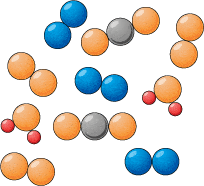
These are found on the Periodic Table.
a)
elements
b)
mixtures
c)
compounds
102.

N represents
a)
cilia
b)
a basement membrane
c)
a nucleus
d)
a lumen
103.
Which organ system is damaged if your scrape your elbow?
a)
endocrine
b)
lymphatic
c)
integumentary
d)
nervous
104.
what is the largest of the facial bones?
a)
frontal
b)
mandible
c)
maxilla
d)
temporal
105.
The spinal chord passes through a large opening in this bone:
a)
ethmoid
b)
parietal
c)
occipital
d)
temporal
106.
The only bone in the face attached by a moveable joint:
a)
maxilla
b)
vomer
c)
zygomatic
d)
mandible
107.
Needle-like pieces of bone with lots of open space characterizes:
a)
compact bone
b)
spongy bone
108.
Dense bone tissue that looks smooth characterizes:
a)
compact bone
b)
spongy bone
109.
limbs, shoulder girdle, pelvic girdle:
a)
appendicular skeleton
b)
axial skeleton
110.
What are the 3 major layers of the skin?
a)
epidermis, dermis, basale
b)
sebaceous, dermis, subcutaneous
c)
corneum, lucidum, granulosum
d)
epidermis, dermis, hypodermis
111.
Muscle fatigue is at least partially due to
a)
loss of actin and myosin from myofibrils
b)
a buildup of lactic acid in muscles
c)
an overabundance of oxygen
d)
holes in the sarcomeres
112.
The energy for muscle contraction comes from
a)
pyruvic acid
b)
ATP
c)
synovial fluid
d)
water
113.
The layer that contains fat is the ?
a)
hypodermis
b)
dermis
c)
epidermis
d)
stratum corneum
114.

Once calcium is released, it will
a)
attaches to myosin head
b)
attaches to receptors
c)
attaches to tropomyosin
d)
attaches to troponin
115.
What are the two ions transported across the membrane in an action potential?
a)
O2- and K+
b)
K+ and Na+
c)
Ca+2 and B+3
d)
Na+1 and Cl
116.
SPECIFIC NEUROTRANSMITTER FOR MUSCLES
a)
SARCOPLASMIC RETICULUM
b)
MYOFIBRIL
c)
ACETYLCHOLINE
d)
AXON TERMINAL
117.
The patella is an example of this type of bone.
a)
Short
b)
Long
c)
Flat
d)
Round
118.

Once calcium is released, it will
a)
attaches to myosin head
b)
attaches to receptors
c)
attaches to tropomyosin
d)
attaches to troponin
119.
___ and ___ are regulatory proteins bound to actin.
a)
Troponin and tropomyosin
b)
Myosin and actin
c)
Calcium and Oxygen
d)
Glycogen and hemoglobin
120.
Skin color is due to a pigment called
a)
Keratin
b)
Melanin
c)
Chromatin
d)
Epithelium
Reset

