
NEW
Font size
S
M
L
XL
 Worksheets
Honors science semester 1 review
Total questions: 70
Worksheet time: 48mins
Name
Class
Date
1.
Why should an experiment be repeated?
a)
to form a hypothesis
b)
to reduce the chance of error
c)
to change controls
d)
to identify the problem
2.
The difference between a hypothesis and a theory is that a hypothesis is
a)
never true whereas a theory is always true.
b)
true whereas a theory is not true.
c)
never true whereas a theory is sometimes true.
d)
an educated guess whereas a theory has been tested successfully many times in many ways.
3.
Which of these is a scientific hypothesis?
a)
Atoms are the smallest particles of matter that exist.
b)
Albert Einstein is the greatest physicist of the twentieth century.
c)
The universe is surrounded by a second universe, which cannot be seen.
4.
Which of the following is a reason to express scientific findings mathematically?
a)
The findings become more difficult to prove by experiment.
b)
The findings become easier to verify by experiment.
c)
The findings become more confusing.
d)
The findings become less appealing to the public.
5.
Which question can best be investigated by a scientist?
a)
Should I buy a red shirt or a green shirt?
b)
Does chocolate milk or plain milk taste better?
c)
Does a plant need sunlight to grow?
d)
Which feels softer, cat fur or dog fur?
6.
This is the outcome of the experiment. We get data and results from this.
a)
Independent Variable
b)
Dependent Variable
c)
Control
d)
Constant
7.
How many independent variables should be tested at a time in a scientific investigation?
a)
none
b)
one
c)
two
d)
three
8.
The variable that is changed on purpose is:
a)
Control
b)
Dependent
c)
Independent
d)
Outcome
9.
A law is better than a theory.
a)
True
b)
False
10.
Laws tells us that it happens but doesn’t describe how or why.
a)
True
b)
False
11.
A theory ________ becomes a law.
a)
sometimes
b)
always
c)
never
12.
A scientific theory is proven true through experiments and observations.
a)
True
b)
False
13.
When a chemical change occurs, the products have a greater mass than the reactants.
a)
True
b)
False
14.
The change in the color of tree leaves in fall is an example of a physical change.
a)
True
b)
False
15.
In a neutral atom, the number of protons is equal to the number of electrons.
a)
True
b)
False
16.
Gamma decay emits energy but no particles.
a)
True
b)
False
17.
An alpha particle is the equivalent of a Helium-4 nucleus.
a)
True
b)
False
18.
Isotopes are forms of an element that have the same number of protons but a different number of neutrons.
a)
True
b)
False
19.
Greek philosophers thought that matter was composed of four elements: air, earth, fire, and water.
a)
True
b)
False
20.
Nuclear decay can change one element into another one.
a)
True
b)
False
21.
Which is a compound?
a)
sodium
b)
sea water
c)
carbon dioxide
d)
brass
22.
According to the Law of Conservation of Mass, in any chemical change
a)
the mass of reactants is greater than the mass of products
b)
the mass of reactants is less than the mass of products
c)
the mass of reactants is equal to the mass of products
d)
the masses of products and reactants have no predictable relationship
23.
Which of the following substances is an element?
a)
Baking Soda
b)
Iron
c)
Salt
d)
Sugar
24.
A chemical composition of two or more different elements joined together in fixed proportions is known as a(n) ____.
a)
compound
b)
element
c)
homogeneous mixture
d)
heterogeneous mixture
25.

What is the Atomic mass?
a)
Atomic Mass = A
b)
Atomic Mass = B
c)
Atomic Mass = C
d)
Atomic Mass = D
26.

Which is the Element Symbol?
a)
Element Symbol = A
b)
Element Symbol = B
c)
Element Symbol = C
d)
Element Symbol = D
27.

Which is the atomic number?
a)
Atomic Number = A
b)
Atomic Number = B
c)
Atomic Number = C
d)
Atomic Number = D
28.
Which one is comprised of the other three?
a)
proton
b)
atom
c)
electron
d)
neutron
29.
Which is the state of matter that has a definite shape and definite volume?
a)
Solid
b)
Liquid
c)
Gas
30.
Which is the state of matter that has an indefinite shape and definite volume?
a)
Solid
b)
Liquid
c)
Gas
31.
Which is the state of matter that has an indefinite shape and indefinite volume?
a)
Solid
b)
Liquid
c)
Gas
32.
Which is NOT a chemical change?
a)
a piece of wood is burned
b)
an egg is cooked
c)
a bar of iron rusts
d)
ingredients for a cake are stirred together
33.
How many electrons are in an neutral atom of sodium?
a)
22
b)
11
c)
12
d)
23
34.
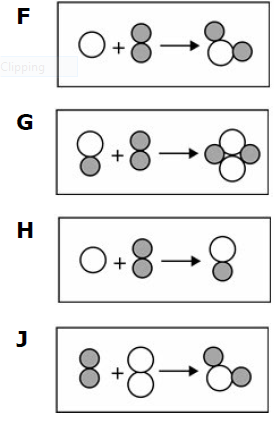
Which of the following models best demonstrates a balanced chemical equation?
a)
F
b)
G
c)
H
d)
J
35.

How many atoms in all are in a molecule of serotonin?
C10H12N2O
a)
22
b)
24
c)
25
d)
4
36.

What is the large number written before a chemical formula called?
a)
Coefficient
b)
Subscript
c)
Reactant
d)
Product
37.

What is a shorthand notation that represents a compound or molecule called?
a)
Chemical Equation
b)
Chemical Formula
c)
Chemical Reaction
d)
Chemical
38.
Balance this equation.
_CH4 + _O2 --> _CO2 + _H2O
_CH4 + _O2 --> _CO2 + _H2O
a)
1,2,1,1
b)
2,1,2,1
c)
1,2,1,2
d)
0,2,0,2
39.
Balance this equation.
_Mg + _Cl2 --> _MgCl2
_Mg + _Cl2 --> _MgCl2
a)
1, 2,1
b)
already balanced
c)
2,1,1
d)
1,1,2
40.
At the end of chemical reactions, what is the total mass of the reactants compared to the total mass of the products?
a)
the product is doubled
b)
the product is half the mass of the reactants
c)
the mass is the same
d)
the mass changes depending on the reaction
41.
Climate change causes extreme weather conditions such as:
a)
excessive heat
b)
drought
c)
extreme storms
d)
all of these
42.
Industrialization is a contributing factor to climate change.
a)
True
b)
False
43.
Increasingly severe weather systems such as monsoons or drought could lead to military conflicts.
a)
True
b)
False
44.
What is the greenhouse effect?
a)
The warming of a planet due to trapped radiation.
b)
The cooling of Earth due to air pollution.
c)
The heating of a solid, such as a rock.
45.
What do scientists think the effect will be of having more greenhouse gases in our atmosphere?
a)
More warming of the atmosphere
b)
More cooling of the atmosphere
c)
More air in the atmosphere
d)
Less air in the atmosphere
46.
Which of the following are greenhouse gases?
a)
Carbon dioxide
b)
Methane
c)
Water vapor
d)
All answers are correct
47.
What type of waves get trapped inside the greenhouse?
a)
Sunlight
b)
Ultraviolet
c)
Microwaves
d)
Infrared
48.
What is climate?
a)
Temporary conditions
b)
Small area conditions
c)
Long-term conditions
d)
Rapidly changing conditions
49.
Which of the following gases, released by animals as a waste product of digestion, can add to global warming?
a)
Carbon Dioxide
b)
Methane
c)
Chlorofluorocarbon
d)
Nitrogen
50.
As greenhouse gases increase, oceans are becoming
a)
clearer
b)
saltier
c)
more acidic
d)
muddier
51.
How do scientists collect evidence about climate?
a)
using remote sensing from space with satellites
b)
by ground-based measurements of surface temperatures, carbon dioxide concentration and sea level
c)
by collecting “proxy data” from tree rings, ice cores, and historical records
d)
all of the above
52.

"For every action, there is an equal and opposite reaction."
a)
Newton's 1st Law
b)
Newton's 2nd Law
c)
Newton's 3rd Law
d)
Newton's 4th Law
53.

Force = Mass x Acceleration
a)
Newton's 1st Law
b)
Newton's 2nd Law
c)
Newton's 3rd Law
d)
Newton's 4th Law
54.

"An object in motion (or at rest) will to stay in motion (or at rest) until an outside force acts upon it."
a)
Newton's 1st Law
b)
Newton's 2nd Law
c)
Newton's 3rd Law
d)
Newton's 4th Law
55.

The tendency of an object to resist changes in its motion is...
a)
inertia
b)
force
c)
acceleration
d)
velocity
56.

Any push or pull on an object.
a)
force
b)
velocity
c)
inertia
d)
momentum
57.
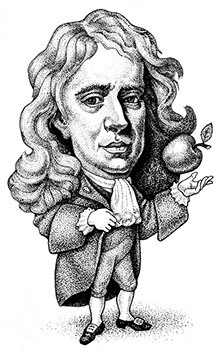
A Newton is a unit of...
a)
force
b)
inertia
c)
acceleration
d)
velocity
58.

When all the forces on an object are equal and opposite, & the net force is zero, that's...
a)
balanced forces
b)
unbalanced forces
c)
terminal velocity
d)
reaction forces
59.

A cannonball with a mass of 0.5 kg is flying at an acceleration of 10 m/sec/sec. What is it's force?
a)
50 Newtons
b)
5 Newtons
c)
20 Newtons
d)
9.5 Newtons
60.

A cannonball with a mass of 10 kg is flying at an acceleration of 5 m/sec/sec. What is it's force?
a)
50 Newtons
b)
5 Newtons
c)
20 Newtons
d)
9.5 Newtons
61.

The net force on a ball thrown in outer space is... (you are no longer touching the ball)
a)
there is none
b)
forward
c)
down and backward
d)
forward and down
62.
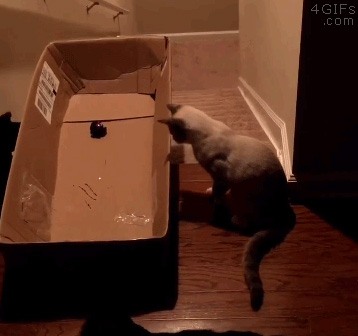
A box sliding down an inclined plane attains a velocity of 27 m/s in 3 seconds from rest. Find the acceleration.
a)
30 m/s
b)
24 m/s2
c)
9 m/s2
d)
81 km/hr
63.
Acceleration is defined as the CHANGE in
a)
time it takes for one place to move to another place.
b)
velocity of an object.
c)
distance divided by the time interval
d)
velocity divided by the time interval
64.
Acceleration only takes place when things speed up.
a)
True
b)
False
65.

A magician pulls a tablecloth out from under dishes and glasses on a table without disturbing them.
a)
Newton's 1st Law
b)
Newton's 2nd Law
c)
Newton's 3rd Law
66.

Pushing a child on a swing is easier than pushing an adult on the same swing, because the adult has more inertia.
a)
Newton's 1st Law
b)
Newton's 2nd Law
c)
Newton's 3rd Law
67.
When a heavy football player and a light one run into each other, who exerts more force?
a)
The heavy one
b)
The light one
c)
They are equal
d)
there is no such thing as force
68.
Billy Bob and LuLu each pull very hard on opposite ends of a rope in a game of tug-of-war. The greatest force on the rope is exerted by.
a)
Billy Bob
b)
Lulu
c)
both are the same
d)
Billy Bob's imaginary friend, Steve.
69.
Newton's third law is the law of __________________.
a)
action and reaction
b)
inertia
c)
acceleration
d)
science rocks
70.
Suppose two carts, one twice as massive as the other, fly apart when the compressed spring that joins them is released. How fast does the heavier cart roll compared with the lighter cart?
a)
twice as fast
b)
the same
c)
half as fast
Reset

