
 Worksheets
Semester 1 Review
Total questions: 50
Worksheet time: 36mins
Name
Class
Date
1.
Choose the property that is a chemical property.
a)
Reacts when mixed with water
b)
Hardness
c)
Boiling point
d)
Freezing point
2.
Which of the following compounds is an organic compound?
a)
NH4OH
b)
FeCl3
c)
CH3OH
d)
CuSO4
3.
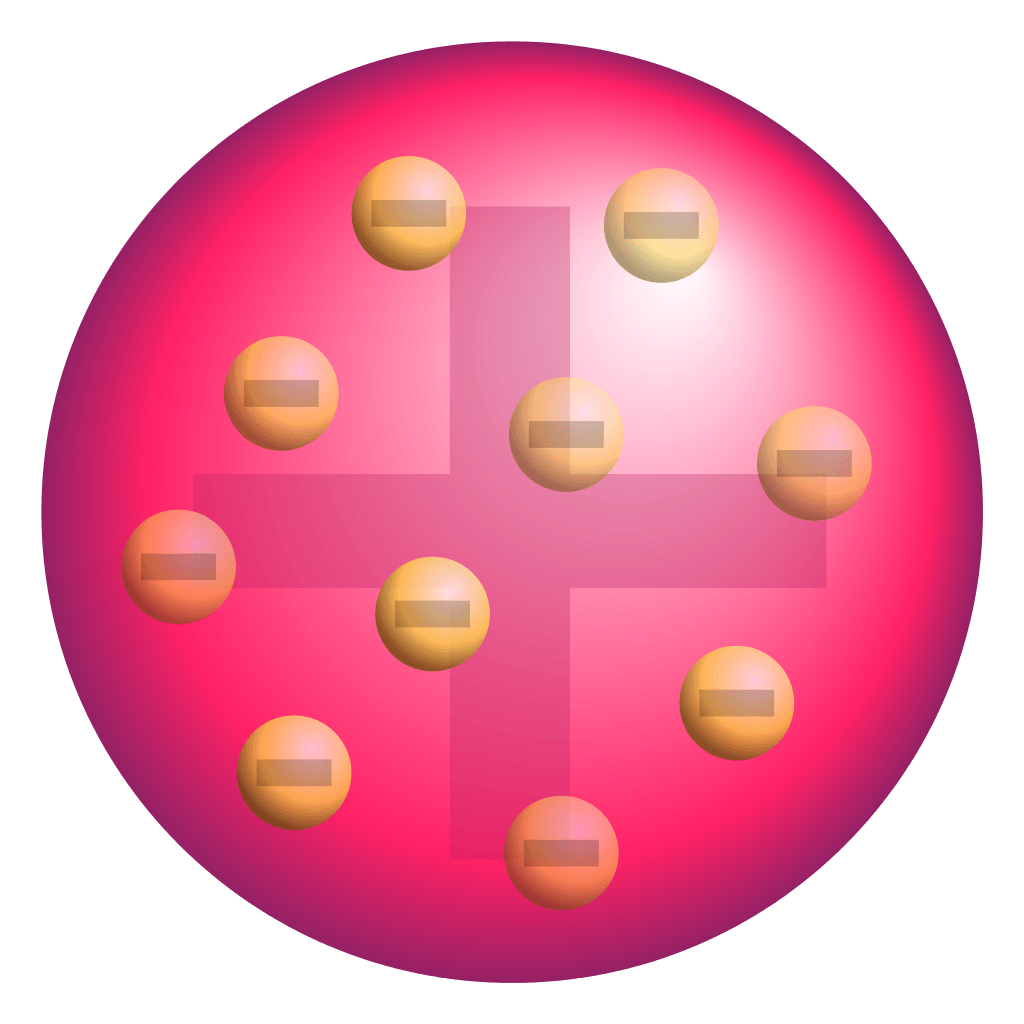
This model was developed after J.J. Thompson discovered electrons, a particle smaller than an atom. Is shows electrons floating freely in a positive space.
a)
The "Plum Pudding Model" of the atom
b)
The "Rutherford Model" of the atom
c)
Democritus's model of the atom
d)
The "Solar System Model" of the atom
4.
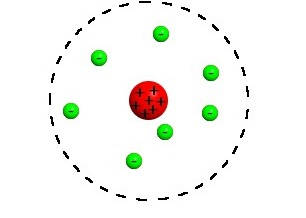
This model this model was the first to show a nucleus, consisting of protons and neutron. Electrons surround the nucleus but are not shown in distinct energy levels.
a)
The "Rutherford Model" of the atom
b)
The "Plum Pudding Model" of the atom
c)
The "Standard Model" of the atom
d)
Democritus's model of the atom
5.

Who created an atomic model that looks like this?
a)
Bohr
b)
Dalton
c)
Rutherford
d)
Thomson
6.

What element is represented in this Bohr Model?
a)
Carbon
b)
Hydrogen
c)
Aluminum
d)
Lithium
7.

Which of the following elements lose valence electrons to become stable?
a)
N
b)
O
c)
Ca
d)
Ne
8.
Which of the following is a physical change?
a)
Phase change (solid to liquid or gas)
b)
Burning paper
c)
Rusting iron
d)
Digesting food
9.
Which of the following elements lose valence electrons to become stable?
a)
Ne
b)
O
c)
C
d)
Ca
10.

What is the weight of this object?
a)
501.1
b)
500.1
c)
510.0
d)
501.0
11.

Using the periodic table, which of the following is located in period 4, family 16?
a)
Selenium
b)
Gallium
c)
Sulfur
d)
Germanium
12.
Pure water has a pH reading of 7. Therefore it is...
a)
A strong acid
b)
Slightly acidic
c)
Basic
d)
Neutral
13.

Which atomic model shows energy levels and the number of electrons orbiting the nucleus of an atom?
a)
The Bohr model
b)
The Dalton model
c)
The Rutherford model
d)
The Thomson model
14.
Which of these have approximately equal masses?
a)
Electrons & protons
b)
Electrons & neutrons
c)
Protons & neutrons
d)
Neutrons & cells
15.
Sodium and water bond together to form sodium hydroxide and a gas. Which of these is a balanced chemical equation for this reaction?
a)
2Na + 2H2O -> 2NaOH + H2
b)
H2O + NaOH -> H2O + Na
c)
Na + 2NaOH -> H2O + 2NaOH
d)
2Na + 2NaOH -> H2O + 2NaOH
16.
Which of these equations is NOT balanced?
a)
4Cu + O2 -> 2Cu2O
b)
H2 + O2 -> H2O
c)
6Mg + P4 -> 2Mg3P3
d)
H2SO4 + 2NaOH -> 2H2O + Na2SO4
17.
An iceberg has a temperature of -20oC and the surrounding water has a temperature of -3oC. In which direction would thermal energy flow?
a)
From the iceberg to the water
b)
From the water to the iceberg
c)
From the bottom of the water to the top
d)
Both are cold so there is no thermal energy
18.
Aluminum has a melting point of 660.32oC and a boiling point of 2,519oC. If given a piece of aluminum at 100oC, which state of matter would it be?
a)
Solid
b)
Liquid
c)
Gas
d)
Plasma
19.
Which of the following is the best description of how electrons are transferred in an ionic bond?
a)
A metal atom loses electrons and a nonmetal atom gains electrons
b)
A metal gains electrons and a nonmetal atom loses electrons
c)
A metal and a nonmetal atom lose electrons
d)
A metal and a nonmetal atom gain electrons
20.
I put a silver spoon, a wooden spoon, and a stainless steel spoon in a pot of boiling pasta for several minutes. Which spoon should I grab with my bare hand to stir the pasta?
a)
Copper spoon
b)
Wooden spoon
c)
Steel spoon
d)
The three spoons will be equally hot
21.
2H2 + O2 ----> 2H2O What is the product?
a)
------>
b)
2H2O
c)
2H2+ O2
22.
What is the left part of a chemical equation called?
H2 + O → H2O
H2 + O → H2O
a)
Reactants
b)
Products
c)
Yields
d)
Chemical Equation
23.

What are the products of the chemical reaction pictured?
a)
CH4 and CO2
b)
CH4 and O2
c)
CO2 and H2O
d)
O2 and H2O
24.
Which is the correct formula for:
three hydrogen (H)
one sulfur (S)
four oxygen (O)
three hydrogen (H)
one sulfur (S)
four oxygen (O)
a)
H3SO4
b)
HSO4
c)
H4S3O
d)
H2O
25.

The red numbers in the image below represent ________
a)
subscripts
b)
coefficients
c)
I don't know, and don't want to try
d)
None of the answers are correct
26.
Is the following equation balanced or unbalanced?
Fe + S --> FeS
Fe + S --> FeS
a)
balanced
b)
unbalanced
27.
How many atoms of aluminum are on each side of the following equation: 4Al + 3O2 --> 2Al2 O3
a)
2
b)
6
c)
1
d)
4
28.
Balance this equation...
H2 + Cl2 --> HCl
H2 + Cl2 --> HCl
a)
It is balanced
b)
3H2 + Cl2 --> 6H2Cl
c)
H2 + Cl2 --> 2HCl
29.
Which of the following shows the correct way to balance the chemical equation?
Fe + O2 -> Fe2O3
Fe + O2 -> Fe2O3
a)
4Fe + 3O2 -> 2Fe2O3
b)
2 Fe + 3O2 -> Fe2O6
c)
4 Fe + O6 -> 2Fe2O3
d)
None of the options are correctly balanced.
30.
Which of the following reactions is balanced?
a)
2CH4 + O2 -> CO2 + H2O
b)
CH4 + 2O2 -> CO2 + H2O
c)
CH4 + 2O2 -> CO2 + 2H2O
d)
None of the chemical equations are balanced.
31.

An extremely strong base would have a pH of:
a)
1
b)
7
c)
9
d)
14
32.

Which is the stronger acid?
a)
pH 1
b)
pH 4
c)
pH 8
d)
pH 13
33.

A flow movement where warmer air gets cools off and cooler air warms up.
a)
Current
b)
Convection current
c)
Conduction current
d)
All of them
34.

Boiling water has more temperature than cold water because...
a)
its molecules are moving MORE
b)
its molecules are moving LESS
c)
it has more molecules
d)
I don't know
35.
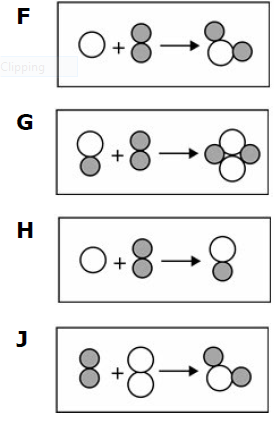
Which of the following models best demonstrates a balanced chemical equation?
a)
F
b)
G
c)
H
d)
J
36.
What happens to electrons in an ionic bond?
a)
They are shared between two atoms
b)
They are shared between many atoms
c)
They are gained/lost (transferred)
d)
They turn into protons
37.
What happens to electrons in a covalent bond?
a)
They are shared between two atoms
b)
They are shared between many atoms
c)
They are gained/lost (transferred)
d)
They turn into protons
38.
What type of bond forms between a metal and a nonmetal?
a)
ionic
b)
covalent
c)
metallic
d)
nuclear
39.
What type of bond forms between two nonmetals?
a)
ionic
b)
covalent
c)
metallic
d)
nuclear
40.
Which of the following forms a covalent bond?
a)
H2O
b)
Pb(HO3)2
c)
Fe2O3
d)
Al(OH)
41.
Which of the following forms an ionic bond?
a)
H2O
b)
Pb(HO3)2
c)
CuSn
d)
C6H12O6
42.

In science, a combination of materials is called a _________________________________ when the materials do not change into anything else.
a)
mixture
b)
molecule
c)
compound
d)
solubility
43.
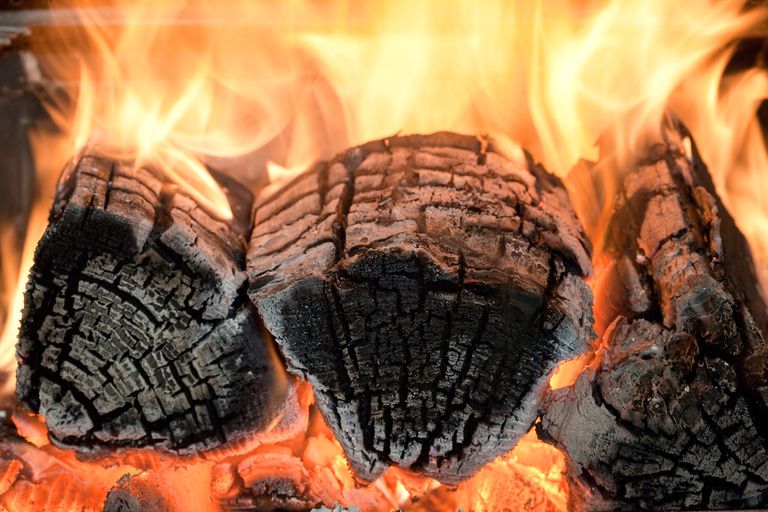
A ___________________________ ___________________________________ causes a material to change into an entirely different material with different properties, but conserves matter.
a)
physical change
b)
chemical
c)
chemical change
d)
physical chemical interaction
44.
What will weigh more when a chemical change is complete? The reactants before the chemical reaction, or the product after the reaction is complete?
a)
They both will weigh the same
b)
The product always weighs more than the reactant
c)
The reactant will weigh more than the product
d)
They both will loose mass after the reaction
45.

Balloons can be twisted into shapes because
a)
the force exerted changes the number of particles
b)
the volume of a gas is constant
c)
particles of gas can be compressed
46.

What is happening at "D" on the graph?
a)
Water is boiling
b)
water is evaporating
c)
water is melting
d)
the sublimation of water
47.

The baby chickens are kept warm from the heat lamps demonstrates this type of heat transfer.
a)
conduction
b)
convection
c)
radiation
48.

This is a lava lamp. When the light bulb heats the wax, the wax rises. When the wax cools, it falls. This cycle of rising/falling is an example of:
a)
Conduction.
b)
Convection.
c)
Radiation.
49.

What phase of matter is illustrated in "C"
a)
solid
b)
liquid
c)
gas
d)
melting
50.

What is labelled "B" on the graph?
a)
solids
b)
liquids
c)
gases
d)
a phase change
100 %

