
Font size
S
M
L
XL
 Worksheets
Plate Tectonics
Total questions: 124
Worksheet time: 2hrs 16mins
Name
Class
Date
1.
Which type of plate boundary would cause mountains to form?
a)
Transform
b)
Convergent
c)
Divergent
d)
Reform
2.
What are the two types of crust
a)
continental and oceanic
b)
ocean and upper
c)
lower and upper
d)
pizza and subway
3.
Which layer has convection currents?
a)
Inner Core
b)
Outer Core
c)
Mantle
d)
Crust
4.
subduction zones in the ocean can create which features?
a)
islands
b)
volcanoes
c)
earthquakes
d)
all of the above
5.
Earthquakes and volcanoes are most likely found in which locations?
a)
At plate boundaries
b)
in oceans
c)
in the middle of continents
d)
in the middle of plates
6.
When one plate sides under neath another, it _________ and the magma _________.
a)
hardens, sinks
b)
melts, sinks
c)
hardens, rises
d)
melts, rises
7.
The Himalayas in Asia are an example of what type of plate boundary?
a)
divergent
b)
continent-to-continent convergent
c)
ocean-to-continent convergent
d)
transform
8.
Transform boundaries are most likely to produce what phenomenon?
a)
volcanoes
b)
deep sea trenches
c)
underwater mountain ranges
d)
earthquakes
9.
When an oceanic plate and a continental plate collide, which one will subduct?
a)
oceanic
b)
continental
c)
neither
10.
Which of the following is NOT a tectonic boundary?
a)
Convergent
b)
Divergent
c)
Sedergent
d)
Transform
11.

What is this image...
a)
Revolving boundary
b)
San Andreas (Transform)
c)
Convergent
12.
Two tectonic plates collide at a _______ plate boundary.
a)
convergent
b)
divergent
c)
transform
13.
The area where two tectonic plates meet.
a)
mantle
b)
focus
c)
plate boundary
d)
convection
14.
Most volcanoes and earthquakes occur...
a)
along the coast
b)
along tectonic plate boundaries
c)
in the Arctic
d)
in the ocean
15.
This landform can occur at a divergent plate boundary.
a)
ocean trench
b)
mid-ocean ridge
c)
tall mountains
d)
transform fault
16.
A continental rift valley can be formed from stretching continental crust at...
a)
transform plate boundaries
b)
convergent plate boundaries
c)
divergent plate boundaries
d)
all plate boundaries
17.
A mid-ocean ridge occurs at a ________ plate boundary.
a)
transform
b)
convergent
c)
divergent
18.

What is the name of the plate boundary that slides past each other?
a)
Divergent
b)
Convergent
c)
Transform
d)
Mr. C the Slide Man
19.

Which of these events can ONLY happen on a DIVERGENT BOUNDARY?
a)
Rift Valley
b)
Mountain
c)
A peninsula
d)
An Insanely complex, long answer that you will click out of instinct.
20.

Scientists think that convection currents that move the plates flow in Earth's
a)
Continental crust
b)
Oceanic crust
c)
Asthenosphere
d)
Lithosphere
21.
Which of the following occurs because of convection currents?
a)
Tectonic plates on the crust move.
b)
The mantle increases in size.
c)
Pressure in the crust increases.
d)
Pressure in the crust decreases.
22.
The mantle of Earth is made partly of magma. When magma rises and sinks, this is called ______________.
a)
a conduction current
b)
a hot spot
c)
a volcanic eruption
d)
a convection current
23.

As you travel from the inner core to the crust, how would temperature, pressure and density of the material change?
a)
They would all increase
b)
They would all decrease.
c)
They would stay the same.
d)
Temperature would decrease, but pressure and density would increase.
24.

What would happen to the convection currents if the heat from the inner core disappeared?
a)
They would stop.
b)
They would change directions.
c)
It would not change.
d)
They would speed up.
25.
Where does the heat come from that drives this convection current in the mantle?
a)
The sun
b)
The crust
c)
the mantle
d)
the core
26.
Mountains form from ...
a)
plates sliding past one another
b)
collision of plates
c)
plates moving away from each other
27.
The area around the pacific plate where boundaries form is called...
a)
death ring
b)
fire zone
c)
ring of fire
d)
zone of fire
28.
Which is true about hotter material in the mantle?
a)
more dense, sinks
b)
less dense, sinks
c)
less dense, rises
d)
more dense, rises
29.
During sea floor spreading, molten material rises up from the mantle...
a)
along the continents
b)
at the mid ocean ridges
c)
deep ocean trenches
d)
at north and south poles
30.
Which of the following is where one plate slides under another plate?
a)
submarine zone
b)
divergence zone
c)
subduction zone
d)
lower zone
31.
Associated with transform boundaries.
a)
Volcanoes
b)
mountains
c)
trenches
d)
earthquakes
32.
This land formation occurs at a divergent boundary.
a)
mid ocean ridge
b)
deep ocean trench
c)
pacific hot spot
d)
rift valley
33.
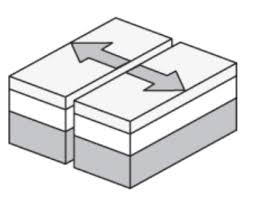
Name the boundary
a)
convergent boundary
b)
divergent boundary
c)
transform boundary
d)
sergent boundary
34.

Name the boundary
a)
convergent boundary
b)
divergent boundary
c)
transform boundary
d)
sergent boundary
35.
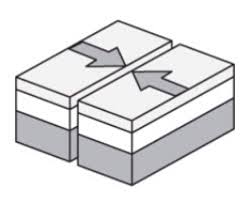
Name the boundary
a)
convergent boundary
b)
divergent boundary
c)
transform boundary
d)
sergent boundary
36.
Which ocean is expanding due to a mid-ocean ridge (divergent boundary)?
a)
Indian
b)
Dead Sea
c)
Atlantic
d)
Artic
37.
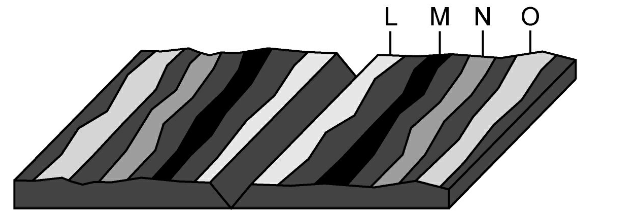
Where would the oldest rock be found if this was a divergent boundary?
a)
L
b)
M
c)
N
d)
O
38.
What type of boundary does not destroy or create new crust?
a)
Divergent
b)
Transform
c)
Convergent
39.

What type of event will occur at this boundary?
a)
Earthquake
b)
Volcano Eruption
c)
Tornado
d)
Mountain Building
40.
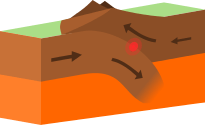
What type of plate boundary is this?
a)
Plate
b)
Divergent
c)
Convergent
d)
Transform
41.
What was the name given to all the continents when they were joined as one super continent?
a)
Supreme Continent
b)
Eurasia
c)
Plate tectonics
d)
Pangaea
42.
Which famous boundary is a convergent boundary with no subdution?
a)
Himalayan Mts
b)
Andes Mts
c)
Mid- Atlantic Ridge
d)
San andres Fault
43.
Which famous boundary is a divergent boundary?
a)
Himalayan Mts
b)
Andes Mts
c)
Mid- Atlantic Ridge
d)
San andres Fault
44.
Geologists obtain evidence about Earth's interior by...
a)
measuring pressure at the surface
b)
studying seismic waves
c)
drilling through each layer
d)
estimation of temperature in the layers
45.
This landform can occur at a divergent plate boundary.
a)
ocean trench
b)
mid-ocean ridge
c)
tall mountains
d)
transform fault
46.
Two tectonic plates collide at a _______ plate boundary.
a)
convergent
b)
divergent
c)
transform
47.
Mountains are created when....
a)
Two continental plates collide
b)
Two oceanic plates pull apart
c)
An Oceanic plate subducts under a Continental Plate
d)
Two continental plates pull apart
48.
How is it possible for new crust to be formed without increasing the surface area of the Earth?
a)
Crust is destroyed at the same time it is created
b)
New crust is underwater where it sinks
c)
New crust breaks more easily than old crust
49.

The outside layer of the earth is called ______________________.
a)
core
b)
crust
c)
mantle
d)
outer core
50.

The huge pieces of the earth's crust are called ____________________________.
a)
crust
b)
plates
c)
directions
d)
seismos
51.

This famous transform fault is located in the western United States creates significant earthquake activity for California
a)
New Madrid
b)
Denali Fault
c)
Ramapo Seismic Zone
d)
San Andreas
52.

What is a break in the Earth's crust?
a)
Fault
b)
Focus
c)
Fold
d)
Mineral
53.
Which of the following occurs because of convection currents?
a)
Tectonic plates on the crust move.
b)
The mantle increases in size.
c)
Pressure in the crust increases.
d)
Pressure in the crust decreases.
54.

Which kind of plate boundary is this?
a)
divergent boundary
b)
transform boundary
c)
convergent boundary (ocean to continent)
d)
convergent boundary (continent to continent)
55.

Which kind of plate boundary is this?
a)
divergent boundary
b)
transform boundary
c)
convergent boundary (ocean to continent)
d)
convergent boundary (ocean to ocean)
56.

Which kind of plate boundary is this?
a)
divergent boundary
b)
transform boundary
c)
convergent boundary (ocean to continent)
d)
convergent boundary (continent to continent)
57.

Which kind of plate boundary is this?
a)
divergent boundary
b)
transform boundary
c)
convergent boundary (ocean to continent)
d)
convergent boundary (continent to continent)
58.
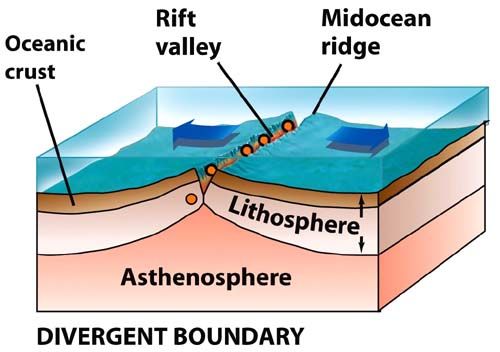
What kind of plate boundary is shown here?
a)
divergent
b)
convergent
c)
transform
d)
strike slip
59.
Which type of evidence was NOT used by Alfred Wegener to support his continental drift hypothesis?
a)
evidence from landforms
b)
evidence from fossils
c)
evidence from human remains
d)
evidence from climate
60.
What is Pangaea?
a)
The name of a German Scientist
b)
the name of the supercontinent that existed millions of years ago
c)
another name for continental drift
d)
the name of an ancient fossil
61.
According to Wegener's hypothesis of continental drift,
a)
Earth's surface is made up of seven major landmasses
b)
the continents DO NOT move.
c)
Earth is slowly cooling and shrinking.
d)
the continents were once joined together in a single landmass
62.
How did scientists discover that rocks farther away from the mid ocean ridge were older than those near it?
a)
by observing eruptions of molten material on the sea floor
b)
by mapping rocks on the sea floor using sonar
c)
by determing the age of rock samples obtained by drilling on the sea floor
d)
by measuring how fast sea floor spreading occurs
63.
A place where two plates slip past each other, moving in opposite directions, is known as a
a)
transform boundary
b)
divergent boundary
c)
convergent boundary
d)
rift valley
64.
What is the primary cause of volcanoes and earthquakes?
a)
crustal plate movements
b)
Earth's gravitational force
c)
higher than usual tides
d)
solar magnetic storms
65.

Which type of plate boundaries occur at X?
a)
Divergent
b)
convergent
c)
transform
d)
subducting
66.

What feature occurs at Y?
a)
mid-ocean ridge
b)
deep ocean trench
c)
hot spot
d)
rift
67.

What is happening at Z?
a)
mid-ocean ridge
b)
subduction zone
c)
transform boundary
d)
sea floor spreading
68.
A collision between two pieces of continental crust at a converging boundary produces a
a)
mid ocean ridge
b)
deep ocean trench
c)
rift valley
d)
mountain range
69.
Scientists recently found coal deposits in eastern Antarctica. This discovery provides evidence of-
a)
coastal erosion
b)
plate tectonics
c)
ocean currents
d)
global warming
70.
The youngest rocks on the seafloor are most likely found...
a)
closest to a mid-ocean ridge
b)
farthest from a mid-ocean ridge
c)
near the coastlines
d)
closest to a deep sea trench
71.
What were magnetic stripes on the ocean floor used to show?
a)
the seafloor was spreading outward from the mid-Atlantic ridge
b)
the seafloor was spreading inward toward the mid-Atlantic ridge
c)
the seafloor was effectively stationary
d)
natural magnetic rocks always form in the mantle of the Earth
72.
Old oceanic crust is more dense than new oceanic crust because it is
a)
hotter
b)
moving toward a deep ocean trench
c)
cooler
d)
closer to the mid-ocean ridge
73.
What is the explanation for underwater mountain ranges?
a)
continental drift
b)
seafloor spreading
c)
converging oceanic plates
d)
shearing
74.
If you used the theory of plate tectonics to predict the most likely place for the next volcanic eruption, you should predict that it is most likely to occur...
a)
along boundaries between colliding lithospheric plates
b)
where one has not happened in at least 10 million years
c)
in the interior of any continent
d)
where a continental lithospheric plate is being subducted beneath an oceanic lithospheric plate
75.
What land form is created when an oceanic plate is subducted beneath a continental plate?
a)
mid-ocean ridge
b)
rift valley
c)
trench
d)
volcanic island arc
76.
What forms when an oceanic and continental plate converge?
a)
island arcs
b)
folded mountains
c)
volcanic mountains
d)
rift valleys
77.
What occurs when two plates come together and the denser one is forced under back into the mantle?
a)
reduction
b)
conduction
c)
subduction
d)
convection
78.
Large pieces of Earth's lithosphere that move around are called?
a)
sections
b)
plates
c)
land masses
d)
faults
79.
What forms when denser oceanic crust is pushed under less dense oceanic crust?
a)
mountains
b)
volcanic islands
c)
rift valleys
d)
mid-ocean ridges
80.
Name the three types of plate boundaries.
a)
convergent, divergent, transform
b)
convergent, divergent, transformers
c)
divergent, insurgent, allegient
d)
conduction, convection, radiation
81.
What was Wegener's hypothesis called?
a)
The Pangea
b)
Moving Continents
c)
The Continental Drift
d)
Techtonic Plates
82.
What evidence helped Wegener support his theory?
a)
Climate
b)
Fossils
c)
Land Features
d)
All of the Above
83.
What are Mid-Ocean Ridges?
a)
A chain of underwater waterfalls
b)
A chain of underwater volcanos
c)
A chain of underwater mountains
d)
A chain of underwater rocks
84.

Which was NOT evidence of Wegener?
a)
Seafloor spreading
b)
fossils
c)
puzzle piece
d)
glacier evidence
85.

Geologists study the inside of the Earth by using____
a)
seismic waves
b)
sound waves
c)
light waves
d)
EM waves
86.

Addition of new sea floor
a)
Subduction
b)
Sea Floor Spreading
c)
Sea Floor subduction
d)
Convergent
87.

Heat transfers within the Earth
a)
Conduction
b)
Convection Current
c)
Ocean Current
d)
Radiation
88.

One large landmass
a)
North America
b)
Pangea
c)
South America
d)
PanAmerica
89.

Part of mantle where lithosphere floats
a)
Crust
b)
Core
c)
Asthenosphere
d)
Atmosphere
90.

Who is the person credited with developing the theory of continental drift?
a)
Harry Hess
b)
Galileo
c)
Alfred Wegener
d)
Newton
91.
What does the theory of continental drift state?
a)
The continents were once joined in a super-continent and have moved over time
b)
Continents are stationary and do not move
c)
The Earth is broken into lithospheric plates that move due to convection currents
d)
none of the above
92.
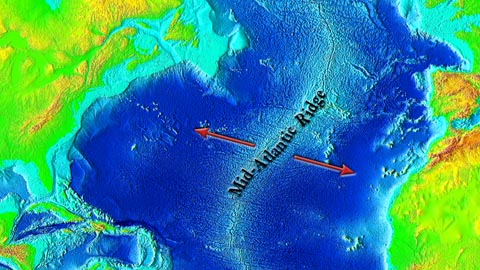
The image shows the Mid Atlantic Ridge. Which type of boundary occurs at this ridge where the ocean floor is spreading apart?
a)
convergent
b)
divergent
c)
transform fault
93.
If the focus of an earthquake occurs beneath the sea floor, as the seismic waves travel through the ocean, they create a massive and destructive
a)
epicenter
b)
tsunami
c)
focus
d)
mountain
94.

Once magma reaches the earth's surface it is called.....
a)
Silica
b)
Rock
c)
lava
95.
Volcanoes can be found...
a)
on land
b)
under water
c)
on islands
d)
all of the above
96.

An area where magma melts through the crust in the middle of a plate is called a ________.
a)
island arc
b)
hot spot
c)
geyser
d)
pipe
97.

What is the name of the Boundary that represents #7?
a)
Reverse
b)
Transform
c)
Convergent
d)
Divergent
98.
What is the name of the boundary that represents #1?
a)
Convergent
b)
Transform
c)
Strike-slip
d)
Divergent
99.
Which of the following is evidence for continental drift?
a)
old maps
b)
volcanoes
c)
earthquakes
d)
fossils
100.

What process is occurring at Z?
a)
Convection currents
b)
Subduction
c)
Two plates moving apart
d)
New ocean floor forming
101.
The Andes Mountains were formed because of this type of boundary.
a)
convergent
b)
divergent
c)
transform
102.

What type of boundary creates an island arc?
a)
Oceanic - Oceanic Convergent
b)
Oceanic - Continental Convergent
c)
Continental - Continental Convergent
d)
Divergent Boundary
103.

What type of boundary creates a mountain chain?
a)
Oceanic - Oceanic Convergent
b)
Oceanic - Continental Convergent
c)
Continental - Continental Convergent
d)
Divergent
104.
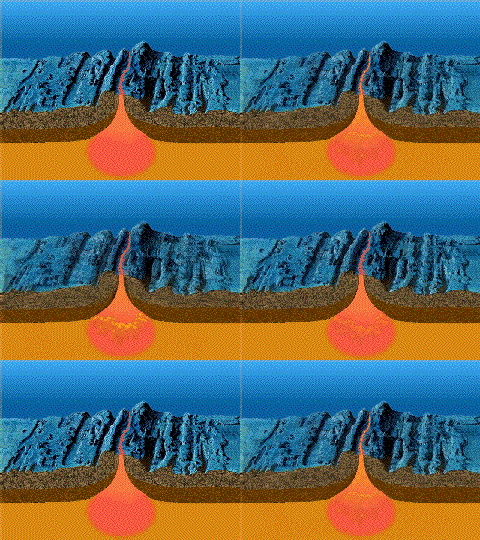
What type of boundary creates new seafloor?
a)
Oceanic - Oceanic Convergent
b)
Oceanic - Continental convergent
c)
Continental - Continental Divergent
d)
Oceanic - Oceanic Divergent
105.
A divergent boundary occurs when plates ....
a)
Pull apart
b)
Come together
c)
Slide past each other
d)
subducting
106.

Which box has a higher density?
a)
Box A
b)
Box B
c)
cannot be determined
d)
they are the same
107.
Mountains form from ...
a)
plates sliding past one another
b)
convergent of plates
c)
plates moving away from each other
108.
This land formation occurs at a divergent continental/ continental boundary.
a)
mid ocean ridge
b)
deep ocean trench
c)
pacific hot spot
d)
rift valley
109.
Associated with transform boundaries.
a)
Volcanoes
b)
mountains
c)
trenches
d)
earthquakes
110.

What kind of plate boundary is shown here?
a)
divergent
b)
convergent
c)
transform
d)
submergent
111.
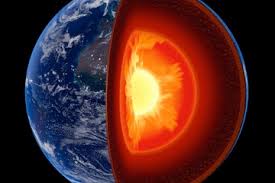
As you travel from the inner core to the crust, how would temperature, pressure and density of the material change?
a)
The would all increase
b)
The would all decrease.
c)
They would stay the same.
d)
Temperature would decrease, but pressure and density would increase.
112.

Based on the diagram, which process explains why less dense, hot magma rises to the surface to displace denser, cooler magma?
a)
conduction
b)
diffusion
c)
radiation
d)
convection
113.

Which feature will most likely form at the location marked by an X?
a)
a desert
b)
a volcano
c)
a rift valley
d)
a transform fault
114.

Which of the following graphs best represents temperatures inside Earth?
a)
A
b)
B
c)
C
d)
D
115.

What is this a picture of?
a)
plate tectonics
b)
continental drift
c)
pangea
d)
glacier scaring
116.
What evidence did Wegener use in his theory?
a)
Continents and fossils fitting together/matching-up like puzzle pieces
b)
glacier scars and other climate evidence from temperature
c)
mountain ranges and rocks line up across continents
d)
all of the above
117.

What is letter G?
a)
Mid-ocean ridge
b)
Abyssal plain
c)
Trench
d)
Continental shelf
118.

What is happening at Z?
a)
mid-ocean ridge
b)
subduction zone
c)
transform boundary
d)
sea floor spreading
119.

What kind of plate boundary is shown here?
a)
divergent
b)
convergent
c)
transform
d)
strike slip
120.

What kind of plate boundary is shown here?
a)
divergent
b)
convergent
c)
transform
d)
strike slip
121.
A mountain that builds up around an opening in Earth's crust is a what?
a)
Earthquake
b)
Volcano
c)
Tornado
d)
Hurricane
122.
The deepest parts of the ocean floor are called what?
a)
Abyssal Plains
b)
Trench
c)
Mid-Ocean Ridge
d)
Seamounts
123.

As you travel from the crust to the inner core, how would temperature, pressure and density of the material change?
a)
The would all increase
b)
The would all decrease.
c)
They would stay the same.
d)
Temperature would decrease, but pressure and density would increase.
124.

During sea floor spreading, molten material rises up from the mantle...
a)
along the continents
b)
at the mid ocean ridges
c)
deep ocean trenches
d)
at north and south poles
Reset

