
 Worksheets
First Semester Review
Total questions: 57
Worksheet time: 39mins
Name
Class
Date
1.
How does the Greenhouse Effect protect life on Earth?
a)
It maintains Earth's temperature
b)
It blocks harmful rays from the sun
c)
It gives us gravity
d)
It traps pollution in the sky
2.
At higher altitudes, air pressure is...
a)
Lower
b)
Higher
c)
The same
d)
Increasing
3.
Which sphere has the hottest temperatures?
a)
Thermosphere
b)
Mesosphere
c)
Stratosphere
d)
Troposphere
4.
Which sphere blocks harmful rays from the sun?
a)
Thermosphere
b)
Mesosphere
c)
Stratosphere
d)
Troposphere
5.
What sphere do we live in?
a)
Thermosphere
b)
Mesosphere
c)
Stratosphere
d)
Troposphere
6.
What force creates air pressure on Earth?
a)
Gravity
b)
Magnetism
c)
Electricity
d)
Greenhouse Effect
7.
What are the layers in order starting from Earth's surface?
a)
Troposphere, Thermosphere, Mesosphere, Stratosphere
b)
Troposphere, Stratosphere, Mesosphere, Thermosphere
c)
Thermosphere, Mesosphere, Stratosphere, Troposphere
d)
Thermosphere, Stratosphere, Mesosphere, Troposphere
8.
How does the atmosphere protect life on Earth?
a)
It blocks harmful rays from the sun
b)
It keeps our planet the right temperature
c)
It provides oxygen to breathe
d)
All of these protect life on Earth
9.
The boys and girls in our class are given the same test in the same amount of time. Their scores were measured to see which group is smarter. What is the independent variable?
a)
Test Score
b)
Gender
c)
Time
d)
Type of test
10.
The boys and girls in our class are given the same test in the same amount of time. Their scores were measured to see which group is smarter. What is the dependent variable?
a)
Test Score
b)
Gender
c)
Time
d)
Type of test
11.
How does pollution effect Earth's temperature?
a)
It traps more heat, warming the planet
b)
It cools our planet
c)
It does not effect our temperature
12.
What is the force with which air pushes on you?
a)
Gravity
b)
Wind
c)
The Air Force
d)
Air Pressure
13.
The process of breaking up rocks on Earth's surface is called...
a)
sediment
b)
erosion
c)
weathering
d)
deposition
14.
The process by which water, ice, wind or gravity moves weathered rock and soil from one place to another.
a)
weathering
b)
erosion
c)
deposition
d)
dumptruck
15.
What is the control/constant in the experiment
a)
changed/test
b)
measured/data
c)
stays the same
16.
A comprehension test was given to students after they had studied textbook material either in silence or with the television turned on. What is the dependent variable?
a)
silence
b)
television turned on
c)
score on test
d)
textbook material
17.
Walker is testing which fertilizer will grow the tallest grass. The height of the grown grass is the __ variable.
a)
constant (same)
b)
independent (changes)
c)
dependent (measured)
18.
The measurable factor in an experiment is known as the:
a)
Control
b)
Independent Variable
c)
Constant
d)
Dependent Variable
19.
The process of moving weathered rock and depositing it in another location is called?
a)
weathering
b)
erosion
c)
deposition
20.
What is potential energy?
a)
The energy of motion
b)
A combination of two types of energy
c)
Stored energy
d)
How far something goes in a specific time
21.
What is kinetic energy?
a)
The energy of motion
b)
A combination of two types of energy
c)
Stored energy
d)
How far something goes in a specific time
22.
Energy makes everything happen in the universe.
a)
True
b)
False
23.
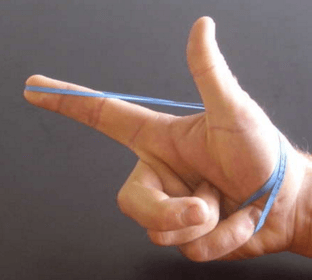
A stretched rubber band.
a)
Potential
b)
Kinetic
24.

A foot kicking a football.
a)
Potential
b)
Kinetic
25.
According to the Law of Conservation of Energy, energy cannot be _________ or ____________.
a)
destroyed, destroyed
b)
created, saved
c)
created, destroyed
d)
lost, found
26.
Gravitational potential energy depends on the ________ and ________ of the object.
a)
Height and mass
b)
Friction and movement
c)
Mass and Movement
d)
Height and Friction
27.
Kinetic energy depends on....
a)
mass, energy
b)
mass, height
c)
height, speed
d)
speed, mass
28.
You should only change _______ thing(s) to have a good, valid experiment.
a)
One
b)
Two
c)
Three
d)
Four
29.
What is the scientific method?
a)
A pink hippo eating science experiments.
b)
A unified method used across the world by teachers used to solve all life problems.
c)
A theory and a law.
d)
A unified method used across the world by scientists to solve scientific problems.
30.
The number of fish in a fish tank would be considered ______data.
a)
quantitative
b)
qualitative
c)
useless
31.
What step does every scientific experiment begin with?
a)
hypothesis
b)
question/problem
c)
procedures
d)
conclusion
32.
In order for an explanation to be considered scientific, it must be based on ____________.
a)
an inference
b)
a conclusion
c)
past experience
d)
evidence
33.
The word stem pseudo- means:
a)
false
b)
true
c)
understand
d)
science
34.
Science or Pseudoscience: Personal bias and the opinion of the scientist.
a)
Science
b)
Pseudoscience
35.
What is a PUSH or PULL of an object?
a)
Motion
b)
Force
c)
Friction
d)
Gravity
36.
Which force produces a change in motion?
a)
unbalanced force
b)
balanced force
c)
gravitational force
d)
frictional force
37.
What is the formula for force?
a)
F=M/A
b)
F=A/M
c)
F=M*A
d)
F=M*F
38.
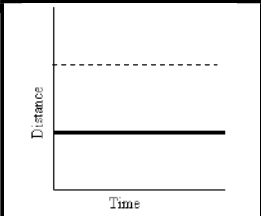
What does this graph represent?
a)
Constant speed
b)
Acceleration
c)
Not moving
39.
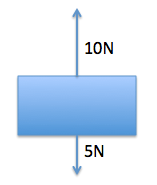
What is the net force on the block? (click on the words to view the picture)
a)
5 Newtons up
b)
5 Newtons down
c)
15 Newtons up
d)
15 Newtons down
40.
Attracts all objects towards each other
a)
gravity
b)
mass
c)
weight
d)
inertia
41.
What does the strength of gravity between two objects depend upon?
a)
Mass & distance
b)
Mass & weight
c)
Gravity & inertia
d)
Inertia & mass
42.
The amount of matter in an object
a)
mass
b)
weight
c)
inertia
d)
gravity
43.
The force of gravity on an object
a)
mass
b)
weight
c)
volume
d)
inertia
44.
the tendency of an object to resist a change in motion
a)
Gravity
b)
Inertia
c)
Weight
d)
Mass
45.
As an object's mass increases, its gravitational pull will ____________.
a)
decrease
b)
increase
c)
stay the same
d)
get weaker
46.
"Bio" in biosphere means ____.
a)
air, vapor
b)
rock, earth
c)
water
d)
life
47.
"Atmo" in atmosphere means ____.
a)
air, vapor
b)
rock, earth
c)
water
d)
life
48.
"Hydro" in hydrosphere means ____.
a)
air, vapor
b)
rock, earth
c)
water
d)
life
49.
"Geo" in geosphere means ____.
a)
air, vapor
b)
rock, earth
c)
water
d)
life
50.
What is a system?
a)
a set of connected things or parts that work together
b)
a pattern
c)
a number
d)
and interogative sentence
51.
The flow of energy from an object at a higher temperature to an object at a lower temperature.
a)
heat
b)
temperature
c)
radiation
d)
conduction
52.
The energy an object has due to the motion of its particles; the total amount of kinetic energy of particles in an object.
a)
heat
b)
thermal energy
c)
conduction
d)
convection
53.
A measure of the average amount of kinetic energy of the particles in the object.
a)
energy
b)
expansion
c)
temperature
d)
heat
54.
Energy that travels across distances in the form of electromagnetic waves.
a)
Convection
b)
Radiation
c)
Conduction
d)
Induction
55.
The process by which energy is transferred in gases and liquids occurring when a warmer, less dense area of gas or liquid is pushed up by a cooler, more dense area of gas or liquid.
a)
Thermal Energy
b)
Radiation
c)
Convection
d)
Expansion
56.
The process by which energy is transferred in gases and liquids occurring when a warmer, less dense area of gas or liquid is pushed up by a cooler, more dense area of gas or liquid.
a)
Thermal Energy
b)
Radiation
c)
Convection
d)
Expansion
57.
The process by which energy is transferred from a warmer object to a cooler object by means of physical contact
a)
Thermal Energy
b)
Convection
c)
Radiation
d)
Conduction
100 %

