wayground logo

Free Printable Worksheets

NEW

Font size

S
M
L
XL
Worksheets

Reviewer 1 4th

Total questions: 55

Worksheet time: 43mins

Name
Class
Date
1.
How do Volcanic mountains form?
a)
When rock combines with water to create a tight structure for a mountain. 
b)
When lava forms into an island. 
c)
When molten rock erupts on earth surface, and creates a mountain structure. 
d)
When rock and lava form a beach. 
2.

Which of these are types of mountains?

a)

rolling, glacial, subterranean, cascades

b)

rocky, green, smoky, white

c)

fault-block, dome, volcanic, folded

d)

salt-block, dome, magnum, frozen

3.
What are the two types of folding?
a)
Horizontal and Vertical
b)
Synclines and Anticlines
c)
Up and down
d)
Bottom and Top
4.

What is the other name of upwarped mountain?

a)

compression mountain

b)

folded mountain

c)

dome mountain

d)

thrust fault mountain

5.

Which is a mountain that occurs when a section of land slips over another at a low angle forming a reverse slip fault which is caused by weak compression stress?

a)

Plateau

b)

fault block mountain

c)

thrust fault moutain

d)

upwarped mountain

6.

continental volcanic mountain

a)

is formed at an active continental margin where a continental plate converges with an oceanic plate and a subduction zone develops.

b)

a long, seismically active submarine ridge system situated in the middle of an ocean basin and marking the site of the upwelling of magma associated with seafloor spreading

c)

is a break in the rocks that make up the Earth's crust, along which rocks on either side have moved past each other.

d)

long, narrow, steep-sided depression in the ocean bottom caused by the subduction of an older plate in the sea floor

7.

type of stress that made this?

a)

shearing

b)

compressional

c)

tensional

8.

Which describes a "Continental-Oceanic convergence"?

a)

compression of two oceanic crust that leads to the formation of a volcanic island arc, a trench and a subduction zone

b)

are the large, thin, relatively rigid plates that move relative to one another on the outer surface of the Earth.

c)

compression of a two continental crust that leads to mountain formation through folding and faulting

d)

compression of a continental and an oceanic crust that leads to the formation of a continental volcanic mountain range which also forms a trench within the subduction zone

9.

A volcano that emits mostly cinders, ashes, and bombs is called

a)

extinct volcano

b)

shield volcano

c)

stratovolcano

d)

cinder cone

10.

A volcano having no historical record of eruption and showing no seismic indications of activity deep underground is called.

a)

extinct volcano

b)

shield volcano

c)

stratovolcano

d)

cinder cone

11.
What do you call the steep-walled depression around the opening of a volcano?
a)
Volcanic Pipe
b)
Vent
c)
Crater
d)
Sinkhole
12.
Has broad, gently sloping sides and a nearly circular base, Forms from lava that contains relatively small amounts of gases and silica, Mauna Kea in Hawaii is an example.
a)
composite volcano
b)
shield volcano
18.
The epicenter of an earthquake is
a)
The point below the surface where rock begins to break and the first motion occurs
b)
The seismic station closest to the earthquake
c)
The place where the greatest damage occurs
d)
The point on the surface directly above the focus
21.
These are the first waves released during an earthquake
a)
S waves
b)
Surface Waves
c)
P waves
15.
We use this tool to measure seismic waves during earthquakes
a)
Seismographs
b)
magnitude
c)
actual magnitude
d)
sonograph
19.
This is the name of the single digit number that means how powerful an earthquake is. It is measured on the Richter scale
a)
Force
b)
Stress
c)
Magnitude
d)
Plate Boundary
20.
P and S waves travel through the earth, and so are called
a)
surface waves
b)
body waves
c)
tsunamis
d)
earth waves
18.
The epicenter of an earthquake is
a)
The point below the surface where rock begins to break and the first motion occurs
b)
The seismic station closest to the earthquake
c)
The place where the greatest damage occurs
d)
The point on the surface directly above the focus
19.
This is the name of the single digit number that means how powerful an earthquake is. It is measured on the Richter scale
a)
Force
b)
Stress
c)
Magnitude
d)
Plate Boundary
20.
P and S waves travel through the earth, and so are called
a)
surface waves
b)
body waves
c)
tsunamis
d)
earth waves
21.
These are the first waves released during an earthquake
a)
S waves
b)
Surface Waves
c)
P waves
22.
Why do shield volcanoes produce quiet eruptions that are not very explosive? 
a)
the lava has a high viscosity that flows quickly
b)
the lava has a low viscosity that flows quickly
c)
the pressure is not very high in shield volcanoes
d)
the pressure is extremely high in shield volcanoes
23.
What is the name of the process used to locate an epicenter.
a)
Seismology
b)
Geology
c)
Triangulation
d)
Translocation
24.
A type of fault where the hanging wall slides upward; caused by compression in the crust.
a)
normal
b)
reverse
c)
strike-slip
25.
A type of fault where the hanging wall slides downward; caused by tension in the crust.
a)
strike-slip
b)
normal
c)
reverse
26.
The point beneath the Earth’s surface where rock breaks under stress and triggers an earthquake is called the
a)
epicenter
b)
focus
c)
magnitude
27.
What does a seismograph record?
a)
the speed of seismic waves
b)
the ground movement caused by seismic waves
c)
the location of the epicenter
28.
The farther a seismic station is from an earthquake, a person will notice that  the time between P and S waves
a)
Increases
b)
Decreases
c)
Same
29.
Point B is the
a)
Epicenter
b)
Focus
c)
Scarp
30.
Which scale measures the intensity of the ground movement?
a)
Mercalli Scale
b)
Richter Scale
c)
Seismogram Scale
d)
Bernoulli Scale
31.
What is mechanical weathering?
a)
Process through which rocks are physically broken into smaller pieces.
b)
Rocks are broken down through chemical changes.
c)
Rocks are worn away from acid in plant roots.
d)
Rocks broken down by machinery.
32.
The diagrams  shows a natural process that weathers rock.
 Which statement best explains why this process results in weathering?
a)
frozen water acts as a solute
b)
water expands when it freezes
c)
the mass of water increases when it freezes
d)
frozen water dissolves most types of rock
33.
How do plants weather rocks?
a)
during photosynthesis
b)
when roots grow into cracks of rocks and expand the rock
c)
when the plant moves water from the roots to the leaves
34.
Lichens (small green plants) growing on a large boulder release enzymes and other acids that slowly break the rock apart. This is an example of:
a)
mechanical weathering
b)
chemical weathering
35.
The formation of stalactites and stalagmites in a cave as water mixed with carbon dioxide creates carbonic acid, which dissolves away the limestone, is an example of:
a)
mechanical weathering
b)
chemical weathering
36.
Carbon dioxide (CO2) combines with water as raindrops fall through the atmosphere. This makes a weak acid, called carbonic acid. Carbonic acid is a very common in nature, where it works to dissolve rock. Pollutants, such as sulfur and nitrogen from fossil fuel burning, create sulfuric and nitric acid. Sulfuric and nitric acids are the two main components of acid rain, which speeds up chemical weathering.
This statue was probably destroyed by _____.
a)
Wind
b)
Humans
c)
Acid Rain
d)
Animals
37.
An avalanche is an example of which process?
a)
Weathering
b)
Erosion
c)
Deposition
d)
Volcanic Eruption
38.
Rocks and pebbles in a river become smooth as they smash into other rocks.
a)
Weathering 
b)
Erosion 
39.
A rock is broken apart by the water in a crack that freezes and turns to ice.
a)
Mechanical Weathering
b)
Chemical Weathering
40.
What is an enormous mass of ice moving over land?
a)
glacier
b)
iceberg
c)
ice wedging
d)
dune
41.
Which type of land suffers the least from wind erosion?
a)
desert
b)
forest
c)
beach
d)
plowed fields
42.
This type of weathering occurs when rock is physically broken down into smaller pieces of rock.
a)
mechanical weathering
b)
chemical weathering
c)
erosion weathering
d)
deposition
43.
These rocks were broken apart from the continuous freeze/thaw of water in the cracks of the rocks. This is an example of:
a)
ice wedging
b)
acid rain
c)
permeability
d)
abrasion
44.
Dark, organic material formed in soil from the decayed remains of plants and animals is called what?
a)
fossil
b)
humus
c)
oil
d)
dirt
45.
Decayed organic material in soil is called______.
a)
Litter
b)
Silt
c)
Humus
d)
Clay
46.
Ellen grabs a topsoil sample in her hand. She rolls it into a ball. The soil feels gritty and the ball falls apart. What part of the topsoil most likely made the topsoil feel gritty?
a)
clay
b)
sand
c)
silt
d)
humus
47.
You dig a small hole in the soil and the next day it rains. The hole fills with water, but does not empty even after several days of dry weather. What is the soil mostly made of?
a)
clay
b)
sand
c)
humus
d)
silt
48.
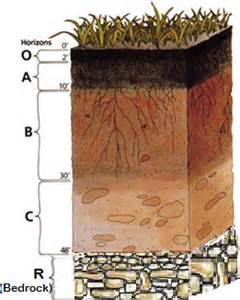
The vertical section of soil that shows all the different layers is called a: 
a)
Soil horizon
b)
Soil profile
49.
In which soil type would water drain easily?
a)
Sand
b)
Silt
c)
Clay
50.
Which soil particles have the smallest pore spaces between sediments?
a)
Clay
b)
Silt
c)
Sand
51.
Soil is made of
a)
weathered rocks and minerals
b)
dead plants and animals
c)
air and water
d)
all of the above
52.
In which horizon is most of the HUMUS?
a)
Horizon A
b)
Horizon B
c)
Horizon C
d)
Horizon D or R
53.
The horizon is called the subsoil, usually consist of clay and other particles leached down from the A Horizon
a)
B Horizon
b)
A Horizon
c)
Erosion
d)
Bedrock
54.
Soil conservation includes all of the following EXCEPT_______.
a)
Desertification
b)
Contour plowing
c)
Terracing
d)
Crop rotation
55.
Many plants cannot grow in sandy soil. Why is this true?
a)
Sandy soil does not hold enough water.
b)
Air cannot pass through sandy soil.
c)
Roots cannot easily push through sandy soil.
d)
Sandy soil has too many nutrients.