
 Worksheets
CP9 Electricity and Circuits (standard and Higher) Part 1
Total questions: 41
Worksheet time: 22mins
Name
Class
Date
1.
10.1 The nucleus of an atom is made up of
a)
Protons and electrons
b)
Protons and neutrons
c)
Neutrons and electrons
2.
10.1 Protons have a charge of
a)
+1
b)
-1
c)
0
3.
10.1 Neutrons have a charge of
a)
+1
b)
-1
c)
0
4.
10.1 Electrons have a charge of
a)
+1
b)
-1
c)
0
5.

10.2 What circuit symbol does this image represent:
a)
Motor
b)
Battery
c)
Cell
d)
Bulb
6.

10.2 What component does this image represent:
a)
LDR
b)
Thermostat
c)
Variable resistor
d)
Resistor
7.

10.2 What component does this image represent:
a)
Cell
b)
Battery
c)
Resistor
d)
Bulb
8.

10.3 Does this diagram show a series or parallel circuit
a)
Series
b)
Parallel
9.

10.3 Does this image show a series or parallel circuit
a)
Series
b)
Parallel
10.

10.3 Explain what will happen if the second bulb were to blow in this circuit
a)
The remaining two bulbs will stay lit
b)
All bulbs will go out
11.
10.4 Voltmeters are connected in parallel with a component
a)
True
b)
False
12.
10.4 What component is used to measure potential difference
a)
Ammeter
b)
Voltmeter
c)
Variable resistor
13.
10.5 The definition for potential difference is
a)
1 joule of energy transferred per second
b)
the energy transferred per unit charge passed
c)
The rate of flow of charge
14.
10.6 The equation linking energy transfer, charge and potential difference is:
a)
E = Q x V
b)
E = Q / V
c)
E = Q / PD
d)
E = Q x PD
15.
10.7 Current is measured in
a)
Volts
b)
Amps
c)
Watts
d)
Joules
16.
10.7 Current is measured using
a)
Voltmeter
b)
Resistor
c)
Ammeter
d)
Newtonmeter
17.
10.8 'The rate of the flow of charge in a circuit' is the definition for
a)
Potential difference
b)
Current
c)
Charge
18.
10.9 Charge is measured in
a)
Amps
b)
Volts
c)
Coulombs
d)
Joules
19.
10.9 The current in a lamp is 0.6A. How much charge flows through it in 1 minute
a)
36C
b)
0.6C
c)
100C
20.
10.9 There is a current of 0.3A in a circuit. How long will it take for 36C to flow past a point in the circuit?
a)
10.8s
b)
0.008s
c)
120s
21.
10.9 The equation to calculate charge is
a)
charge = current x time
b)
charge = current / time
c)
charge = current / voltage
d)
charge = current x voltage
22.
10.10 State 2 things required for a current to flow
a)
Closed circuit, bulb
b)
Closed circuit, resistor
c)
Battery, bulb
d)
Closed circuit, source of potential difference
23.
10.11 Current is conserved in a circuit
a)
True
b)
False
24.
10.12 When the resistance in a circuit increases...
a)
The current increases
b)
The current decreases
c)
The current stays the same
25.
10.13 Resistance is measured in
a)
Amps
b)
Coulombs
c)
Ohms
d)
Joules
26.
10.13 The equation linking potential difference, current and resistance is
a)
V = I / R
b)
V = I x R
c)
PD = I x R
d)
PD = I / R
27.
10.13 Calculate the resistance in a circuit when the current is 0.3A and the potential difference is 9V
a)
0.033 Ohms
b)
2.7 Ohms
c)
30 Ohms
28.
10.14 When 2 resistors are connected in parallel the net resistance is
a)
Increased
b)
Decreased
c)
Stays the same
29.
10.14 When 2 resistors are in series the net resistance is...
a)
Increased
b)
Decreased
c)
Stays the same
30.
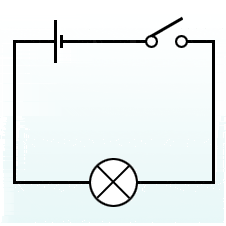
10.15 This circuit contains
a)
Cell, open switch, bulb
b)
Battery, open switch, bulb
c)
Cell, closed switch, motor
d)
Battery, closed switch, bulb
31.

10.16 If the current reads 0.3A in the first bulb, what will it read in the second?
a)
0.3A
b)
0.6A
c)
0.15A
32.

10.18 Which of the components shown in the graph above shows that current and potential difference are in direct proportion
a)
Resistor
b)
Filament Bulb
c)
Diode
33.

10.18 Which of the components shown in the graph above shows that as the potential difference increases the current rises exponentially
a)
Resistor
b)
Filament Bulb
c)
Diode
34.

10.19 Describe the trend of the resistance in a light-dependent resistor
a)
As the light intensity increases the resistance decreases
b)
As the light intensity increases the resistance increases
c)
As the light intensity increases the resistance stays the same
35.

10.20 Describe what happens to the resistance in a thermistor with an increase in themperature
a)
As the temperature increases the resistance increases
b)
As the temperature increases the resistance decreases
c)
As the temperature increases the resistance stays the same
36.

10.21 Which of the components shown in the graph above shows that as the potential difference increases the current also increases but begins to level off
a)
Resistor
b)
Filament Bulb
c)
Diode
37.
10.22 State what happens when there is an electric current in a resistor
a)
The potential difference changes
b)
Increase in heat energy
c)
Decrease in heat energy
38.
10.23 State the type of energy that is wasted when an electrical current does work against electrical resistance
a)
Sound energy
b)
Kinetic energy
c)
Light energy
d)
Heat energy
39.
10.24 Describe how an electric current causes heating in a wire
a)
The ions in the lattice bump into each other
b)
The ions are free to move in the wire
40.
10.25 Which of the following will reduce the resistance of a wire
a)
Using a wider wire
b)
Using a thinner wire
c)
Using a longer wire
41.
10.26 A disadvantage of the heating effect of an electric current is
a)
Fire risk
b)
Less effiicient
c)
Current slows
d)
All of the answers
100 %

