

wayground logo

Free Printable Worksheets

NEW

Font size

S
M
L
XL
Worksheets

Chapter 2: Pressure

Total questions: 40

Worksheet time: 36mins

Name
Class
Date
1.

Liquid pressure is because of the forces between the liquid particles and the _________ of the container.

a)

Volume

b)

Mass

c)

Surface

d)

Density

2.

When divers return to the surface of water quickly, the pressure is ________.

a)

Increased

b)

Decreased

c)

Not changing

3.

The pressure exerted by a liquid

a)

increases with depth.

b)

decreases with depth.

c)

is constant

d)

first increases and then decreases.

4.

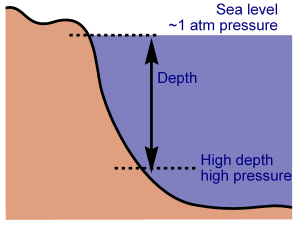
The pressure of the water at the bottom of a pond is ___ at the surface of the pond.

a)

either lower or higher

b)

higher than

c)

same

d)

lower than

5.

The diagrams show, to the same scale, the vertical sections of a set of circular vessels, each containing the same depth of water.

a)

The water exerts the same pressure on the base of each vessel.

b)

The water exerts the greatest pressure on the base of vessel S.

c)

The water exerts the greatest pressure on the base of vessel P.

d)

The water exerts the same force on the base of each vessel.
6.

When you increase your depth under water, the water pressure on your body

a)

increases

b)

decreases

c)

stays the same

7.

Diagram shows the design of a dam. Why does the thickness of the dam increase with its depth?

a)

The design of this structure is stronger.

b)

Water pressure increases with depth.

c)

The cost of construction is lower.

d)

Water pressure acts uniformly in all directions.

8.
Where is pressure the greatest on the dam?
a)
D
b)
C
c)
B
d)
A
9.
As you climb up a mountain what happens to the air pressure?
a)
decreases
b)
increases
c)
stays the same
10.
What happens to the amount of oxygen molecules as altitude increases?
a)
fewer molecules
b)
more molecules
c)
same amount of molecules
d)
nothing happens to the molecules
11.
Air pressure is greater _______.
a)
at the top of the mountain
b)
at the bottom of the mountain
c)
at the center of the mountain
12.

a)

A

b)

B

c)

C

d)

D

13.
What is the equation used to calculate pressure?
a)
pressure= force/mass
b)
pressure =mass/volume
c)
pressure=area/force
d)
pressure=force/area
14.
Pressure decreases when the surface area over which a force is applied increases
a)
True
b)
False
15.
Which of the statements is true?
a)
The bottom of the boot exerts more pressure than the shoe as a result of an increase in surface area.
b)
The bottom of the shoe exerts more pressure than the boot as a result of an decrease in surface area.
c)
The bottom of the shoe exerts the same pressure as the bottom of the boot.
16.

Atmospheric pressure depends on .......

a)

mass

b)

density

c)

altitude

d)

magnitude

17.
Air pressure is greatest when near Earth's surface because?
a)
The air molecules are farther apart.
b)
The air molecules are closer together.
c)
Air molecules collide.
d)
Air molecules are tightly packed.
18.

An object weighing 30 N displaces a volume of water with a weight 20 N. What will the object do?

a)

It will sink

b)

It will float

c)

It will fly

d)

None of these answers

19.
An object will float in water when the buoyant force equals the object's ___________________.
a)
density
b)
weight
c)
pressure
d)
depth
20.
Buoyancy is the tendency for objects to float in a fluid. Buoyancy pushes the opposite direction of...
a)
waves push.
b)
magnetic pull.
c)
the wind.
d)
gravity's pull
21.
Diagram 10 shows a diver in the sea
Which physical quantity will increase when the diver dives deeper?
a)
Pressure
b)
Buoyant Force
c)
Atmospheric pressure
d)
Gravitational field strength
22.
Which of the following diagrams shows the best design for the wall of a reservoir?
a)
A
b)
B
c)
C
d)
D
23.
Objects A-D are in water. Which is the most dense?
a)
A
b)
B
c)
C
d)
D
24.
What does pressure measure?
a)
Strength
b)
Force exerted on a given area of surface
25.

A boy weighing 65kgf wear a shoes of area 10cm2 , and a girl weighing 40 kgf wears sandals with heel of area 2 cm2 . compare the pressure exerted.

a)

13 : 4

b)

13 : 40

c)

65 : 20

d)

6.5 : 2.0

26.

P1 is the pressure at a depth in seawater& P2 is that in the river water are related as

a)

P1 > P2

b)

P1 < P2

c)

P1 ≠ P2

d)

P1 = P2

27.

Calculate the pressure at the bottom of a cylindrical vessel filled with water.Area of cross section is 250 cm2. density of water is 1000 kg m-3. water is filled to a height of 10cm.

g = 10 ms-2

a)

250 Pa

b)

105 Pa

c)

2500 Pa

d)

1000 Pa

28.

In an enclosed system, transmission of pressure exerted on a fluid is uniform throughout the fluid. This statement can be referred to

a)

Hydraulic system

b)

Pascal’s principle

c)

Aerofoil system

d)

Bernoulli’s principle

29.

Diagram shows an operation of fluid through an enclosed system. Calculate the force needed to lift the car?

a)

20 N

b)

60 N

c)

100 N

d)

120 N

30.

Diagram shows a hydraulic system to lift a 120N load. Piston, P is exerted with force, F. What happened to the pressure at X, Y and Z?

a)

Pressure at X, Y and Z is equal

b)

X has the largest pressure

c)

Y has the largest pressure

d)

Z has the largest pressure

31.
To generate lift, a blade is angled so the _________ pressure air moves under the blade.
a)
high
b)
low
c)
not enough information
d)
None of the above
32.

Whose Principle is used to describe why flight is possible?

a)

Newton

b)

Wright Brothers

c)

Bernoulli

33.
Why is the top of an airplane wing curved?
a)
To create an area of low pressure above the wing
b)
To create an area of high pressure above the wing
c)
To create equal pressure above and below the wing
d)
To make the wing look really cool
34.
If you blow air between these two balloons, the pressure between the balloons would_________.
a)
Increase
b)
Decrease
c)
Stay the same
35.
Think about Bernoulli's Principle.  What do you think will happen when you have running water next to a shower curtain?
a)
Curtain goes outward from the shower
b)
Curtain goes in towards the shower
c)
Curtain stays the same
d)
Water gets the curtain wet
36.
The upward force exerted by a liquid on an object immersed in or floating on the liquid
a)
pressure
b)
buoyant force
c)
normal force
d)
gravity
37.
Looking at the image... can oak float in water? 
a)
Yes
b)
No
38.
Archimedes' Principle states that... 
a)
The buoyant force acting on an object equals the volume of the fluid displaced by the object. 
b)
The buoyant force acting on an object equals the weight (force of gravity) of the fluid displaced by the object.
c)
The buoyant force acting on an object will always be equal. 
39.
A force is applied in a closed container, the pressure increases the same amount. EX: squeezing a water bottle or toothpaste
a)
Archimede's Principle
b)
Pascal's Principle
c)
Bernoulli's Principle 
40.
What is the pressure in the hydraulic fluid?
a)
1210 N
b)
484 N/m2
c)
8000 N
d)
3025 N/m2
