
 Worksheets
Benchmark 2 Review
Total questions: 68
Worksheet time: 38mins
Name
Class
Date
1.
A person walks 50 meters directly north, stops, and then travels 32 meters directly south. What is their distance traveled?
a)
82 meters
b)
18 meters
c)
32 meters
2.
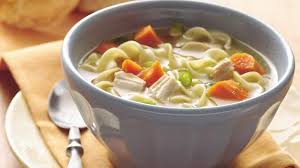
Chicken noodle soup
a)
heterogeneous mixture
b)
homogeneous mixture
3.
On a graph, which axis shows the independent variable?
a)
x-axis
b)
y-axis
c)
neither
d)
it changes
4.
On a graph, which axis shows the dependent variable?
a)
x-axis
b)
y-axis
c)
neither
d)
it changes
5.
Which is an example of a physical property?
a)
ability to react with acid
b)
color
c)
flammability
d)
ability to react with oxygen
6.
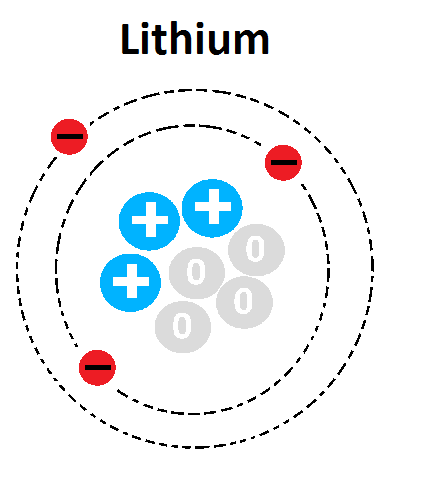
What is the atomic number of this atom?
a)
1
b)
3
c)
4
d)
7
7.

What state of matter is segment 5?
a)
Solid
b)
Liquid
c)
Gas
d)
Plasma
8.
The periodic table has __ groups.
a)
8
b)
7
c)
18
d)
2
9.
When you are holding a book, energy is stored between the book and Earth; this type of energy is called ________ potential energy.
a)
Kinetic
b)
Potential
c)
Gravity
d)
Friction
10.
the central region of an atom where its neutrons and protons are is its
a)
nucleus
b)
electron cloud
c)
core
d)
center
11.
The positive particles of an atom are
a)
electrons
b)
positrons
c)
neutrons
d)
protons
12.
Which element has the atomic number 2?
a)
Helium
b)
Flourine
c)
Potassium
d)
Hydrogen
13.
What is condensation?
a)
gas to solid
b)
gas to liquid
c)
liquid to solid
d)
solid to liquid
14.
The slower the particles in a substance move,
a)
the colder it is.
b)
the warmer it is.
c)
the more energy it has.
d)
the less energy it has.
15.

Which part is known as the atomic mass?
a)
Cu
b)
29
c)
63.546
d)
copper
16.
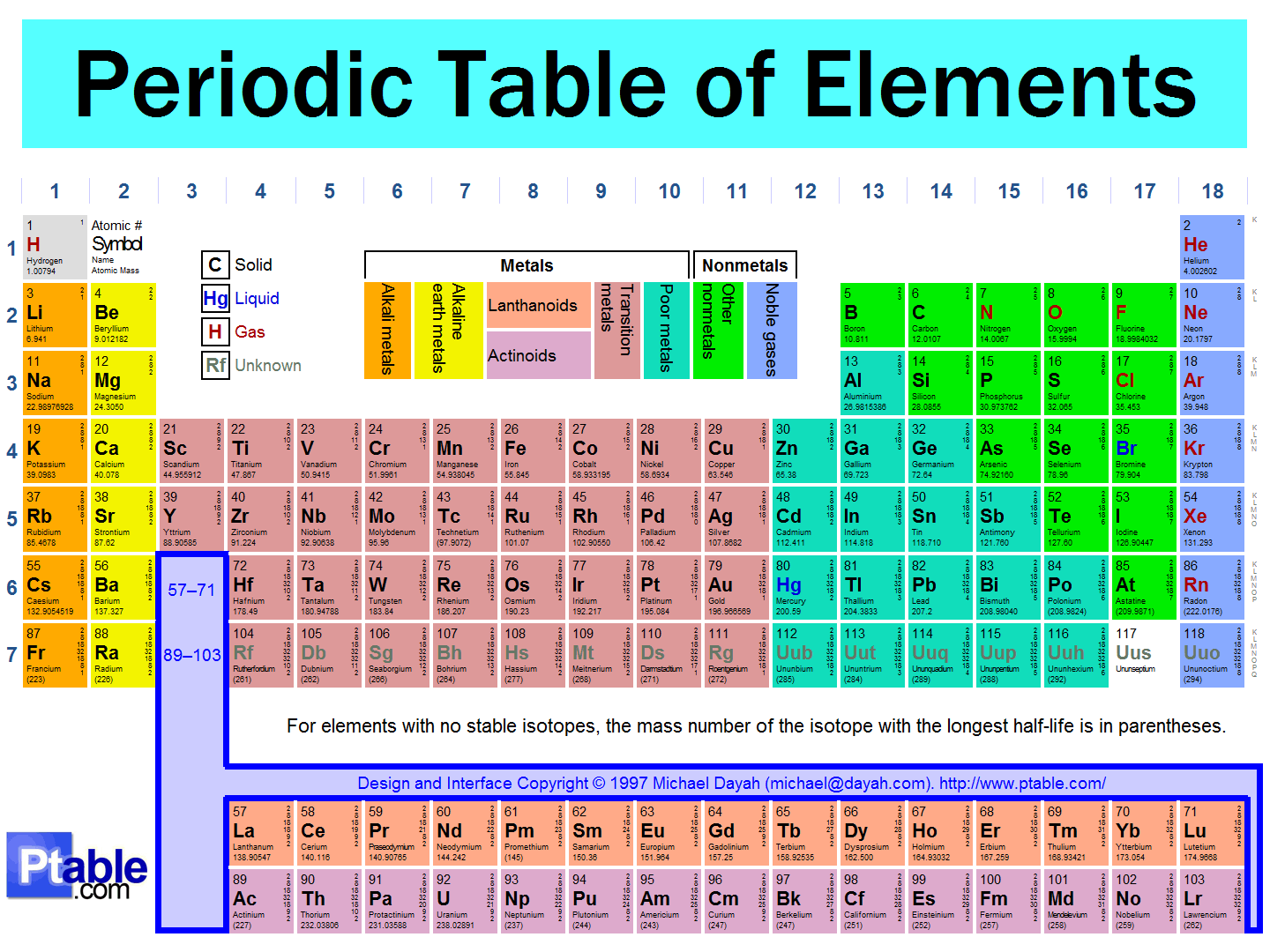
A vertical column is called...
a)
group
b)
tower
c)
period
d)
crew
17.

What is the net force in this picture?
a)
50 Newtons to the right
b)
950 Newtons to the right
c)
950 Newtons to the left
d)
50 Newtons to the left
18.
Definite volume but not definite shape
a)
solid
b)
liquid
c)
gas
d)
solid, liquid and gas
19.
_______ are the ROWS on the periodic table.
a)
Families
b)
Groups
c)
Periods
d)
Elements
20.

The force that opposes motion between two surfaces in contact with each other.
a)
inertia
b)
friction
c)
momentum
d)
gravity
21.

A force that opposes motion between a surface in contact with the atmosphere.
a)
air resistance
b)
gravity
c)
momentum
d)
terminal velocity
22.

What phase change can happen if enough heat energy is REMOVED from a gas?
a)
it melts
b)
it freezes
c)
condensation
d)
evaporation
23.

Segment D?
a)
gas
b)
liquid
c)
boiling/condensation
d)
melting/freezing
24.
I have an x-axis and a y-axis. I help to track changes over time. What am I?
a)
Circle Graph
b)
Histogram
c)
Line Graph
d)
Dot Plot
25.
Which is not a way to speed up the rate of dissolving?
a)
Stir the mixture
b)
Add ice to the mixture
c)
Add heat to the mixture
d)
Use smaller particles.
26.
Which of the following is an example of a physical change?
a)
Tearing paper
b)
Burning paper
c)
Setting off fireworks
27.
A super heated gas is called________
a)
Vapor
b)
Liquid
c)
Solid
d)
Plasma
28.
A possible explanation to a problem that has not yet been tested.
a)
data
b)
theory
c)
hypothesis
d)
fact
29.
When experimenting with the growth of a plant, a scientist uses three (of the same type of) plants, two different fertilizers, equal light, and equal water. What type of variable is the fertilizer?
a)
Dependent
b)
Independent
c)
Control
d)
Compound
30.
The part of the experiment that is not tested. It is used for comparison.
a)
Control Group
b)
Experimental Group
c)
Results
d)
Data
31.
What are all the things that are kept the same in an experiment?
a)
controls
b)
data
c)
constants
d)
independent variables
32.
This type of graph is used to show fixed quantity data broken into percents.
a)
Bar
b)
Line
c)
Pie/Circle
d)
Scatter plot
33.

The substance being dissolved to form a solution is the __________.
a)
solvent
b)
solute
c)
precipitate
d)
mixture
34.

Vinegar
a)
Heterogeneous
b)
Homogeneous
35.
Particles in a ______________________ have more energy than the other states of matter.
a)
gas
b)
solid
c)
liquid
36.
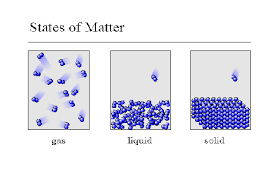
At higher temperatures
a)
particles in an object have less energy
b)
particles in an object move faster
c)
a gas contracts
d)
solids freeze
37.
A physical change is...
a)
a change that doesn't change the identity of the substance
b)
a change that makes something new.
c)
a chemical reaction
d)
an exercise at the gym
38.
Which of the following statements describes a solid?
a)
It has a fixed shape
b)
It takes the shape of it's container
39.
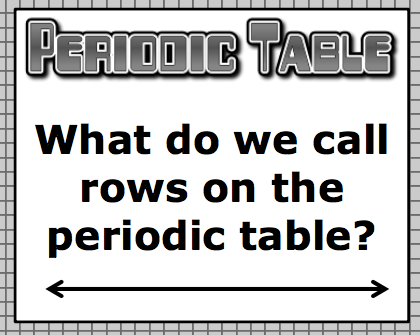
a)
Periods
b)
Groups
40.

How many protons are in Beryllium?
a)
4
b)
9
c)
5
d)
2
41.
A particle that moves around the nucleus is a(n)...
a)
Proton
b)
Neutron
c)
Electron
d)
Quark
42.

What does the nucleus of an atom contain?
a)
Electrons and neutrons
b)
Protons and neutrons
c)
Neutrinos and positrons
d)
DNA and RN
43.
Which is the smallest?
a)
electron
b)
proton
c)
atom
d)
neutron
44.

How many neutron are in the atom "K"?
a)
7
b)
2
c)
39
d)
20
45.
Which of the following is NOT a part of the Kinetic Theory of Matter?
a)
All matter is made up of tiny particles.
b)
Occasionally, particles stop moving.
c)
Particles are always moving in random paths.
d)
The type of movement of particles depends on the amount of energy.
46.
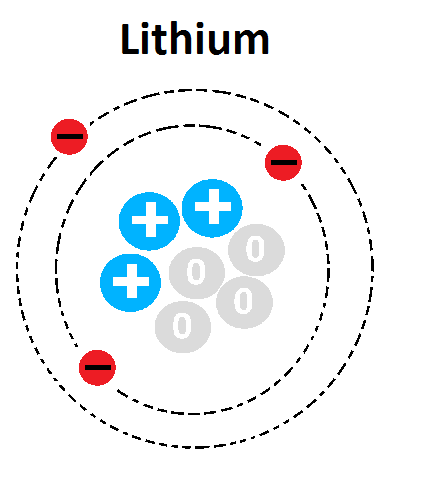
What is the mass number of this atom?
a)
1
b)
3
c)
4
d)
7
47.
Flammability is an example of what property?
a)
Chemical property
b)
Physical property
48.

What is this called?
a)
Beaker
b)
Flask
c)
Test Tube
d)
Graduated Cylinder
49.

Identify the equipment shown here:
a)
beakers
b)
flasks
c)
decanters
d)
graduated cylinders
50.

What is this called?
a)
Beaker
b)
Flask
c)
Test Tube
d)
Graduated Cylinder
51.
Which is the SI unit for mass ?
a)
kilogram, kg
b)
meter, m
c)
newton, N
d)
weight, W
52.
The base unit for length in SI units is the
a)
gram
b)
liter
c)
meter
d)
milliliter
53.
What is a solvent?
a)
The substance that does the dissolving in a solution.
b)
The substance that is being dissolved in a solution.
c)
The mixing of different substances.
d)
The process in which neutral molecules lose or gain electrons
54.
What is a solute?
a)
The substance that does the dissolving in a solution.
b)
The substance that is dissolved into the solution.
c)
The mixing of different substances.
d)
The process in which neutral molecules lose or gain electrons
55.
Which of the following WILL NOT increase the rate that a sugar cube dissolves?
a)
Crushing up the sugar cube
b)
Mixing the cube as you stir
c)
heating up the water before mixing in the sugar
d)
adding an additional sugar to the solvent
56.

The tendency of an object to resist changes in its motion is...
a)
inertia
b)
force
c)
acceleration
d)
velocity
57.

Which of Newton's 3 Laws of Motion is demonstrated here?
a)
1st
b)
2nd
c)
3rd
58.

Which of Newton's 3 Laws of Motion is demonstrated here?
a)
1st
b)
2nd
c)
3rd
59.

Which way is the box moving?
a)
to the right
b)
to the left
c)
going up
d)
going down
60.

A drag racer accelerated from 0 m/s to 200 m/s in 5 s. What was the acceleration?
a)
0 m/s
b)
40 m/s2
c)
-40 m/s2
d)
40 m/s
61.
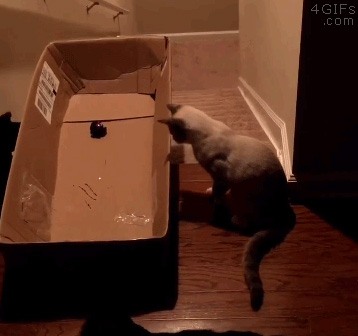
A box sliding down a ramp reaches a velocity of 27 m/s in 3 seconds from rest. Find the acceleration.
a)
30 m/s
b)
24 m/s2
c)
9 m/s2
d)
81 km/hr
62.
Alan travels 100km in 5hrs. Find his average speed in km/h
a)
5km/hr
b)
10km/hr
c)
50km/hr
d)
20km/hr
63.
Energy due to motion is ____________ energy.
a)
Potential
b)
Energy
c)
Kinetic
d)
Friction
64.

What kind of energy is in flowerpot sitting on a windowsill?
a)
Potential
b)
Kinetic
65.

What kind of energy is in a moving skateboard?
a)
Potential
b)
Kinetic
66.
A 20 kg bike accelerates at 10 m/s2. what was the force
a)
25
b)
200 N
c)
20 N
d)
10 N
67.
If a 10 kilogram object accelerates suddenly at 15 m/s^2, how much force was applied to the object?
a)
150 Newtons
b)
15 Newtons
c)
150 kilograms
d)
100 kilograms
68.
A persons walks 50 meters directly north, stops, and then travels 32 meters directly south. What is their displacement?
a)
82 meters
b)
18 meters
c)
28 meters
100 %

