wayground logo

Free Printable Worksheets

NEW

Font size

S
M
L
XL
Worksheets

Ch. 4: Atomic Structure Review

Total questions: 70

Worksheet time: 2hrs 36mins

Name
Class
Date
1.

Whose atomic model said electrons orbit the atom like planets orbit the sun (planetary model)

a)

Einstein

b)

Thomson

c)

Rutherford

d)

Dalton

2.
What are the 3 particles that make-up the atom?
a)
protons, neutrons, and isotopes
b)
neutrons, isotopes, and electrons
c)
positives, negatives, and electrons
d)
protons, neutrons, and electrons
3.
Rutherford's gold foil experiment provided evidence that...
a)
negative and positive charges are spread evenly throughout the atom.
b)
alpha particles have a positive charge.
c)
gold is not a dense as previously thought.
d)
there is a dense positively charged nucleus at the center of an atom.
4.
What does the nucleus of an atom contain?
a)
Electrons and neutrons
b)
Protons and neutrons
c)
Neutrinos and positrons
d)
DNA and RN
5.
J.J. Thompson discovered the ____________. His model is called the raisin bun/plum pudding model. 
a)
proton
b)
electron
c)
neutron
d)
nucleus
6.
Ernst Rutherford discovered that the atom is
a)
Composed of mostly empty space with negative electrons surrounding a positive nucleus
b)
A highly dense sphere of positive
c)
A highly dense sphere of a negative space
d)
Composed mostly of empty space with positive electrons surrounding a negative nucleus
7.
What is the atomic number of an element with 12 protons, 13 neutrons and 12 electrons?
a)
12
b)
13
c)
25
d)
24
8.
What are the three types of radioactivity?
a)
Sedimentary, Metamorphic, Igneous.
b)
Alpha, Beta, Gamma.
c)
Cardiac, Smooth, Skeletal. 
d)
Verbal, Situational, Dramatic.
9.
Beta particles are...
a)
negatively charged
b)
no charge
c)
back at it again with the white vans
d)
positively charged
10.
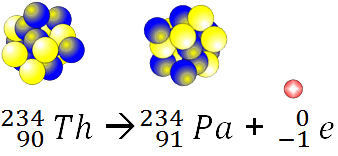
Which type of nuclear radiation is being emitted here?
a)
Alpha
b)
beta
c)
gamma 
d)
none
11.

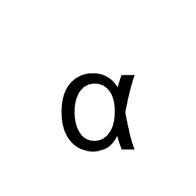
Has the symbol

a)

Alpha

b)

Beta

c)

Gamma

d)

Fish

12.
The picture above represents Rutherford’s __________ experiment.
a)
gold foil
b)
cathode ray tube
c)
oil drop
d)
physical and chemical changes
13.
This is a model of what was thought be an atom after what experiment?
a)
Cathode Ray Tube Experiment
b)
Gold Foil Experiment
c)
Plum Pudding Model
d)
Planetary Model
14.

Who first proposed the idea of matter being made of particles than could not be cut any further and named it atom

a)

Democritus

b)

Aristotle

c)

Dalton

d)

Thomson

15.
Whose atomic model is this (solid sphere with specific properties)
a)
Bohr
b)
Dalton
c)
Rutherford
d)
Thompson
16.
Whose atomic model is this
a)
Bohr
b)
Democritus
c)
Rutherford
d)
Thomson
17.
Whose atomic model is this
a)
Bohr
b)
Democritus
c)
Rutherford
d)
Thomson
18.

A proton is made up of . . .

a)

leptons

b)

quarks

c)

bosons

d)

neutrons

19.
The word "atom" means what?
a)
"indivisible"
b)
"Adam"
c)
"extremely small"
d)
"indestructible"
20.

One of Dalton's conclusions of his atomic theory was that all atoms of the same element are -

a)

Reactive

b)

different

c)

combined

d)

identical

21.
The number of protons in an atom of any element can be found on the periodic table as a (an)
a)
atomic mass
b)
atomic number
c)
atomic charge
d)
group number
22.
The number of electrons in a neutral atom of an element can be found...
a)
by subtracting the atomic number from the atomic mass.
b)
by adding the atomic number and atomic mass.
c)
by using its atomic number.
d)
by using its atomic mass
23.
The number of neutrons in any element can be found by... 
a)
using its atomic number.
b)
using its atomic mass.
c)
adding the atomic number and atomic mass.
d)
subtracting the atomic number from the mass number.
24.
Ernest Rutherford proved that the atom was mostly empty space using what very malleable element?
a)
copper
b)
gold
c)
antimony
d)
bismuth
25.
When emitted from a nucleus as radiation, a beta particle increases the atomic number by...
a)
one.
b)
two.
c)
three.
d)
four.
26.
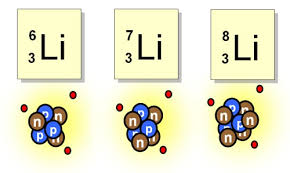
How many neutrons does the isotope of lithium have?
a)
8
b)
3
c)
4
d)
5
27.
Isotopes are atoms of the same element, but with different numbers of 
a)
Protons
b)
Neutrons
c)
Electrons
d)
Energy Levels
28.

The number in Kr-84 represents what about Krypton?

a)

The number of electrons

b)

The number of protons

c)

The mass number

d)

The Atomic Mass

29.
What is the atomic number of this atom?
a)
1
b)
3
c)
4
d)
7
30.
Most of the mass in an atom is concentrated in the...
a)
electrons
b)
nucleus
c)
protons
d)
empty space
31.

Who first had the idea of the existence of the atom?

a)

Democritus

b)

Dalton

c)

Rutherford

d)

Thompson

32.

Who first had evidence of the atom and included it in his atomic theory?

a)

Democritus

b)

Dalton

c)

Rutherford

d)

Thompson

33.
Most of the mass of an atom is found in which part of an atom?
a)
Nucleus
b)
Electron Cloud
c)
Electrons
d)
Protons
34.
Letter A on the picture is showing what?
a)
Electron
b)
Neutron
c)
Proton 
d)
Nucleus
35.
Letter C on the picture is showing what?
a)
Electron
b)
Neutron
c)
Proton 
d)
Nucleus
36.
Letter E on the picture is showing what?
a)
Electron Cloud
b)
Neutron
c)
Proton 
d)
Nucleus
37.
_______ is a positive particle
a)
Proton
b)
Neutron
c)
Electron
d)
Atom
38.
Which of the following answers correctly shows the subatomic particles that are similar in size?
a)
Electron and Proton
b)
Electron and Neutron
c)
Proton and Neutron
d)
None are similar in size
39.
A neutral atom of the isotope Mg-26 would consist of:
(hint: use your periodic table to help)
a)
12 protons, 26 neutrons, 26 electrons
b)
26 protons, 12 neutrons, 26 electrons
c)
26 protons, 14 neutrons, 14 electrons
d)
12 protons, 14 neutrons, 12 electrons
40.
Iron-60 (atomic number 26) is an isotope that is often used to study meteorites.  How many neutrons does iron-60 have?
a)
26
b)
60
c)
34
d)
86
41.
Who believed that atoms of the same element are identical to each other?
a)
Bohr
b)
Rutherford
c)
Dalton
d)
Thomson
42.
Protons and neutrons are made up of smaller particles call quarks. How many quarks were discovered?
a)
2
b)
4
c)
6
d)
8
43.
How many quarks (held together by a strong nuclear force) make up a proton?
a)
1
b)
3
c)
5
d)
7
44.
A(n) ________________ is somewhat like a shelf in a refrigerator, but unlike a shelf each has a different number of electrons it can hold. 
a)
nucleus
b)
energy level
c)
electron cloud
d)
proton
45.
Who found evidence that you can't create or destroy matter, when he found the mass of the reactants = the mass of products?
a)
Lavoisier
b)
Proust
c)
Franklin
d)
Democritus
46.
How many neutrons in C-14?
a)
6
b)
7
c)
14
d)
8
47.
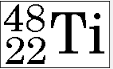
How many protons does this isotope of titanium have?
a)
48
b)
22
c)
26
d)
70
48.

How many protons does uranium-235 have?

a)

238

b)

92

c)

146

d)

143

49.
What do these isotopes of carbon all have in common?
a)
neutrons & mass number
b)
atomic number and neutrons
c)
atomic number and electrons
d)
protons, atomic number, and mass number
50.

What quantities vary between isotopes of an element?

a)

protons, electrons, and mass #

b)

protons, electrons, and atomic number

c)

neutrons and electrons

d)

neutrons and mass #

51.
which atom has  4 neutrons?
a)
Li-6
b)
Li-7
c)
Li-8
d)
they have the same # of neutrons
52.
Fluorine has an atomic number of 9. What can you conclude about an atom of fluorine from this fact?
a)
it has 9 protons
b)
it weighs 9 grams
c)
it has 9 electron shells
d)
it has a boiling point of 9 degree celsius
53.
In what part of an atom can protons be found?
a)
inside the electron
b)
inside the neutron
c)
inside the atomic nucleus
d)
inside the electron shells
54.
If a hydrogen atom has 1 proton, 1 electron, and 1 neutron, its atomic number is:
a)
1
b)
2
c)
3
d)
4
55.
On the periodic table, how is atomic mass represented?
a)
As an average of the mass of different isotopes
b)
as the exact mass of every atom
c)
as the mass of the most common isotopes
d)
As the masses of all protons added together
56.
What do carbon-12 and carbon-14 have in common?
a)
they have same number of protons
b)
they have the same number of neutrons
c)
they have the same atomic mass
d)
they have the same atomic weight
57.
How many neutrons does a Sodium 24 isotope have?
a)
12
b)
13
c)
14
d)
15
58.

Who did the oil drop experiment?

a)

Millikan

b)

Thomson

c)

Rutherford

d)

Dalton

59.

Which of the following laws would support the statement, "The mass ratio of sulfur to oxygen in every sample of sulfur trioxide is 2:3 (32:48)."

a)

law of multiple proportions

b)

law of definite proportions

c)

law of mass- energy

d)

law of thermodynamics

60.

In oxides of nitrogen, atoms combine in small whole number ratios. This evidence supports the law of

a)

mass action

b)

conservation of mass

c)

definite proportions

d)

multiple proportions

61.

Which of the following is NOT a part of Dalton's atomic theory?

a)

Atoms cannot be divided, created or destroyed.

b)

The number of protons in an atom is its atomic number.

c)

In chemical reactions, atoms are combined, separated or rearranged.

d)

All matter is composed of extremely small particles called atoms.

62.

A pure sample of ammonia contains 14 g of nitrogen and 3 grams of hydrogen. A second sample of pure ammonia contains 28 g nitrogen and 6 g of hydrogen. This is an example of the

a)

law of universal gravitation

b)

law of multiple proportions

c)

law of definite proportions

d)

law of mass action

63.

Which of the following sets of compounds illustrate the law of multiple proportions?

a)

MgO, CaO

b)

FeO, Fe2O3

c)

PbI2, PbF2

d)

CBr4, CF4

64.
Solve this equation for alpha decay.
85209At = ___ + 24He
a)
83205Bi
b)
86209Rn
c)
81207Tl
d)
85208At
65.
Balance the following equation:
146C --> 0-1e + ________
a)
145B
b)
146C
c)
147N
d)
42He
66.
Radioactive materials have unstable...
a)
electrons
b)
protons
c)
nuclei
d)
neutrons
67.

Determine the atomic number, mass number, number of protons, neutrons, and electrons for a neutral atom of potassium-39.

a)

Atomic # 19

Mass # 39

Protons 19

Neutrons 20

Electrons 19

b)

Atomic # 19

Mass # 39.098

Protons 19

Neutrons 19

Electrons 19

c)

Atomic # 39

Mass # 19

Protons 39

Neutrons 19

Electrons 39

d)

Atomic # 19

Mass # 39.098

Protons 19

Neutrons 20

Electrons 19

68.

If 75.0% of the isotopes of an element have a mass of 35.0 amu and 25.0% of the isotopes have a mass of 37.0 amu, what is the atomic mass of the element?

a)

35.0 amu

b)

36.0 amu

c)

35.5 amu

d)

37.0 amu

69.

Consider an element Z that has two naturally occurring isotopes with the following percent abundances: the isotope with a mass number of 22.0 is 65.0% abundant; the isotope with a mass number of 24.0 is 35.0% abundant. What is the average atomic mass for element Z?

a)

19.9 amu

b)

22.7 amu

c)

23 amu

d)

23.3 amu

70.

Gallium has two naturally occurring isotopes. The mass of gallium-69 is 68.9256 amu and it is 60.108% abundant. The mass of gallium-71 is 70.9247 amu and it is 39.892% abundant. Calculate the atomic mass of gallium.

a)

4958.8597 amu

b)

6972.3081 amu

c)

70.0928 amu

d)

69.7231 amu