
 Worksheets
Reaction Rates and Equilibrium
Total questions: 67
Worksheet time: 44mins
List four factors that affects the rate of a reaction
temperature
concentration
surface area
volume
catalysts
A temperature increase causes the particles ......
to slow down
move faster
collide higher
in the right order
How does a catalyst work in speeding up a reaction?
By lowering the activation energy or reaction
by giving them more energy
by making them more available

Why does a higher concentration increase the rate of reaction?
it increases the amount of reactants
it lowers the activation energy
it increases the energy of particle collisions
it increases the frequency of particle collisions

the energy difference between reactants and products
SO2 + O2 <=> SO3
If the concentration of SO2 is increased, the equilibrium position of the reaction will shift ___________.
SO2 + O2 <=> SO3
If the equilibrium position shifts to the right, the concentration of O2 will ___________.
N2 + O2 <=> 2NO
If O2 is removed, the concentration of N2 will _______.
N2 (g) + 3 H2 (g) <=> 2 NH3 (g)
If the pressure in the system is increased, which substance(s) will increase in concentration?
roll the magnesium strip into a small ball
Grind up the strip of magnesium
When we investigate the rate of reaction we are looking at the...
amount of product formed
speed of reaction
concentration of reacting particles
combining reactants with products
Place the reaction in hot water
Add more reactants
Place the reaction in a ice bath
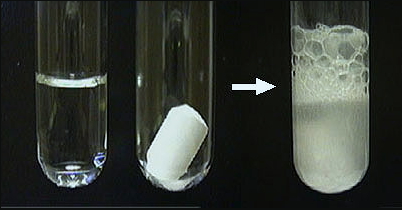
How could we make this reaction happen more quickly?
Decrease the concentration of the acid
crush the chalk to increase the surface area
Put the test tube in an ice bath
The major theory of reaction rate is called
Collision theory
Crash theory
Newton's laws
Thermodynamics
You know that a chemical reaction is occurring here because you see __________________ . (Pick 3)
purple color
smoke
ice formation
fire
a yellow precipitate
In this chemical reaction, what was the first evidence that you saw?
Production of fire
Production of light
Production of purple smoke
Production of white powder
When zinc reacted with hydrochloric acid, what was the result of this reaction?
a white powder
a blue liquid
a brown precipitate
a gas
Which of the following is evidence of a chemical reaction?
Tearing paper.
Change in color.
Production of a gas.
Change in temperature.
Production of a precipitate.
List four factors that affects the rate of a reaction
temperature
concentration
surface area
volume
catalysts
A temperature increase causes the particles ......
to slow down
move faster
collide higher
in the right order
A catalyst be regenerated or used again and again
False
True
Rank the state os matter from FASTEST to SLOWEST particle speed.
solid, liquid, gas
liquid, solid, gas
gas, liquid, solid
gas, solid, liquid
The higher the temperature a substance has the
more energy it has
less energy it has
In a solution when particles collide, most of the collisions
are successful
are unsuccessful
result in a chemical reaction
do not result in a chemical reation
What factors affect reaction rate?
size of atoms
temperature
concentration
surface area
catalysts
A log is burning in a campfire. If the concentration of oxygen reaching the log is increased, what will happen to the reaction rate?
reaction rate decreases
reaction rate increases
reaction rate remains the same
What is necessary for a chemical reaction to occur?
Correct orientation of particles when they collide
particle collisions
an increase or decrease in temperature
particle collisions with sufficient energy
a catalyst
What happens to reaction rate if surface area is decreased?
it increases
it decreases
it stays the same
What happens to reaction rate when a reactants concentration is increased?
it increases
it decreases
it remains the same
What happens to reaction rate when temperature is decreased?
it increases
it decreases
it stays the same.
What does a catalyst do to speed up a reaction?
It reduces the surface area of the reactants
It increases the surface area of the reactants.
It reduces the required energy for a chemical reaction to occur
It increases the required energy for a chemical reaction to occur
A reactants surface area is increased. What happens?
more collisions occur
the same number of collisions occur
greater collision energy
less collision energy
the same collision energy
A reactants concentration is increased. What happens?
more collisions occur
the same number of collisions occur
greater collision energy
less collision energy
the same collision energy
A reactants temperature is increased. What happens?
more collisions occur
the same number of collisions occur
greater collision energy
less collision energy
the same collision energy
The minimum quantity of energy which the reacting species must possess in order to undergo a specific reaction.
collision theory
activation energy
reaction rate
chemical reaction
the rate at which a chemical reaction takes place
activation energy
collision theory
reaction rate
chemical reactions
A substance that increases the rate of a chemical reaction without itself undergoing any permanent chemical change.
catalyst
products
reactants
chemical reaction
A substance that takes part in and undergoes change during a reaction.
products
reactants
catalyst
collision
A substance that is formed as the result of a chemical reaction.
products
reactants
catalyst
collision
Describes the 3 reasons chemical reactions occur.
collision theory
reaction rate
chemical reaction
activation energy
A process that involves rearrangement of the molecular or ionic structure of a substance, as opposed to a change in physical form or a nuclear reaction.
collision theory
reaction rate
chemical reaction
activation energy
Which of the following is NOT true at equilibrium?
The forward and reverse reactions proceed at the same rate.
The amount (concentration) of reactants and products do not change.
The amount (concentration) of the reactants is equal to the concentration of the products.
The forward and reverse reactions continue to occur.
During equilibrium, the rates of the forward and the reverse reaction are ________
equal
unequal
unequal for exothermic reactions
unequal for endothermic reactions

Around what time does the reaction reach equilibrium?
25 min
70 min
45 min
80 min


