
 Worksheets
Quarter 2 Review
Total questions: 38
Worksheet time: 46mins
Name
Class
Date
1.
What are the main components of DNA?
a)
Nitrogen bases, phosphates, and deoxyribose sugars.
b)
Nitrogen bases, salts, and deoxyribose sugars.
c)
Deoxyribose sugars, phosphates, and carbon bases.
d)
Thymine, deoxyribose sugars, and carbon bases.
2.
Human cells have how many chromosomes?
a)
12
b)
48
c)
23
d)
46
3.
How many parents are required for asexual reproduction?
a)
one
b)
two
c)
six
d)
four
4.
Organisms that reproduce asexually generally have offspring that are
a)
unicellular.
b)
multicellular.
c)
genetically varied.
d)
genetically identical.
5.

In the system shown, there are 80 particles, all in region A (the left half of the box). No extra particles can enter the system. When the system is in equilibrium, what will be true of the particles?
a)
Since there are no y particles, the system is already in equilibrium.
b)
Due to the constant motion of particles, there will never be equilibrium.
c)
In equilibrium there will be exactly 40 x particles in A and 40 x particles in B and those numbers will remain constant.
d)
In equilibrium, there will be approximately 40 x particles in A and 40 x particles in B, and those numbers will fluctuate but will remain near 40.
6.
Fred is a playful poodle with long, curly black fur. He enjoys fetching balls and sleeping on his soft bed. His owner took him to the groomers for a nail trim and hair cut. Which characteristic could be inherited by Fred's puppies?
a)
Trimmed Nails
b)
Pom pom haircut
c)
Curly fur
d)
Sleeping on a soft bed
7.
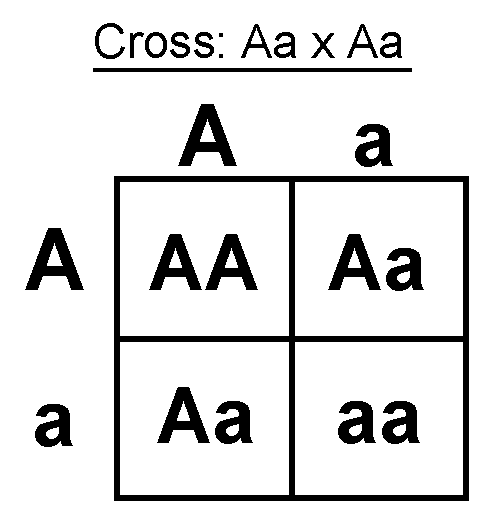
What is the phenotype of the offspring? (A-Brown hair; a-blond hair)
a)
50 % Brown Hair and 50% Blond Hair
b)
25 % Brown Hair and 75% Blond Hair
c)
75 % Brown Hair and 25% Blond Hair
d)
0% Brown Hair and 100% Blond Hair
8.

B = brown fur b = white fur
In the Punnett square, what is the probability for white fur?
In the Punnett square, what is the probability for white fur?
a)
0%
b)
25%
c)
50%
d)
75%
9.

The image you see is a mammoth. Which trait most suggests that the mammoth was adapted to live in a cold climate?
a)
Its thick, furry coat
b)
Its long, flexible trunk
c)
Its sharp, curved tusks
d)
Its broad, powerful body
10.
If a portion of Strand I of DNA has the base sequence GATCAC, what is the sequence of bases on the complementary Strand II?
a)
GATCAC
b)
CUAGUG
c)
CTACAC
d)
CTAGTG
11.
Which statement best describes a chromosome?
a)
It is a gene that has thousands of different forms.
b)
It has genetic information contained in DNA.
c)
It is a reproductive cell that influences more than one trait.
d)
It contains hundreds of genetically indentical DNA molecules.
12.
What scientific technique allows the insertion of a gene from one organism into another?
a)
genetic recombination
b)
genetic replication
c)
cloning
d)
genetic engineering
13.

What does this image show?
a)
Double Helical Structure of DNA
b)
Triple Helical Structure of DNA
c)
I don't know, is that a Rorschach test?
d)
The image is inconclusive
14.
Which two molecules forms the sides (backbone) of the DNA ladder?
a)
deoxyribose and adenine
b)
deoxyribose and a hydrogen bond
c)
sugar and the nucleus
d)
deoxyribose (sugar) and phosphate
15.

Name this structure
a)
double helix
b)
nucelotide
c)
twisted ladder
d)
hydrogen bond
16.
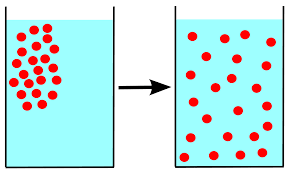
The picture below is an example of _________________.
a)
osmosis
b)
isotonic
c)
diffusion
d)
active transport
17.
Osmosis is the movement of _____ across a membrane.
a)
food
b)
sugar
c)
oxygen
d)
water
18.

Equilibrium?
a)
a large amount of substance on side of the cell and a small amount on the other side
b)
a small amount of substance on side of the cell and a large amount on the otherside
c)
equal amount of substance on either side of the membrane
d)
no particles on either side of the a cell membrane
19.

_______ regulates what enters and leaves a cell.
a)
Cell Membrane
b)
Nucleus
c)
Mitochondria
d)
Cytoplasm
20.

Two black-fur mice are bred, and have the litter shown below. What is the most likely explanation for the presence of the white-fur offspring?
a)
One of the parents is heterozygous.
b)
Both of the parents are heterozygous.
c)
A mutation occurred.
d)
The parents' fur color has no influence on the offspring's fur color.
21.
Adenine bonds with ______________.
a)
Guanine
b)
Thymine
c)
Cytosine
d)
Adenine
22.
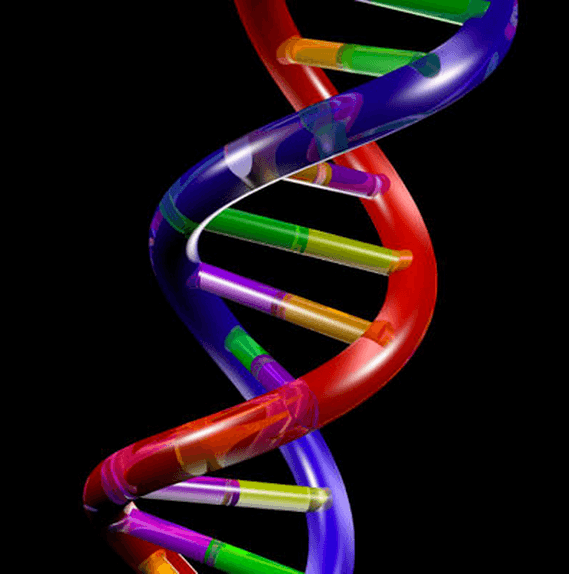
What determines the code, or information, of a DNA molecule?
a)
The shape (structure) of the nitrogen bases
b)
The order (sequence) of the nitrogen bases
c)
The color of the nitrogen bases
d)
The frequency (number) of nitrogen bases
23.
Which organelle is DNA usually found in?
a)
cell membrane
b)
vacuole
c)
chloroplast
d)
nucleus
24.
A process in which DNA has the unique ability to make an exact copy of itself.
a)
Replication
b)
Translation
c)
Transcription
25.
Who were the first guys to build a model of a DNA molecule?
a)
Larry, Moe, and Curley Joe
b)
Watson and Crick
c)
Watson and Holmes
d)
Superman and Batman
26.
Which of the following is NOT an example of natural selection?
a)
People selectively breeding hamsters.
b)
Insect populations developing resistance to certain pesticides.
c)
Bacteria becoming resistant to antibiotics.
d)
Male birds of certain species developing colorful feathers to attract female mates.
27.
What is the advantage of having different shaped beaks?
a)
To look different from other species.
b)
To be able to eat the food readily available in the environment.
c)
To protect itself against predators.
d)
To protect itself against prey.
28.
Remains of ancient organisms are called
a)
Extinctions
b)
Fossils
c)
Mutations
d)
Variations
29.
How did Rosalind Franklin's photo 51 affect the work of Watson and Crick?
a)
It was used to determine the physical structure of DNA
b)
It was used to identify the four bases that make up DNA
c)
It was used to determine the theory of independent assortment
d)
It was used to show DNA was the molecule of inheritance
30.

DNA codes for...
a)
cholesterol
b)
proteins
c)
fatty acids
d)
a sandwich
31.
What hereditary material controls all of the cell's activities?
a)
Chloroplast
b)
Cytoplasm
c)
DNA
d)
ATP
32.

Which section of the shown figure carries the code for a particular trait in an organism?
a)
W
b)
X
c)
Y
d)
Z
33.

This is a diagram of how equine feet have changed over millions of years. What is this gradual change over time called?
a)
Artificial selection
b)
Evolution
c)
Darwinism
d)
Eugene
34.
Mrs. Tucker sprayed Febreze at the back of the classroom and, after a few minutes, everyone at the front noticed the smell. What happened?
a)
Diffusion
b)
Active transport
c)
Osmosis
d)
Wind
35.
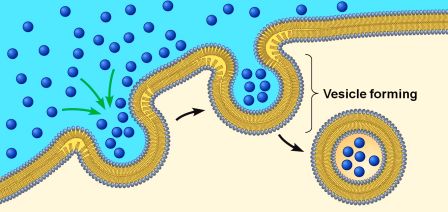
Which form of active transport is being shown?
a)
Facilitated Diffusion
b)
Exocytosis
c)
Endocytosis
d)
Protein Pumps
36.

The process shown requires energy to move substances into and out of the cell. What is it?
a)
Active transport
b)
Osmosis
c)
Diffusion
d)
Respiration
37.

In which type of rocks do we usually find fossils?
a)
Metamorphic
b)
Sedimentary
c)
Igneous
d)
Organic
38.

The dark colored peppered moth is an example of a beneficial mutation. Why did dark colored peppered moths flourish during the industrial revolution when there was more pollution in the air?
a)
Dark moths cannot be seen as easily by predators as light colored moths.
b)
Dark moths are resistant to pollution.
c)
Dark moths can be seen easier by predators.
d)
Light moths hid in the dark pollution.
100 %

