wayground logo

Free Printable Worksheets

NEW

Font size

S
M
L
XL
Worksheets

Economic and Population Geography

Total questions: 50

Worksheet time: 33mins

Name
Class
Date
1.

Which factor is most responsible for increasing life expectancy in many less industrialized nations?

a)

Declining birth rates

b)

Availability of health insurance

c)

Access to primary education

d)

Improved healthcare programs

2.

A factor that draws or attracts people to another location

a)

push factor

b)

pull factor

3.
Which of the following is NOT an example of tertiary economic activity
a)
Tourism & Hotels
b)
Banking
c)
Transportation
d)
Fishing
4.
The total value of all goods and services produced in a country in a given year. 
a)
Gross Domestic Product
b)
Economic System
c)
Free Enterprise Economy 
d)
Democracy
5.
Average number of people living on one square mile
a)
Population Movement 
b)
Population Distribution 
c)
Population Density 
d)
Population Growth 
6.
Jaylynn has opened a restaurant serving strawberry desserts. Tien and Marcela are security guards at the restaurant. What business sector are they all apart of?
a)
Tertiary
b)
Primary
c)
Secondary
7.

What is life expectancy?

a)

The number of years needed for one to reach 60 years.

b)

The average number of years that people are expected to live in a country.

c)

The difference between the mortality rate and the death rate of a country

d)

What one expects to face in life.

8.

Which factor is most directly related to the level of economic development of a country?

a)

High urban population/ Urbanization

b)

Fertility rate

c)

Mortality rate

d)

Religious diversity

9.
What is literacy rate?
a)
The percentage of people with at least a 4 year college degree
b)
the percentage of people in a country that can read and write.
c)
It measures how well off people in a country are. 
d)
the average number of years a person in a country is expected to live. 
10.
Today, many people from Syria and Iraq are attempting to migrate to Europe. When settled in Europe, they'll be appropriately regarded as 
a)
Emigrants
b)
Immigrants
c)
Gypsies
d)
Missionaries
11.
How would high fertility rates and low life expectancy affect a nation's population?
a)
GDP per capita would slightly decrease
b)
Literacy rate would increase
c)
Average age of population would be high
d)
Average age of population would be low
12.
Mr. Johnson left Jamaica to live in the U.S., therefore he is an  ______________ of Jamaica.
a)
emigrant
b)
resident
c)
immigrant
d)
citizen
13.
The skills, level of education, and managerial capabilities are directly related to what type of resource?
a)
Renewable
b)
Human
c)
Capital
d)
Non-renewable
14.
Steve wants to leave rural Nebraska and go to live in Miami, Florida with his cousin, though he dislikes the warm weather and the big city feel, but even more, Steve is tired of being bullied in his neighborhood. 
a)
There are many things that attracts Steve to Miami
b)
Steve feels pushed to leave his home
c)
Steve doesn't like the rural area.
d)
Steve's cousin hates the thought of living in Nebraska
15.
Which of these is NOT a push factor
a)
Overpopulation
b)
Religious Persecution
c)
Lack of job opportunities
d)
Arable Land (land good for farming)
16.
Imperialism is a --
a)
policy of extending control or authority over foreign countries for it's own benefit
b)
policy of trading between countries so that both countries benefit 
c)
policy of interdependence between countries so that ideas can be shared
d)
trade policy between countries; generally one country limits trading and inequities occur
17.
Which level of economic activity matches with the activity displayed in the image?
a)
Primary
b)
Secondary
c)
Tertiary
d)
Quaternary
18.

World population distribution is highly uneven in which population density is higher on the coasts than the interior. One main reason for this pattern is due to

a)

access to trade routes and travel

b)

access to fishing

c)

access to fresh water sources

d)

the oceans act as a natural barrier

19.

Which statement best explains why nations must trade?

a)

All nations belong to free trade agreements

b)

All nations seek out new production methods

c)

No nation has all necessary resources

d)

No nation can employ all of its laborers

20.

Which is a resource that allows nations to develop a high per-capita Gross Domestic Product (GDP)?

a)

State-owned farms

b)

Humanitarian aid

c)

Skilled workforce

d)

Governmental restrictions

21.
A ___ engages in tertiary economic activity.  
a)
carpenter 
b)
lumberjack 
c)
orange grower 
d)
police officer  
22.

A country with a mostly rural population engaged in mainly primary economic activities is probably a

a)

developing nation.

b)

developed nation.

c)

industrialized nation.

d)

primary nation.

23.
The ___ level of economic activity is represented in this photograph. 
a)
Tertiary
b)
Primary
c)
Quaternary
d)
Secondary
24.

What is the word for the number of people who can read and write in a country

a)

income

b)

literacy rate

c)

life expectancy

d)

free enterprise

25.
This type of economy depends on supply and demand and consumers freely choose what buy and sell. 
a)
Mixed Economy
b)
Market Economy
c)
Command Economy
d)
Traditional Economy
26.
What type of economy do most countries in the world have?
a)
Market economy
b)
Command economy
c)
Traditional economy
d)
Mixed economy
27.
This population pyramid demonstrates a country that is most likely...
a)
developed 
b)
developing
c)
in transition 
d)
highly developed 
28.
This population pyramid demonstrates a country that is 
a)
developed
b)
developing
c)
in transition
d)
least developed 
29.
If Country A has a low growth rate, high literacy rate, and largely tertiary level economic activity, then it is 
a)
developing 
b)
in transition
c)
developed
d)
in North Africa 
30.
Which of the following is NOT infrastructure?
a)
communications and transportation
b)
entrepreneurial abilities
c)
power, water, and sanitation
d)
schools and colleges 
31.
Which economic activity deals with natural resources such as fishing, farming, or hunting?
a)
Primary Economic Activity
b)
Secondary Economic Activity
c)
Tertiary Economic Activity
32.
A tax placed on imports
a)
Tax
b)
Tea
c)
Tariff
d)
Fee
33.
Which of the following trade barriers is a block or restriction on trade with another country.
a)
Tariff
b)
Embargo
c)
Quota
34.

Is it a developed nation or developing nation? Country has a high GDP Per Capita

a)

Developed Nation

b)

Developing Nation

35.

Is it a developed nation or developing nation? Country has a Low Life Expectancy Rate

a)

Developed Nation

b)

Developing Nation

36.

Is it a developed nation or developing nation? Country has a High Infant Mortality Rate

a)

Developed Nation

b)

Developing Nation

37.

Is it a developed nation or developing nation? Country has a Low Rate of Urban Living

a)

Developed Nation

b)

Developing Nation

38.

In general, any movement of individuals or populations from one location to permanently settle into another.

a)

Demography

b)

Migration

c)

Urbanization

d)

Survivorship

39.
The act of leaving one's native country for another country.
a)
Urbanization
b)
Internal Migration
c)
Emigration
d)
Immigration
40.
Forces that drive people to leave a country
a)
Pull Factors
b)
Push Factors
c)
Gross Domestic Products
d)
Death Rates
41.
The act of coming to a new country
a)
Emigration
b)
Immigration
c)
Urbanization
d)
Internal Migration
42.
If my government is selling me bread for $5 a loaf, and I have no choice but to buy that type of bread, I live in a _____ economy. 
a)
Traditional 
b)
Market 
c)
Command 
d)
Mixed
43.
What are the four types of economic activities?
a)
primary, secondary, tertiary, quaternary
b)
primary, locus, tert, secondary
c)
quaternary, primal, opid, tertiary
d)
None of the above
44.
Even if a country has equal birthrates and death rates it can still experience
population growth due to
a)
Migration 
b)
Doubling Time 
c)
Long life expectancy 
d)
High standard of living 
45.
The transition from rural areas to cities.
a)
Urbanization 
b)
Industrialization 
c)
Social Organization 
d)
Assimilation 
46.

Rate of deaths per thousand people of the population

a)

Mortality Rate

b)

Fertility Rate

c)

Longevity Rate

d)

Life Expectancy

47.
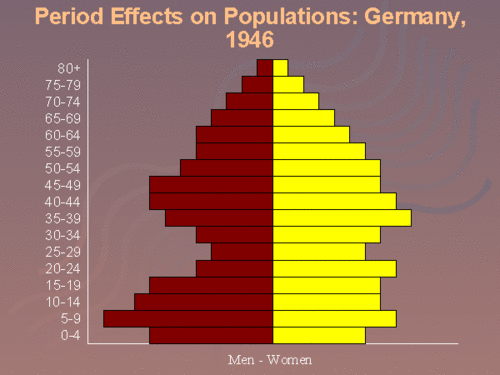
A population pyramid with a small number of males ages 20-40 years old might reflect which recent event?
a)
major disease epidemic
b)
extended war
c)
economic recession
d)
increased birth rate
48.
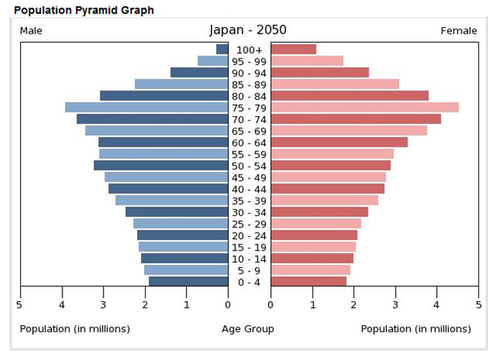
What public need does this population pyramid indicates for the future of the country?
a)
investment in healthcare for the elderly
b)
economic expansion due to a large number of young workers
c)
new schools needed for young people
49.

The scientific study of populations into categories such as race, ethnicity, age, gender, income levels, religion, etc.

a)

Demography

b)

Population studies

c)

Geography

d)

Ecology

50.

The basic facilities of a country or region, such as roads, bridges, and sewers.

a)

Age Structure

b)

Demographic Transition

c)

Migration

d)

Infrastructure