
 Worksheets
Earth Science SOL Comprehensive Review
Total questions: 50
Worksheet time: 43mins
Name
Class
Date
1.
This area of science creates and uses maps of physical features of the Earth.
a)
Geology
b)
Geography
c)
Cartography
d)
Mapology
2.
Frank has an eraser. It has a mass of 4g, and a volume of 2cm3. What is its density?
a)
8 g/cm3
b)
2 g/cm3
c)
1/2 g/cm3
d)
24 g/cm3
3.

What is the dependent variable?
a)
Amount of each trash
b)
Type of trash
c)
Where the trash is located
d)
When the trash was picked up
4.
Late stage in the life cycle of a comparatively low-mass main sequence star; formed when its core depletes its helium and its outer layers escape into space, leaving behind a hot, dense core.
a)
Nebula
b)
Main Sequence
c)
White Dwarf
d)
Supernova
5.
Which hierarchy is correct, from largest to smallest?
a)
universe, solar system, galaxy, planet, star
b)
universe, star, planet, solar system, galaxy
c)
galaxy, universe, solar system, planet, star
d)
universe, galaxy, solar system, star, planet
6.
How long does it take the earth to make 1 revolution
a)
One year
b)
One day
c)
One hour
d)
One minute
7.
the process that provides the sun with its energy
a)
solar flare
b)
Photosphere
c)
radiative zone
d)
nuclear fusion
8.

Who was the first man to walk on the moon?
a)
Neil Armstrong
b)
Buzz Aldrin
c)
Yuri Gagarin
d)
John Glenn
9.
Tides are caused by ___________
a)
wind
b)
gravitational pull of moon
c)
waves gravitation toward land
d)
rain
10.

Which of the following choices has the moon phases in the correct order?
a)
Full moon, new moon, waxing gibbous, first quarter, waxing crescent, waning gibbous, waning cresent, last quarter
b)
waxing gibbous, new moon, first quarter, waxing crescent, full moon, waning crescent, third/last quarter, waning gibbous
c)
New Moon, Waxing Crescent, First Quarter, Waxing Gibbous, Full Moon, Waning Gibbous, Third/last quarter, Waning Crescent
d)
New Moon, Waning Crescent, First Quarter, Waning Gibbous, Full Moon, Waxing Gibbous, Third/Last Quarter, Waxing Cresecent
11.
The bold lines that appear on the map every 5th contour line with the exact elevation written on it is the ______________________
a)
Index Contour line
b)
Contour interval
c)
Relief
d)
Slope
12.

Find the contour interval:
a)
5 ft
b)
10 ft
c)
20 ft
d)
25 ft
13.
Which province is known for its karst topography?
a)
Piedmont
b)
Coastal Plain
c)
Valley & Ridge
d)
Blue Ridge
14.

About 97% of the water on Earth is ___________________.
a)
fresh water
b)
groundwater
c)
salt water
d)
ice
15.

When fertilizers run off farmland into streams and ponds, the nitrogen content of the water increases. This can lead to rapid growth of algae in a process called eutrophication. How can this process affect other organisms in the water?
a)
Oxygen is used up as algae is decomposed, reducing the amount available to other organisms.
b)
The water becomes better able to support aerobic organisms.
c)
The algae provide food for fishes and other organisms, leading to decreased algae populations.
d)
The extra nitrogen provides additional food for the other organisms, increasing their population.
16.
What type of boundary creates a new seafloor?
a)
convergent continental to continental
b)
convergent ocean to continental
c)
convergent ocean to ocean
d)
divergent
17.
The order of the planets is:
a)
Mars,Venus,Earth,
Mercury,Saturn
Jupiter, Uranus, Neptune
Mercury,Saturn
Jupiter, Uranus, Neptune
b)
Earth,Venus,Mars
Jupiter, Neptune,
Mercury,Saturn,
Uranus
Jupiter, Neptune,
Mercury,Saturn,
Uranus
c)
Mercury,Venus,Earth
Mars,Jupiter,
Saturn,Uranus
Neptune
Mars,Jupiter,
Saturn,Uranus
Neptune
18.

What landform can you see in the picture?
a)
Floodplain
b)
Delta
c)
Waterfall
d)
Oxbow lake
19.

This famous transform fault is located in the western United States creates significant earthquake activity for California
a)
New Madrid
b)
Denali Fault
c)
Ramapo Seismic Zone
d)
San Andreas
20.
An instrument that detects and measures earthquakes is a
a)
seismogram
b)
focus seismic map
c)
focus
d)
seismograph
21.
How old is the Earth?
a)
4.5 billion years old
b)
2 billion years old
c)
1.9 billion years old
d)
5.9 billion years old
22.

Could the Trilobite be considered an index fossil in this diagram?
a)
Yes
b)
No
23.

Which city has partly cloudy skies?
a)
Boise
b)
New York
c)
Atlanta
d)
Dallas
24.
What is the flat land located on either side of the mid-ocean ridge?
a)
continental slope
b)
continental shelf
c)
abyssal plain
d)
ocean basin
25.

This region has sandy, flat land?
a)
Valley and Ridge
b)
Piedmont
c)
Coastal Plain
d)
Appalachian Plateau
26.

The ozone layer protects us from
a)
UV rays
b)
CFCs
c)
Increased atmospheric heat
d)
Decreased atmospheric heat
27.
Which of the following is a renewable resource?
a)
Oil
b)
Gems
c)
Plants
d)
Metals
28.

A mineral breaks into pieces like are shown in the picture. How would you describe its breakage?
a)
Fracture
b)
Cleavage
c)
Glassy
d)
Waxy
29.

Which indicator would not be good as the only indicator when identifying a mineral?
a)
Color
b)
Breaking Pattern
c)
Specific Gravity
d)
Hardness
30.

Which city is located at 38 degrees north and 120 degrees west?
a)
San Fransisco
b)
New York
c)
New Orleans
d)
London
31.
The cycle of the moon lasts about a _.
a)
day
b)
year
c)
week
d)
month
32.

Scientists think that convection currents that move the plates flow in Earth's
a)
Continental crust
b)
Oceanic crust
c)
Mantle/Asthenosphere
d)
Lithosphere
33.
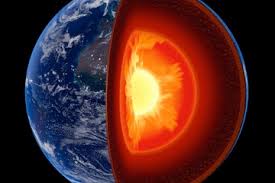
As you travel from the INNER CORE to the CRUST, how would temperature, pressure and density of the material change?
a)
The would all increase
b)
The would all decrease.
c)
They would stay the same.
d)
Temperature would decrease, but pressure and density would increase.
34.
What are the cone-shaped dripstone deposits that are on the floor of caves?
a)
icicles
b)
rocksicles
c)
stalactites
d)
stalagmites
35.
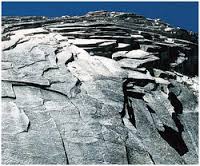
What is mechanical weathering?
a)
Process through which rocks are physically broken into smaller pieces.
b)
Rocks are broken down through chemical changes.
c)
Rocks are worn away from acid in plant roots.
d)
Rocks broken down by machinery.
36.
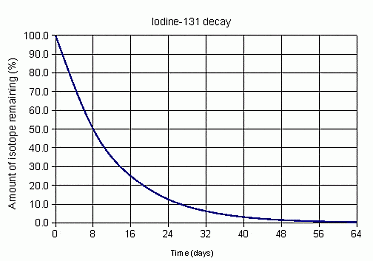
What is the half-life of iodine-131?
a)
32 days
b)
8 days
c)
16 days
d)
24 days
37.
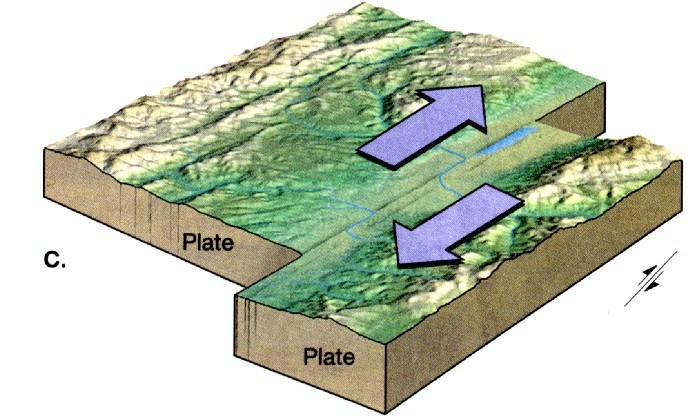
What type of plate boundary is this?
a)
Transform
b)
Convergent
c)
Divergent
d)
Plate
38.

Which geographic region of Virginia has the least impact on the water quality of the Chesapeake Bay?
a)
Coastal Plain
b)
Piedmont
c)
Blue Ridge Mountains
d)
Appalachian Plateau
39.
The sun and all of the planets and other bodies that travel around it make up our...
a)
Galaxy
b)
Solar System
c)
Cluster
d)
Constellation
40.

What color are the hottest stars?
a)
red
b)
yellow
c)
orange
d)
blue
41.

This rock is made from tiny pieces of other rocks that settled to the bottom of a valley millions of years ago. What type of rock is this?
a)
Sedimentary
b)
Igneous
c)
Metamorphic
42.
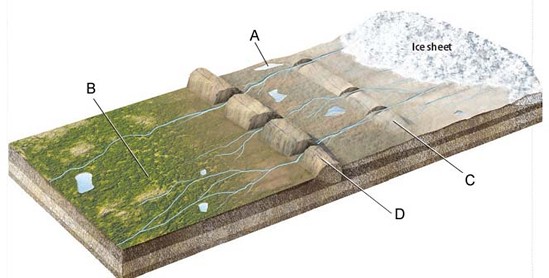
What glacial features are indicated by the labels C and D on the figure?
a)
moraines
b)
outwash plains
c)
kettle lakes
d)
ice sheets
43.

These rocks were broken apart from the continuous freeze/thaw of water in the cracks of the rocks. This is an example of:
a)
ice wedging
b)
acid rain
c)
permeability
d)
abrasion
44.
What are the four gas giant planets?
a)
Jupiter, Saturn, Uranus, and Neptune
b)
Jupiter, Mercury, Venus, and Earth
c)
Saturn, Neptune, Mars, and Mercury
d)
Earth, Uranus, Pluto, and Mars
45.
Layer of Earth's atmosphere that contains most of the ozone
a)
thermosphere
b)
mesosphere
c)
stratosphere
d)
troposphere
46.

Which pie graph correctly shows the percentage of elements by volume in Earth's troposphere?
a)
1
b)
2
c)
3
d)
4
47.

Name this landform.
a)
delta
b)
canyon
c)
sand dune
d)
cave
48.

Stalactites are formed from minerals being dropped in one place over many years. What processes formed stalactites?
a)
weathering
b)
erosion
c)
deposition
49.

Which two regions of Virginia are divided by the fall line?
a)
Appalachian Plateau and Blue Ridge
b)
Piedmont and Blue Ridge
c)
Blue Ridge and Piedmont
d)
Coastal Plain and Piedmont
50.

How would you classify granite?
a)
intrusive
b)
extrusive
c)
clastic
d)
foliated
100 %

