
 Worksheets
Physical Science, First Semester Exam 2018
Total questions: 75
Worksheet time: 1hrs 8mins
Name
Class
Date
1.
The amount of matter in an object is a measure of the object's ________________.
a)
volume
b)
density
c)
mass
d)
solubility
2.
Which of the following units provides the best measure for the amount of space that matter occupies?
a)
mL
b)
grams
c)
cm3
d)
Both mL and cm3
3.

What is the volume of the rock? The water level is displaced from 20 mL to 23 mL with the rock.
a)
3 mL
b)
23 mL
c)
20 mL
d)
43 mL
4.
What would be the best way to measure the volume of a small rock?
a)
L x W x H with a ruler
b)
Put on triple beam balance
c)
Mass ÷ Volume
d)
Displacement method using graduated cylinder
5.
Which of the following is not a characteristic property of matter?
a)
Density
b)
Mass
c)
Phase/State
d)
Solubility
6.
What is the formula for calculating density?
a)
Mass ∗ Volume
b)
Volume ∗ Mass
c)
Mass ÷ Volume
d)
Volume ÷ Mass
7.
If you had a sealed bottle of water, how would the mass of the water bottle change after a 5 day period?
a)
Mass would increase.
b)
Mass would stay the same.
c)
Mass would decrease.
d)
None of the above.
8.

Which statement is true?
a)
Oil is the most dense substance.
b)
Corn syrup is less dense than water.
c)
Oil is less dense than water.
d)
Oil and corn syrup have the same density but different masses.
9.
What is the most dense metal?
a)
Aluminum
2.7 g/cm3
2.7 g/cm3
b)
Steel
7.14 g/cm3
7.14 g/cm3
c)
Nylon
1.2 g/cm3
1.2 g/cm3
d)
Copper
8.14 g/cm3
8.14 g/cm3
10.
In which state does matter completely fill its closed container?
a)
Gas
b)
Liquid
c)
Solid
d)
Ice
11.
Which state of matter has a fixed shape and volume and it's molecules move very slowly?
a)
Liquid
b)
Gas
c)
Solid
d)
Plasma
12.
The boiling point of water is ______________.
a)
0° C
b)
50° C
c)
200° C
d)
100° C
13.
The volume of water in a beaker was 215 mL. After 5 days, the volume of the water was 200 mL. What best explains the change in volume?
a)
Some of the water absorbed the air.
b)
Some of the water evaporated and escaped into the air as water vapor.
c)
Some of the water disappeared.
d)
Some of the water was released due to condensation.
14.
When a gas turns into a liquid, it is called ___________________.
a)
Condensation
b)
Evaporation
c)
Melting
d)
Freezing
15.
The boiling point of water is ______________.
a)
0° C
b)
50° C
c)
200° C
d)
100° C
16.
The volume of water in a beaker was 215 mL. After 5 days, the volume of the water was 200 mL. What best explains the change in volume?
a)
Some of the water absorbed the air.
b)
Some of the water evaporated and escaped into the air as water vapor.
c)
Some of the water disappeared.
d)
Some of the water was released due to condensation.
17.
When a gas turns into a liquid, it is called ___________________.
a)
Condensation
b)
Evaporation
c)
Melting
d)
Freezing
18.
5 grams of salt was mixed with 50 mL of water to form a solution. In the solution, the water was which of the following?
a)
Solvent
b)
Saturate
c)
Solute
d)
Transparent
19.
Boiling
a)
liquid to gas
b)
gas to solid
c)
gas to liquid
d)
solid to liquid
20.
Particles (molecules) in a ______________________ have more energy than the other states of matter.
a)
gas
b)
solid
c)
liquid
21.
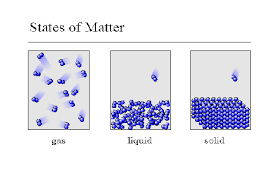
At higher temperatures
a)
particles in an object have less energy
b)
particles in an object move faster
c)
a gas contracts
22.
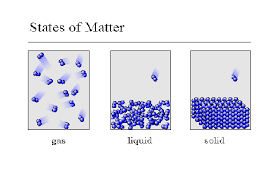
A gas
a)
has a definite shape but no definite volume
b)
has a definite volume but no definite shape
c)
has fast-moving particles
23.
Freezing
a)
Solid to gas
b)
Liquid to solid
c)
Gas to solid
d)
Liquid to gas
24.
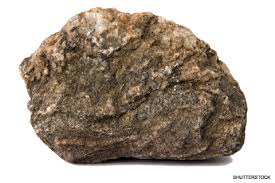
Which state of matter has tightly packed molecules?
a)
solid
b)
liquid
c)
gas
25.
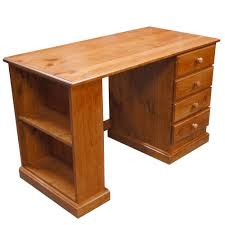
Which state of matter has a definite shape?
a)
solid
b)
liquid
c)
gas
26.
What is happening when my ice cream changes from a solid to a liquid?
a)
freezing
b)
melting
c)
burning
d)
evaporation
27.
Define a liquid.
a)
Indefinite shape, indefinite volume
b)
Definite shape, definite volume
c)
Found in stars
d)
Definite volume, indefinite shape
28.
The state of matter that has no definite size or shape is
a)
Solid
b)
Liquid
c)
Gas
29.
Particles of a liquid
a)
are tightly packed together and stay in a fixed position.
b)
have no viscosity.
c)
decrease in volume with increasing temperature.
d)
are free to move around one another but still touch.
30.
What term describes a solid changing to a gas?
a)
Deposition
b)
Sublimation
c)
Evaporation
d)
Freezing
31.
Particles (molecules) in a ______________________ have more energy than the other states of matter.
a)
gas
b)
solid
c)
liquid
32.
What is condensation?
a)
gas to solid
b)
gas to liquid
c)
liquid to solid
d)
solid to liquid
33.
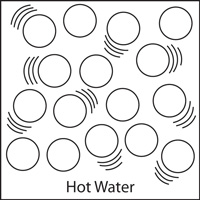
The speed of the molecules determines the _____.
a)
volume
b)
density
c)
pressure
d)
temperature
34.
The slower the particles in a substance move,
a)
the colder it is.
b)
the warmer it is.
c)
the more energy it has.
d)
the less energy it has.
35.
Thermal energy is...
a)
heat energy.
b)
the energy of motion
c)
energy of nuclear processes.
d)
an indication of physical change.
36.
A chemical change
a)
doesn't really change much.
b)
creates a new substance
c)
is a change in the state of matter
37.
A physical change is...
a)
a change that doesn't change the identity
b)
a change that makes something new.
c)
a chemical reaction
38.

The mass of one proton is equal to the mass of one...
a)
neutron
b)
electron
39.

The mass of one proton is greater than the mass of one...
a)
neutron
b)
electron
40.

The mass of about 1,836 electrons is equal to the mass of one...
a)
proton
b)
neutron
c)
a proton or a neutron
d)
neither a proton nor a neutron
41.
All of the mass of an atom comes from what location?
a)
nucleus
b)
electron cloud
42.
The two subatomic particles that make up the mass of the atom are the _____ and the _____.
a)
proton, neutron
b)
proton, electron
c)
neutron, electron
d)
electron, energy levels
43.
What subatomic particle has no effect on the mass of the atom?
a)
proton
b)
neutron
c)
electron
44.
An atom of an element contains 20 protons. What is the identity of the element? (NOTE: you will need to use your Periodic Table)
a)
Neon
b)
Calcium
c)
Potassium
d)
Argon
45.

What is the atomic mass of the atom pictured?
a)
9
b)
10
c)
18
d)
19
46.
What is the atomic number of the atom pictured?
a)
9
b)
10
c)
18
d)
19
47.
What is the element name of the atom pictured?
a)
Fluorine
b)
Neon
c)
Argon
d)
Potassium
48.

What is the element name of the atom pictured?
a)
Sodium
b)
Magnesium
c)
Titanium
d)
Vanadium
49.

How many neutron are in the atom of Potassium?
a)
7
b)
2
c)
39
d)
20
50.

How many neutrons are in an atom of Beryllium?
a)
4
b)
9
c)
9.01
d)
5
51.

How many electrons are in an atom of Lithium?
a)
3
b)
6
c)
7
d)
6.941
52.

How many protons does an atom of Nitrogen have?
a)
14
b)
7
c)
15
d)
18
53.
All matter is made of
a)
energy
b)
atoms
c)
air
d)
chemistry
54.
The _________ of an element equals the number of protons in an atom of that element.
a)
mass number
b)
neutrons
c)
atomic number
d)
isotopes
55.

How many protons does an Aluminum atom have? (use the picture to help you)
a)
27
b)
13
c)
14
d)
40
56.
Particles in an atom that are neutral and have no charge are
a)
negatrons
b)
electrons
c)
neutrons
d)
protons
57.
True or False? Neutrons have a negative charge
a)
True
b)
False
58.
What is the atomic number for an element with three protons?
a)
2
b)
1
c)
3
d)
6
59.
A particle that moves around the nucleus is a(n)...
a)
Proton
b)
Neutron
c)
Electron
d)
Quark
60.
Which of the following best describes the properties of metals?
a)
hard, brittle, and nonconductive
b)
liquid, dark, and conductive
c)
shiny, malleable, and conductive
d)
soft, oily, and very reactive
61.
How are the elements in the periodic table arranged?
a)
by their atomic mass
b)
by their chemical symbol
c)
by their chemical name
d)
by their atomic number
62.
_______ are horizontal rows of elements that contain increasing numbers of protons and electrons.
a)
groups
b)
periods
63.

The yellow atoms are called
a)
metals
b)
nonmetals
c)
metalloids
d)
noble gases
64.

The atoms along the staircase are called
a)
metals
b)
nonmetals
c)
metalloids
d)
noble gases
65.
Elements on the right side of the of the zigzag line are normally?
a)
non metals
b)
metals
c)
metalloids
d)
rare earth metals
66.
The elements in this group have 5 valence electrons and include elements N, P, and As.
a)
Group 5
b)
Group 1
c)
Group 18
d)
Group 15
67.
Which of the following is not a property of metals?
a)
brittle
b)
malleable
c)
lustrous
d)
conductive
68.
Elements in Group 2 have
a)
Two energy levels
b)
Two valence electrons
c)
Two compounds
d)
Two electrons
69.
The noble gases have how many valence electrons?
a)
1
b)
2
c)
7
d)
8
70.
How is the periodic table arranged by?
a)
Color of elements
b)
Order of atomic number
c)
density level
d)
Temperature of melting point
71.
Who first arranged the periodic table?
a)
Vladimir Mendeleev
b)
Dmitri Mendeleev
c)
Ivan Mendeleev
d)
Vasily Mendeleev
72.
A possible explanation to a problem that has not yet been tested.
a)
data
b)
theory
c)
hypothesis
d)
fact
73.
This variable in an experiment is the one being deliberately changed by the scientist.
a)
dependent variable
b)
independent variable
c)
data
d)
control group
74.
The summary at the end of an experiment that explains the results.
a)
conclusion
b)
procedures
c)
materials
d)
responding variable
75.
Which is NOT a step in the scientific method?
a)
Make observation
b)
Form a theory
c)
Collect data
d)
Form a hypothesis
100 %

