
 Worksheets
SSA Fluency 2017-2018
Total questions: 121
Worksheet time: 7hrs 16mins
Name
Class
Date
1.
What is a scientific investigation that tests a hypothesis?
a)
Repeated Observation
b)
Model
c)
Controlled Experiment
d)
Theory of Science
2.
It is important for scientists to write down every step of their experiment so that other scientists can ________ it.
a)
repeat/replicate
b)
judge
c)
tell about
3.
Scientists often put their information (data) into a chart or graph. What kind of graph would show change over time in an experiment?
a)
pie chart
b)
bar graph
c)
line graph
d)
plot chart
4.
What is an educated guess called in science?
a)
guess
b)
variable
c)
hypothesis
5.
A ____________ is any factor that can change in an experiment or change the outcome of the experiment.
a)
hypothesis
b)
theory
c)
variable
6.
The ________________________ is the one and only thing that we CHANGE in an experiment. For example: Does the type of soil affect plant growth? - the type of soil is the ____________
a)
control variable
b)
dependent variable
c)
independent variable
7.
The _________________________ is the same thing as the result we are looking for in an investigation. Example: Does the type of soil affect plant growth? - plant growth is an example of _______)
a)
control variable
b)
dependent variable
c)
independent variable
8.
All the things that we MUST keep the SAME in an experiment are called the _________________. (for example: Does soil type affect plant growth? -we must keep plant type, age, amount of water, amount of sunlight, etc... the same)
a)
control variables
b)
dependent variable
c)
independent variable
9.
It is SO important to repeat scientific investigations for validity (to prove it's true), and to record everything so other scientists can repeat them. When another scientist repeats and gets the same or similar results, they have ___________ the investigation.
a)
repeated
b)
replicated
c)
observed
d)
completed
10.
Something that takes up space and has mass.
a)
volume
b)
matter
c)
mass
d)
density
11.
A state of matter that has a definite volume and shape.
a)
solid
b)
liquid
c)
gas
d)
matter
12.
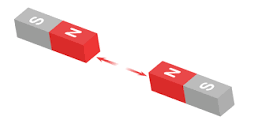
What will happen when these magnets are brought close together?
a)
They will attract each other.
b)
They will repel each other.
c)
Both magnets will turn to the left
d)
Both magnets will turn to the right
13.

This instrument can be used to see if materials conduct electricity. Which of these groups contains items that could all conduct electricity to complete the circuit?
a)
rubber ball, plastic comb, nail
b)
paper clip, penny, screw
c)
cork, dollar bill, tweezers
d)
pencil, eraser, spoon
14.
____________ allows electricity to flow.
a)
A conductor
b)
An insulator
c)
A magnet
15.

When a balloon is rubbed on the hair ...
a)
negative charges are transferred from the hair to the balloon.
b)
positive charges are transferred from the hair to the balloon.
c)
negative charges are transferred from the balloon to the hair.
d)
positive charges are transferred from the balloon to the hair.
16.
In which state of matter are molecules moving the slowest?
a)
solid
b)
liquid
c)
gas
d)
all of the above
17.
Gas particles are...
a)
tightly packed.
b)
loosely bonded and flowing.
c)
free to fly in all directions.
d)
so hot that the electrons are removed from the nucleus.
18.
If you wanted to test the effect of gravity on an object, which set of materials should you choose?
a)
battery, wires, lightbulbs
b)
hot plate, water, thermometer
c)
two different types of balls, metric ruler
d)
two cups, two different types of soil, water and seeds
19.
Students conduct an investigation to observe the Sun's movement. Which safety procedure should students following during this investigation?
a)
Wear gloves and goggles
b)
Keep loose hair tied back
c)
Never look directly at the Sun
d)
Record all data in science notebooks
20.
Students conduct and investigation to determine which substances are soluble in water. All of the following have the property of solubility in water EXCEPT -
a)
sugar cubes
b)
salt crystals
c)
cooking oil
d)
food coloring
21.
Which testable question could be used to investigate the effects of force on an object?
a)
Why do toy cars move?
b)
Which type of battery lasts the longest?
c)
Where can magnets be purchased?
d)
Do balls roll faster on rough or smooth surfaces?
22.
All of the following are poor insulators of electricity EXCEPT -
a)
penny
b)
nail
c)
eraser
d)
paperclip
23.
Which mixture can be separated using a coffee filter?
a)
rocks and sand
b)
sand and water
c)
lemon juice and water
d)
sand and iron filings
24.
What physical property of matter can be measured using the triple beam balance?
a)
length
b)
height
c)
volume
d)
mass
25.
Students are combining dried beans and rice. What would be the most efficient way to separate the ingredients?
a)
Evaporation
b)
Coffee Filters
c)
Tweezers
d)
Microscope
26.
The force of friction is caused by:
a)
surfaces rubbing against one another
b)
objects heating or cooling
c)
rough surfaces
d)
smooth surfaces
27.
What would take the most force?
a)
Rolling a rock down a hill
b)
Pushing a rock on ice
c)
Pushing a rock on a gravel road
d)
Pulling a rock on wheels
28.
Things in motion want to keep moving, things not moving want to stay at rest.This is the definition of:
a)
Inertia
b)
Mass
c)
Gravity
d)
Simple machine
29.
Mrs. King has a mixture of pepper, sugar, and water. If she wanted to separate them, what should she use?
a)
tweezers and coffee filter
b)
strainer and magnet
c)
her hands
d)
a hot plate
30.

What describes the ability of a solid to dissolve in water?
a)
melt
b)
dissapear
c)
solubility
d)
evaporate
31.

Buoyancy means the ability to:
a)
evaporate
b)
attract magnetic objects
c)
repel things that are not electrical
d)
float or sink
32.

What is the state of matter that has a definite volume but no definite shape
a)
solid
b)
liquid
c)
plasma
d)
gas
33.
What are physical properties of matter?
a)
A mixture that is evenly mixed
b)
A combination of two or more substances
c)
solids, liquids, and gases
d)
characteristics of matter that can be observed or measured
34.
Which type of objects would float?
a)
Those heavier than water
b)
Those with the same density as water
c)
Those less dense than water
d)
Those that are only made of gas
35.
Which moon phase comes after waxing crescent?
a)
First Quarter
b)
Waning Crescent
c)
Full moon
d)
Waxing Gibbous
36.
Sometimes people see figures such as animals in the arrangement of the stars, these figures are called:
a)
Supernova
b)
Constellations
c)
Supergiants
37.
The orbit of the Earth around the sun is:
a)
circular
b)
elliptical
c)
irregular
38.
What causes the temperatures at the north and south pole to remain cold throughout the year?
a)
The speed at which the Earth moves around the sun
b)
The tilt of the Earth on its axis
39.
Fill in the blanks.In a 24 hour period, the earth completes one ________ on its ________
a)
rotation, orbit
b)
revolution, axis
c)
rotation, axis
d)
revolution, orbit
40.
A shooting star is actually a:
a)
a star
b)
a meteor
c)
and asteroid
41.
What revolves around a planet?
a)
star
b)
moon
c)
comet
42.
Which moon phase is Earth between the moon and the sun?
a)
New moon
b)
full moon
c)
first quarter
43.
Which of the following best describe the shape of the Earth's orbit?
a)
Earth's orbit is a perfect circle around the sun.
b)
Earth's orbit is an irregular triangle around the sun
c)
Earth's orbit is elliptical, like a flattened circle.
44.
Which of the following best describes the size of the sun in relation to other stars?
a)
The sun is a dwarf star
b)
the sun is an averaged size star.
c)
The sun is a giant star
45.
Which planet is located between mars and Saturn?
a)
Mercury
b)
Earth
c)
Jupiter
d)
Uranus
46.
Which order is correct?
a)
Jupiter, Mercury, Saturn, Neptune
b)
Mercury, Earth, Mars, Jupiter
c)
Earth, Mars, Venus, Jupiter
d)
Uranus, Jupiter, Neptune, Saturn
47.

What season is the Southern hemisphere in when the North Pole is leaning into the Sun?
a)
Summer
b)
Fall
c)
Winter
d)
Spring
48.

Which planet is the largest?
a)
Jupiter
b)
Saturn
c)
Uranus
d)
Neptune
49.
The order of the planets is:
a)
Mars,Venus,Earth,
Mercury,Saturn
Jupiter, Uranus, Neptune
Mercury,Saturn
Jupiter, Uranus, Neptune
b)
Earth,Venus,Mars
Jupiter, Neptune,
Mercury,Saturn,
Uranus
Jupiter, Neptune,
Mercury,Saturn,
Uranus
c)
Mercury,Venus,Earth
Mars,Jupiter,
Saturn,Uranus
Neptune
Mars,Jupiter,
Saturn,Uranus
Neptune
50.
Which Planet comes after Earth in the solar system?
a)
Mercury
b)
Mars
c)
Venus
d)
Eros
51.

When the Northern Hemisphere of Earth is Leaning away from the Sun, What season is the Southern Hemisphere experiencing?
a)
Summer
b)
Winter
c)
Spring
d)
Fall
52.

This type of force is an attraction between two objects
a)
contact
b)
gravity
c)
friction
d)
push
53.

This type of force resist motion between two surfaces that are pressed together
a)
contact
b)
gravity
c)
friction
d)
air resistance
54.

What is the force caused by air on an object called?
a)
Gravity
b)
Air resistance
c)
Friction
d)
Push
55.

What is defined as a push or pull?
a)
force
b)
motion
c)
vector
d)
speed
56.
What is MOVEMENT?
a)
Inertia
b)
Force
c)
Work
d)
Motion
57.

If an object is not moving the forces acting upon it are _____________
a)
gravity
b)
force
c)
equal and opposite
d)
mass
58.

Which object will hit the ground first?
a)
A
b)
B
c)
the same time
59.

Which object will hit the ground first?
a)
A
b)
B
c)
the same time
60.
Which is NOT a force?
a)
Gravity
b)
Push
c)
Pull
d)
Cat
61.

If an object has MORE _______, it will have more gravity.
a)
mass
b)
distance
62.
Which is NOT a force?
a)
Air resistance
b)
Moon
c)
Friction
d)
Pull
63.

An object in motion will stay _____________, until acted on by a force.
a)
gravity
b)
push
c)
in motion
d)
equal and opposite
64.

Every action has an _______ and ________ reaction.
a)
equal, opposite
b)
push, pull
c)
force, mass
d)
gravity, friction
65.
Science is based on __________ and _____________.
a)
Fact and Opinion
b)
Observation and Fact
c)
Random Statements and Theory
66.
An independent variable is:
a)
What you are testing/changing in the experiment
b)
The results that you get from an experiment
c)
The conclusion you come to from an experiment
d)
What you expect/predict to happen in an experiment
67.
A dependent variable is:
a)
What you are testing/changing in the experiment
b)
The results that you get from an experiment
c)
The conclusion you come to from an experiment
d)
What you expect/predict to happen in an experiment
68.
Which of these questions could NOT be answered with an investigation?
a)
What plants grow best in this climate?
b)
What fruit tastes the best?
c)
How much water does an apple tree need?
d)
What plants grow well in the shade?
69.
Which helps scientists understand very large objects?
a)
a survey
b)
a hypothesis
c)
a procedure
d)
a model
70.
Someone who asks questions about the natural world is a(n)
a)
engineer
b)
model
c)
scientist
d)
teacher
71.
You want to conduct an experiment about the plants in your classroom. What would be your first step?
a)
Gather materials
b)
Observe plants
c)
Ask a question
d)
Analyze your results
72.
During which step of the Scientific Method do you propose what you think will happen?
a)
Ask a question
b)
Experiment
c)
Hypothesis
d)
Conclusion
73.
This group in an experiment does not receive the variable from the experimenter.
a)
Independent variable
b)
Dependent variable
c)
Control group
d)
Constant
74.

You are testing to see if music helps plants grow better. You divide the plants into four groups. What is group D?
a)
the model group
b)
the control group
c)
the population group
d)
the experimental group
75.

Which is the dependent variable in Amelia's experiment?
a)
the number of bean plants in each group
b)
the amount of water given daily to each plant
c)
the height of each bean plant
d)
the amount of fertilizer given to each group of bean plants
76.
Information from which a conclusion can be drawn or a prediction can be made are called
a)
tools
b)
procedures
c)
details
d)
data
77.
What is Matter?
a)
The amount of space an object takes up.
b)
Anything that has mass or takes up space.
c)
The pull of gravity on an object.
d)
A solid, liquid or gas.
78.
What is mass?
a)
The amount of matter in something, measured in grams.
b)
The gravitational pull of an object
c)
The amount of space something takes up.
d)
Wheter or not an object sinks or floats.
79.
What are physical properties?
a)
How fast someone can run
b)
The chemical makeup of an item
c)
Measurable characteristics to describe an object
d)
How quickly someone can learn a sport or physical activity.
80.
If an item floats on top of water it is...
a)
Less dense than water.
b)
More dense than water
c)
The same density as water.
d)
A gas.
81.
What is a conductor?
a)
Something that stops heat and electricity.
b)
Something that creates power.
c)
Something that allows heat or electricity to flow through it.
d)
Something that dissolves in water.
82.
What does MELTS stand for?
a)
Mechanical. Energy, Light, Thermal, Solar
b)
Magnetism, Electrical, Light, Thermal, Sound
c)
Mechanical, Electrical, Liquid, Thermal, Solid
d)
Mechanical, Electrical, Light, Thermal, Sound
83.

What is this called?
a)
refraction
b)
reflection
c)
reconstroction
d)
retraction
84.

Light travels...
a)
A. in ovals
b)
B. in circles
c)
C. in squares
d)
D. in straight lines
85.

Reflection is...
a)
A. light bouncing off a surface
b)
B. the bending of light
c)
C. the absorption of light
d)
D. light breaking into colors
86.
What are the reasons for the seasons?
a)
Earth's tilt and rotation.
b)
Earth's rotation and revolution.
c)
Earth's tilt and revolution.
d)
Earth's tilt and resolution
87.
The spinning of an object on its axis is called______
a)
orbit
b)
rotation
c)
revolution
d)
tide
88.
How long does it take the Earth to make one REVOLUTION around the Sun?
a)
12 hours
b)
24 hours
c)
365 days
d)
29.5 days
89.
What is earth's revolution?
a)
When earth orbits around the sun
b)
When earth bounces
c)
When the sun spins around the earth
d)
When the earth spins on it's axis
90.
Pick the control from the following variables..
vanilla ice cream
vanilla ice cream with sprinkles
vanilla ice cream with hot fudge & caramel
vanilla ice cream
vanilla ice cream with sprinkles
vanilla ice cream with hot fudge & caramel
a)
Vanilla ice cream
b)
vanilla ice cream with sprinkles
c)
vanilla ice cream with hot fudge & caramel
d)
I like it all
91.
A student wants to test the hypothesis of "If salt is added to water then the boiling point of water will decrease." What is the independent variable?
a)
Amount of salt
b)
Boiling Point
c)
Amount of water
92.
A student wants to test the hypothesis of "If salt is added to water then the boiling point of water will decrease." What is the dependent variable?
a)
amount of salt
b)
boiling point
c)
same amount of water
93.
Plants grow best in colored light. What is the independent variable of this statement?
a)
Plant Growth
b)
Colored Light
94.
Dark sodas have more carbonation than clear sodas. What is the dependent variable of this statement?
a)
Type of Soda
b)
Amount of carbonation
95.
Which brand of paper towel will absorb the most liquid? What is the independent variable?
a)
Brand of paper towel
b)
Amount of water absorbed
96.
Which brand of paper towel will absorb the most liquid? What is the dependent variable?
a)
brand of paper towel
b)
amount of water absorbed
97.
Research as shown to support that if students pay attention in class have higher test scores. What is the independent variable?
a)
research
b)
paying attention
c)
test scores
98.

Identify the equipment shown here:
a)
beakers
b)
flasks
c)
decanters
d)
graduated cylinders
99.

Identify the equipment shown here:
a)
graduated cylinder
b)
Erlenmeyer flask
c)
beaker
d)
volumetric flask
100.
Which of the following is a sign that a chemical reaction has occurred?
a)
change in shape
b)
melting
c)
formation of a gas
d)
dissolving
101.

Is burning wood a chemical or physical change?
a)
chemical
b)
physical
102.
A severe storm which involves a funnel cloud forming over land is:
a)
hurricane
b)
tornado
c)
thunderstorm
d)
blizzard
103.
A severe storm that involves winds over 119mph and forms over water is:
a)
tornado
b)
thunderstorm
c)
hurricane
d)
blizzard
104.
This severe weather involves lightning, rain, and possibly hail
a)
thunderstorm
b)
tornado
c)
hurricane
d)
blizzard
105.
This severe weather involves low temperatures and snow either falling or drifting
a)
hurricane
b)
thunderstorm
c)
tornado
d)
blizzard
106.
What two processes make sediment?
a)
Weathering
b)
Erosion
c)
Weathering & Erosion
107.
Extreme Heat and Pressure creates a _________ rock.
a)
Igneous
b)
Metamorphic
c)
Sedimentary
d)
Mineral
108.
The three groups of rocks are classified by
a)
How they form
b)
Color
c)
Grain size
d)
Chemical Composition
109.
Fossils are only found in
a)
Sedimentary rocks
b)
Foliated Metamorphic rocks
c)
Igneous Rocks
d)
Nonfoliated Metamorphic rocks
110.

The process when rocks break into smaller pieces due to exposure to natural elements is called
a)
erosion
b)
weathering
c)
sediments
111.
Which type of rock results from melting and cooling of magma?
a)
Igneous
b)
Metamorphic
c)
Sedimentary
d)
Extrusive
112.
Which type of rock forms from extreme heat and pressure?
a)
Igneous
b)
Sedimentary
c)
Organic
d)
Metamorphic
113.
Sediment being moved from one area to another is called
a)
erosion
b)
deposition
c)
weathering
d)
compaction
114.
A naturally occurring solid mixture of minerals and organic matter is a
a)
mineral
b)
rock
c)
composition
d)
pebble
115.
Texture is determined by
a)
the chemicals in a rock
b)
the color of a rock
c)
the bumpiness of a rock
d)
the size and shape of the rock's mineral grains
116.
Which of the following are nonrenewable resources?
a)
Plants and animals
b)
Wind and water
c)
Sunlight and water
d)
Coal and petroleum
117.

What is an example of a renewable resource?
a)
hydroelectric
b)
oil
c)
coal
d)
fossil fuel
118.

Do Renewable energy sources run out?
a)
Yes
b)
No
119.
Where does most of earth`s energy come from?
a)
The sun
b)
Mars
c)
Wind
d)
Water
120.
what is a non renewable resource?
a)
water
b)
wind
c)
coal
d)
biomass
121.
what is a renewable resource used for?
a)
food
b)
diging
c)
energy
d)
smelting
100 %

