

wayground logo

Free Printable Worksheets

Font size

S
M
L
XL
Worksheets

IPC Electricity Test Review

Total questions: 53

Worksheet time: 1hrs 16mins

Name
Class
Date
1.

The flow of electricity in a circuit is called a (a)   .

2.
____________ stops the flow of electricity. (a)  
Choose from the below words
A conductor
An insulator
A magnet
3.
Two batteries in a circuit make the lights in the circuit brighter than one battery.
a)
true
b)
false
4.
An example of a parallel circuit is
a)
the wiring in a house
b)
a flashlight
c)
a single circular path
5.
The flow of electricity requires a
a)
complete path
b)
incomplete path
c)
insulated current
6.

What kind of circuit is this?

(a)  

7.
Electricity is the flow of ______.
a)
electrons
b)
protons
c)
neutrons
d)
atoms
8.
A material in which electrons are able to move easily
a)
Circuit
b)
Insulator 
c)
Resistance 
d)
Conductor 
9.
A material in which electrons are not able to move easily 
a)
Circuit 
b)
Insulator 
c)
Resistance 
d)
Conductor
10.
provides more than one path for the electrons to follow
a)
series circuit
b)
parallel circuit
c)
insulator
d)
conductor
11.
the type of current that is used in  outlets
a)
apparating current
b)
diverting current
c)
AC
d)
DC
12.

Name the unit of an electric current.

a)
watt
b)
ohm
c)
volt
d)
amp
13.

Match the following units with what they measure.

a)

watt

1.

unit of power

b)

ohm

2.

unit of resistance

c)

volt

3.

unit of electric potential

d)

amp

4.

unit of electric current

14.

Watt is the unit that measures (a)   .

15.
What does the switch do in a circuit?
a)
It supplies the power.
b)
It carries electricity.
c)
It opens and closes the circuit.
d)
It is an insulator.
16.
Identify the components that are sources of electrical energy.
17.
) What would happen if an extra battery cell is added?
a)
A)The lights will glow dim
b)
The wire will glow
c)
The lights will glow brighter
d)
None of the above
18.
What is one benefits of using a parallel circuit?  
a)
It gets confusing.
b)
There are no problems.
c)
If one goes down, it does not affect the others. 
d)
Porque es para llelio. 
19.
What is one problem with using a series circuit? 
a)
It has a lot of series. 
b)
If one goes down, they all go down! 
c)
It doesn't work properly.
d)
There are no problems. 
20.
What types of charges attract?
a)
Positive and Positive
b)
Positive and Neutral
c)
Negative and Neutral
d)
Positive and Negative
21.
What charge does an electron have?
a)
negative (-)
b)
positive (+)
c)
neutral or no charge (0)
22.
A continuous flow of electricity is called_____________
a)
series
b)
circuit
c)
static
d)
current
23.
What is voltage?
a)
how hard electrons are being pushed
b)
how light their being pushed 
c)
how electrons are made 
d)
how electrons do work 
24.
What is an amp?
a)
How many electrons are being pushed 
b)
How many electrons are being pulled
c)
How hard electrons are being pushed
25.
A Charging system producing 14.5 Volts with a current flow of 43.5 Amps, what is the circuit resistance
a)
58 Amps
b)
0.33 Amps
c)
13 Amps
d)
1 Amp
26.
What would the circuit resistance be if a 7.5 Amp draw was present with the engine running and the charging system producing 15 Volts
a)
15 Ohms
b)
4 Ohms
c)
0.3333 Ohms
d)
2 Ohms
27.
What is the power of a 10V bulb with 5A through it?
a)
2W
b)
2V
c)
50W
d)
50A
28.
What resistance is needed to cause a 20A current flow because of a 100V battery?
a)
0.2Ώ
b)
2000Ώ
c)
120Ώ
d)
29.
What is the current through a 4V bulb with a power of 36W?
a)
9W
b)
9A
c)
60V
d)
60A
30.
You rub your socks on the rug on a dry winter day. You build up a charge of positive and negative ions. It's called ________ energy.
a)
overload
b)
static
c)
electronic
d)
regulated
31.
You plug in an extension cord and have to be very careful around the electrical outlet. However, you can handle the extension cord without worry of being shocked by the electrical charge. Which statement best explains why you can do this?
a)
A. The cord is made of a combination of materials, which are good conductors of electricity. The combination of two conductors directs the flow of electricity away from you and down the cord.
b)
B. The extension cord is made of plastic which only conducts electricity for a certain period of time. If you handle the cord, the electricity passes through it so fast that you are not in danger of being shocked.
c)
C. The extension cord is made of copper wire, which is a good conductor of electricity; however, it is covered with plastic, an insulator, which does not allow the electrical current to flow to you.
d)
D. The cord has a plastic cover, which is a good conductor of electricity so it carries the electrical current away from your hand, which is an insulator.
32.
Using the diagram of the balloons wall and sweater why does the balloon "stick" to the sweater and wall? 
a)
The negative charge of the balloon is attracted and pulled toward the negative charge on the sweater and wall
b)
The positive charge of the balloon is attracted to and pulled toward the positive charge on the sweater and wall
c)
The negative charge of the balloon is attracted to and pulled toward the positive charge of the sweater and the wall
d)
The neutral charge (positive and negative) of the balloon is attracted and pulled toward the positive charge of the sweater and wall 
33.
A current of 0.5 A flows through a resistance of 10 ohms for half an hour. Find the amount of electrical energy consumed by the resistance.
 
Remember:
V = IR
P = VI
E = Pt
a)
22500 J or 22.5 KJ
b)
4500 J or 4.5 KJ
c)
79.2 W
d)
2.5 A
34.

An electric meter reads 1,346 kWh at the end of the month. Find the cost of electrical energy consumed in that month if 1 kWh of energy costs $0.12. What was the electric bill for that month?

a)

$161.52

b)

$52.80

c)

$27.00

d)

$96.00

35.
a pair of 15-watt computer speakers are connected to a 12-volt power supply. what is the electric current running through the speakers? 
a)
1.25 A
b)
0.8 A
c)
12.5 A
d)
180 A
36.
 A flashlight bulb with a potential difference of 4.5 V across its filament has a power output of 8.0 W. How much current is in the bulb filament? 
a)
3.7 A
b)
0.23 A
c)
1.8 A
d)
0.56 A
37.
Calculate the electric power of an electrical appliance in which 10 A of current is flowing through a resistor of 2 ohms.
 
Remember: V=IR and P=VI
a)
80 W
b)
200 W
c)
2.5 A
d)
22.5 KJ
38.
Calculate the electric power of an electrical appliance of 20 V having a resistance of 10 ohms.
 
Remember: I=V/R and P=VI
a)
200 W
b)
40 W
c)
2.5 A
d)
79.20 KJ
39.
A lamp changes __________ energy into light energy.
a)
Kinetic
b)
Electrical
c)
Sound
d)
Chemical
40.
What is the unit of electrical power?
a)
watt
b)
volt
c)
ampere
d)
ohm
41.

A kilowatt-hour is equivalent to

a)

1000 W.

b)

3600 J.

c)

3,600,000 J/s.

d)

3,600,000 J.

42.

How much energy does a 100-W light bulb use in 8.0 hours?

a)

0.0080 kWh

b)

0.80 kWh

c)

13 kWh

d)

800 kWh

43.

When 5.00 A is flowing through an 10.0-Ω device, how much power is being dissipated in the device?

a)

50.0 W

b)

250 W

c)

500 W

d)

2.50 kW

44.

If the battery produced 12.6 Volts and what would be the current flow be for a 6 Ohm resistor?

a)

2.4 Amps

b)

15 Amps

c)

1.71 Amps

d)

2.1 Amps

45.

If a blender is plugged into a 110 V outlet that supplies 2.7 A of current, what amount of power is used by the blender?

a)

40.7 W

b)

297 W

c)

112.7 W

d)

378 W

46.

What is the voltage of a circuit with 15 amps of current and toaster with 8 ohms of resistance?

a)

120V

b)

1.88V

c)

7A

d)

0.5A

47.

How many ohms of resistance must be present in a circuit that has 120 volts and a current of 10 amps?

a)

1200 ꭥ

b)

110 ꭥ

c)

0.08 ꭥ

d)

12 ꭥ

48.

Using the diagram above, how much current would be measured in each circuit if the light bulb has a resistance of 6 ohms?

a)

circuit A= 1A ; circuit B= 1A

b)

circuit A= 2A ; circuit B= 2A

c)

circuit A= 1A ; circuit B= 2A

d)

circuit A= 1A ; circuit B= 6A

49.

Using the diagram above, how much current would be measured in each circuit if the light bulb has a resistance of 12 ohms?

a)

circuit A= 6A ; circuit B= 0A

b)

circuit A= 1A ; circuit B= 2A

c)

circuit A= 2A ; circuit B= 1A

d)

circuit A= 0.5A ; circuit B= 1A

50.

A balloon is rubbed against hair. Afterwards it sticks to a wall. Explain these observations.

a)

the balloon is repelled by the wall.

b)

the balloon and wall are oppositely charged.

c)

the balloon and wall are equally charged.

d)

the balloon was sticky.

51.

Who invented alternating electrical current (AC)?

a)

Thomas Edison

b)

George Westinghouse

c)

Nikolai Tesla

d)

General Electric (GE)

52.

What was the biggest problem with direct current (DC) during Tesla and Edison's "War of the Currents."

a)

It was considered very dangerous.

b)

DC was too powerful for the circuits that existed at the time.

c)

DC would not make as much money as AC.

d)

DC could not travel more than 5 miles.
53.

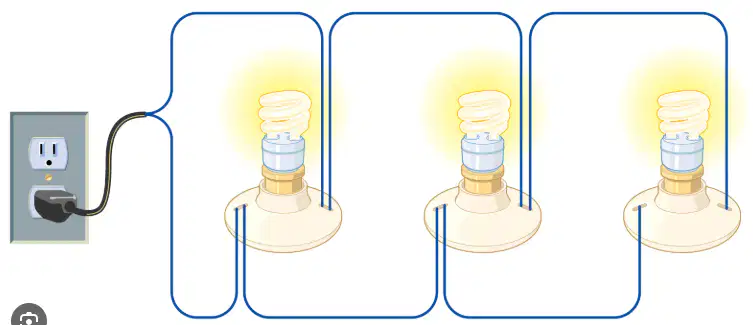
In a ​ (a)   circuit, the wires of the circuit are arranged such that there are ​ (b)   or ​ (c)   pathways for the ​ (d)   to travel on. This allows for multiple loads (lightbulbs) to ​ (e)   functioning if one malfunctions.

Choose from the below words
parallel
two
more
electrons
remain
series
protons
