
 Worksheets
Force and Motion
Total questions: 81
Worksheet time: 2hrs 16mins
Name
Class
Date
1.
What is a PUSH or PULL of an object?
a)
Motion
b)
Force
c)
Friction
d)
Gravity
2.
What is MOVEMENT?
a)
Inertia
b)
Force
c)
Work
d)
Motion
3.
What happens when one force PULLS an object toward another?
a)
Friction
b)
Motion
c)
Gravity
d)
Magnetism
4.
What is a force that works AGAINST MOTION?
a)
Force
b)
Motion
c)
Gravity
d)
Friction
5.
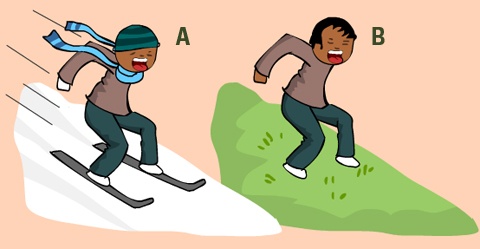
Why is it harder for the boy in Image B to get down the hill?
a)
Motion
b)
Friction
c)
Work
d)
Displacement
6.

In the image, which of the person and their bikes will get down a hill faster?
a)
The boy because he is younger
b)
The woman because she is stronger
c)
The boy because he has a greater mass which applies a greater force
d)
The woman because she has more mass and applies a greater force
7.
How is gravity affected by mass?
a)
the larger the mass of the object, the greater the gravity
b)
small objects have no gravity
c)
gravity is not affected by mass of objects, whether large or small
8.
Which force produces a change in motion?
a)
unbalanced force
b)
balanced force
c)
gravitational force
d)
frictional force
9.
Which force produces a change in motion?
a)
unbalanced force
b)
balanced force
c)
gravitational force
d)
frictional force
10.
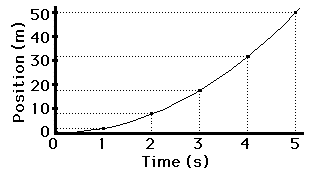
The picture of the position vs. time graph shows an object that is...
a)
accelerating/speeding up
b)
moving at a constant speed
c)
not moving
d)
accelerating/slowing down.
11.
What is force?
a)
A force is a push or a pull upon an object resulting from the object's interaction with another object.
b)
something used in Star Wars
c)
It is the amount of space between two points.
d)
It is Superman's power
12.
Why does a rolling ball stop?
a)
Gravity
b)
Friction
c)
Waterfalls
d)
Sand
13.
A push or pull that causes a change in motion
a)
Friction
b)
Gravity
c)
Force
d)
Mass
14.
The amount of matter in an object
a)
weight
b)
force
c)
gravity
d)
mass
15.
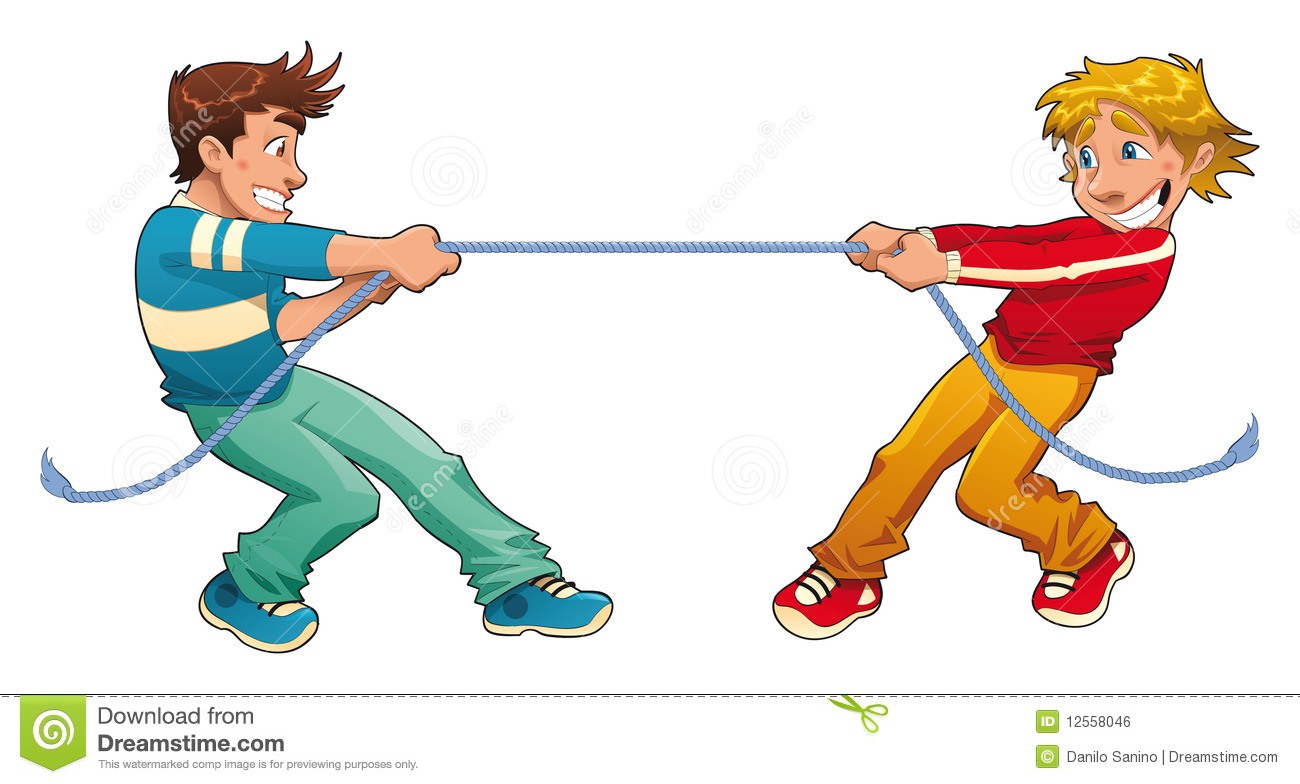
If these boys are pulling with the same amount of force. What will happen?
a)
The boy in blue will win.
b)
They will not move at all.
c)
The boy in red will win.
d)
Both will fall down.
16.
What pulls a ball back to earth?
a)
Gas
b)
Gravity
c)
Friction
d)
Molecules
17.
What is the standard unit force is measured in?
a)
Newtons
b)
pounds
c)
grams
d)
meters
18.
What is the standard unit force is measured in?
a)
Newtons
b)
pounds
c)
grams
d)
meters
19.
What happens when one object moves an object over a distance?
a)
Inertia
b)
Work
c)
Displacement
d)
Magnetism
20.
A distance vs. time graph shows an object's
a)
frame of reference
b)
speed
c)
acceleration
d)
favorite food
21.
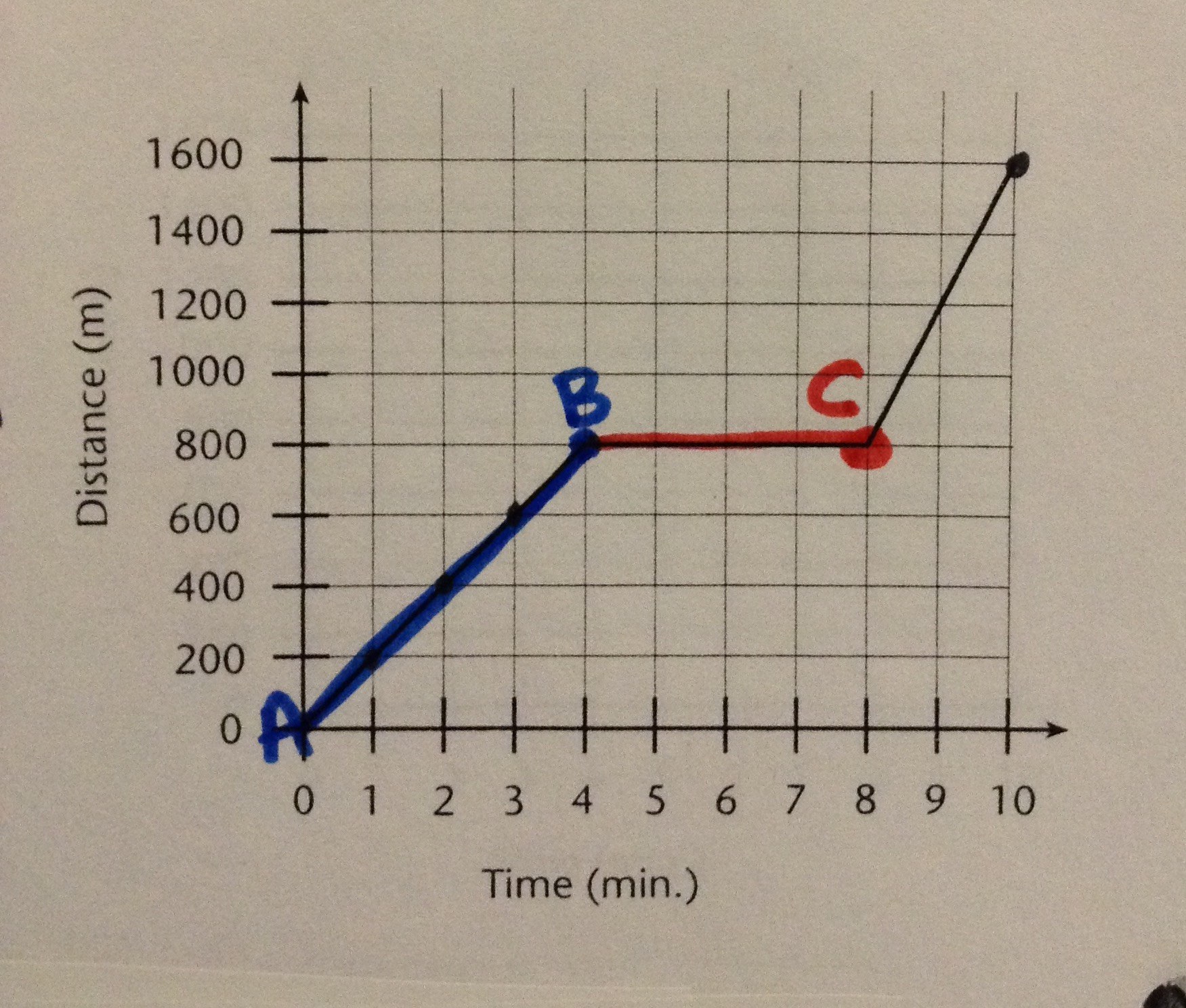
LT4: The graph shows Ashley riding her bike to Maria's house.
What is occurring from point A to point B?
What is occurring from point A to point B?
a)
they are traveling at a constant speed
b)
they are decreasing in speed
c)
they stopped to take a break
22.
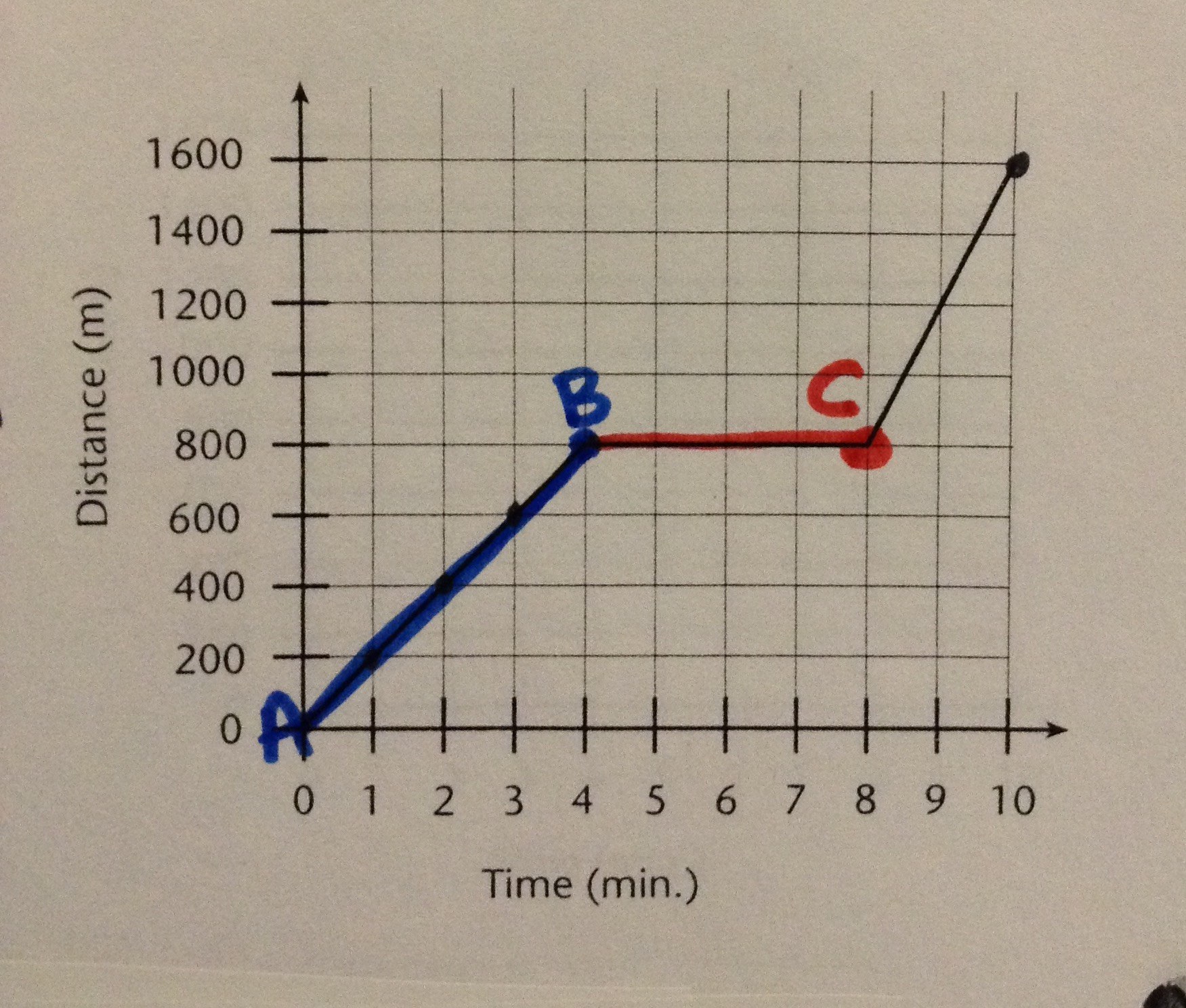
LT4: The graph shows Ashley riding her bike to Maria's house.
What was occurring from point B to point C?
What was occurring from point B to point C?
a)
She was increasing her speed.
b)
She stopped for 4 minutes
c)
She was decreasing in speed
23.
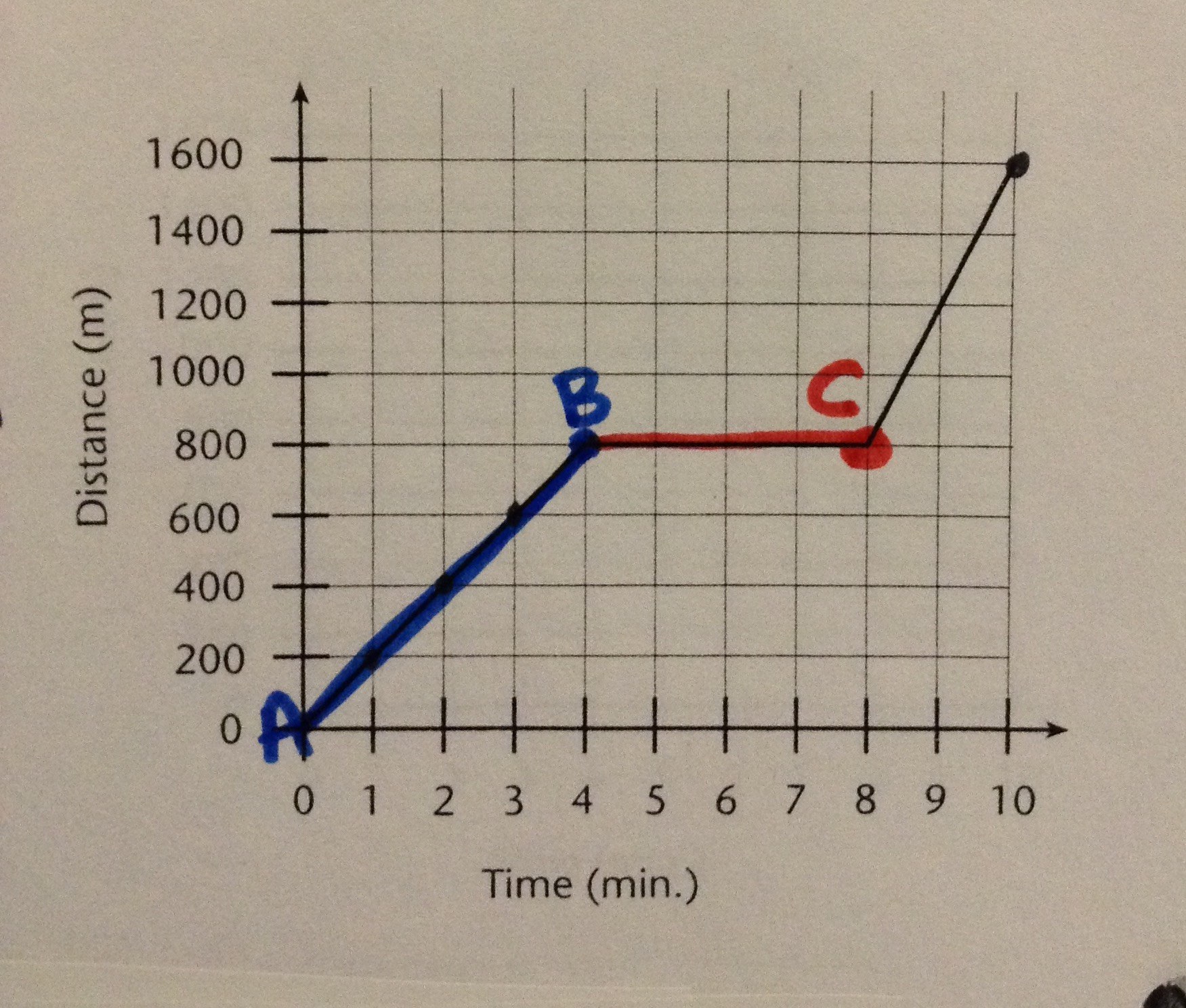
LT4: The graph shows Ashley riding her bike to Maria's house.
What was her average speed for the ENTIRE trip?
What was her average speed for the ENTIRE trip?
a)
1600 m/min
b)
200 m/min
c)
160 m/min
24.
LT5: The rate at which velocity CHANGES is:
a)
acceleration
b)
speed
c)
direction
d)
physics
25.

The graph represents
a)
no motion
b)
Constant velocity
c)
Acceleration
d)
negative acceleration
26.

The graph respresents
a)
No motion
b)
Constant Velocity
c)
Acceleration
d)
Deceleration
27.
An object is _____ if its position changes relative to another object.
a)
in motion
b)
at reset
c)
a frame of refence
d)
magical
28.
A place or object used for comparison to determine if another object is in motion is called a
a)
comparison point
b)
reference point
c)
point of view
d)
motion detector
29.
Speed =
a)
distance / time
b)
time / distance
c)
distance * time
30.
You walk 10 meters to math class in 20 seconds. Your average speed is
a)
2 m/s
b)
0.5 m/s
c)
200 m/s
d)
5 m/s
31.
On a distance-versus-time graph, a straight line ALWAYS indicates that an object’s speed is _____.
a)
constant
b)
zero
c)
increasing
d)
decreasing
32.
Change in speed over a given period of time is
a)
velocity
b)
motion
c)
speed
d)
acceleration
33.
On a distance vs. time graph, the steeper the slope _____
a)
the slower the speed
b)
the faster the speed
c)
less acceleration
d)
greater acceleration
34.
The rate at which velocity changes is called
a)
motion
b)
average speed
c)
instantaneous speed
d)
acceleration
35.
What is the equation to find speed?
a)
s=t/d
b)
s=d x t
c)
s=d/f
d)
s=d/t
36.
When something has speed in a certain direction it is called ___________.
a)
motion
b)
position
c)
velocity
d)
speed
37.
Acceleration of an object happens when things ________
a)
slow down
b)
go faster
c)
change direction (turn)
d)
All of the above
38.

The formula:
? = D/T with direction
is used to find
? = D/T with direction
is used to find
a)
Velocity
b)
Speed
c)
Force
d)
Acceleration
39.
LT1 The process of changing distance or position from another object
a)
reference point
b)
location
c)
acceleration
d)
motion
40.
LT2 The distance an object travels per unit of time (how far, how fast) is called:
a)
direction
b)
speed
c)
acceleration
d)
deceleration
41.
What is the starting point used to describe the position of an object?
a)
Beginning point
b)
Ending point
c)
Reference point
d)
positive
42.
The direction often used to describe movement AWAY from an object is __________
a)
positive
b)
negative
c)
plus
d)
minus
43.

Alan travels 100km in 5hrs. Find his average speed in km/h
a)
5km/hr
b)
10km/hr
c)
50km/hr
d)
20km/hr
44.
Acceleration: is the rate of change in ___________.
a)
speed
b)
distance
c)
velocity
d)
displacement
45.
Acceleration only takes place when things speed up.
a)
True
b)
False
46.

A proper quantity showing velocity would be
a)
25 m/s.
b)
30 m south.
c)
15 m/s north.
d)
10 m.
47.
Speed is different from velocity because
a)
Velocity has a direction
b)
Speed uses Distance /Time
c)
Velocity doesn't include time
d)
Velocity doesn't include distance
48.
What is the hot wheels acceleration if it has a starting velocity of 10 m/s and after 5 s it has a final velocity of 30 m/s.
a)
4 m/s/s
b)
-4 m/s/s
c)
6 m/s/s
d)
20 m/s
49.
How far did the duck waddle if it waddled 5 m/min for 30 minutes? d = s x t
a)
150 m
b)
6 m
c)
7 m
d)
15 m
50.
What was the car's speed if it drove 120 miles in 2 hours? s=d/t
a)
240 mi/hr
b)
60 mi/hr
c)
30 mi/hr
d)
70 mi/hr
51.
A distance vs. time graph shows an object's
a)
frame of reference
b)
speed
c)
acceleration
d)
favorite food
52.
Velocity is both ____ and _____.
a)
speed , direction
b)
direction, mass
c)
volume, density
d)
direction, magnitude
53.
How much time does it take for a car travelling at 70 miles/hour to travel 450 miles?
a)
6.42 hours
b)
0.22 hours
c)
19,500 hours
d)
none of the above
54.
65mi/hr South is an example of...
a)
Speed
b)
Velocity
c)
Acceleration
d)
Direction
55.
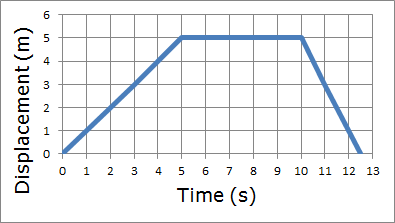
What is the person doing from 5 seconds to 10 seconds?
a)
Walking
b)
Running
c)
Standing Still
d)
Walking Fast
56.
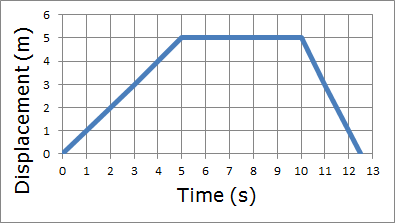
According to the graph how far does the person travel in the first 5 seconds?
a)
2 m
b)
10 m
c)
0 m
d)
5 m
57.
What is the person doing from 5 seconds to 10 seconds?
a)
Walking
b)
Running
c)
Standing Still
d)
Walking Fast
58.

How far is the person from the starting point after 3 seconds?
a)
0 m
b)
2 m
c)
3 m
d)
6 m
59.
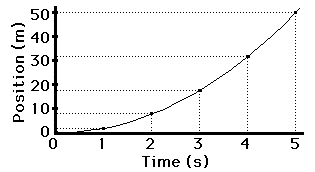
The picture of the position vs. time graph shows an object that is...
a)
accelerating/speeding up
b)
moving at a constant speed
c)
not moving
d)
accelerating/slowing down.
60.
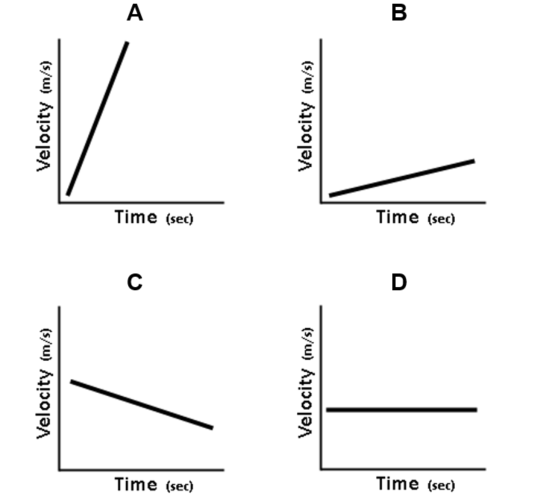
Which graph represents zero acceleration (constant velocity)?
a)
A
b)
B
c)
C
d)
D
61.

Which graph shows the object standing still?
a)
A
b)
B
c)
C
d)
D
62.
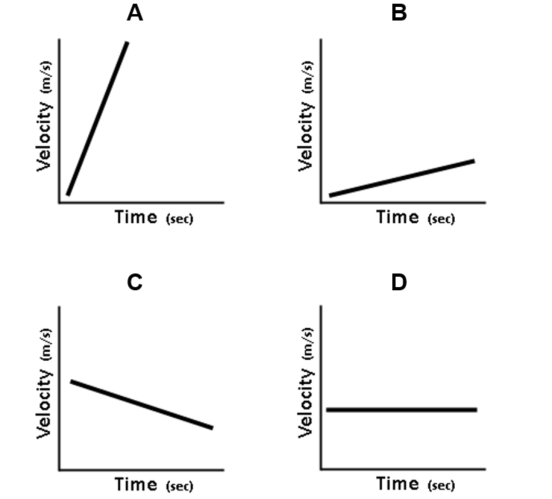
Which graph represents the greatest acceleration?
a)
A
b)
B
c)
C
d)
D
63.
Which of the following is the correct equation to solve for time?
a)
T = D/S
b)
T = S/D
c)
T = S x D
d)
T = D x S
64.
Which of the following is the correct equation to calculate distance?
a)
D = S x T
b)
D = S/T
c)
D = T/S
d)
D = T + S
65.
If I walk 6 miles east then turn around and walk 8 miles west, what is my displacement?
a)
2 miles west
b)
2 miles east
c)
10 miles west
d)
10 miles east
66.
Bill runs 400 meters to Andy's house, turns around, and runs 400 meters back home. What is Bill's distance?
a)
0 meters
b)
400 meters
c)
800 meters
d)
1600 meters
67.

What is this graph showing?
a)
Constant Speed
b)
Acceleration (speeding up)
c)
Deceleration (slowing down)
d)
No motion
68.
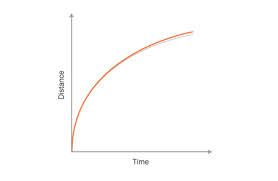
What is this graph showing?
a)
Constant Speed
b)
Acceleration (speeding up)
c)
Deceleration (slowing down)
d)
No motion
69.

How many times does this object STOP moving?
a)
None
b)
Once
c)
Twice
d)
Three times
70.

How far does the object move?
a)
40m
b)
80m
c)
100
d)
100m
71.
How many times does this object STOP moving?
a)
None
b)
Once
c)
Twice
d)
Three times
72.
Which graph represents zero acceleration (constant velocity)?
a)
A
b)
B
c)
C
d)
D
73.
Which graph shows the object standing still?
a)
A
b)
B
c)
C
d)
D
74.
According to the graph how far does the person travel in the first 5 seconds?
a)
2 m
b)
10 m
c)
0 m
d)
5 m
75.
The picture of the position vs. time graph shows an object that is...
a)
accelerating/speeding up
b)
moving at a constant speed
c)
not moving
d)
accelerating/slowing down.
76.
What two measurements are necessary for calculating speed?
a)
Mass and time
b)
Temperature and mass
c)
Mass and distance
d)
Distance and time
77.

At 60 seconds, how far had this object traveled?
a)
0 m
b)
10 m
c)
20 m
d)
40 m
78.

How long did it take this object to travel 10 m?
a)
0 s
b)
10 s
c)
15 s
d)
20 s
79.
Can be measured in seconds (s)
a)
Distance
b)
Time
c)
Speed
d)
Acceleration
80.
A description of the speed and direction of an object's motion
a)
Velocity
b)
Speed
c)
Acceleration
d)
Vector
81.
A measurement of how fast an object is moving
a)
Velocity
b)
Speed
c)
Vector
d)
Acceleration
100 %

