wayground logo

Free Printable Worksheets

Font size

S
M
L
XL
Worksheets

Capasitors

Total questions: 83

Worksheet time: 1hrs 5mins

Name
Class
Date
1.
Two resistors have the same resistivity and cross-sectional area. One is twice as long as the other. What is the voltage on the longer resistor? 
a)
12 V
b)
8 V
c)
6 V
d)
4 V
2.
A parallel plate capacitor is connected to a cell of constant emf. The plates are moved further apart without disconnecting the cell. What happens to the capacitance and voltage across the plates?
a)
capacitance increases; voltage remains constant
b)
capacitance remains constant; voltage decreases
c)
capacitance decreases; voltage increases
d)
capcitance decreases; voltage remains constant
3.
Capacitors C1 and C2 are connected in parallel and a potential difference is applied to the combination. If the capacitor that is equivalent to the combination has the same potential difference, then the charge on the equivalent capacitor is the same as: 
a)
the charge on C1
b)
the sum of the charges on C1 and C2
c)
the difference of the charges on C1 and C2
d)
the product of the charges on C1 and C2
4.
Two identical capacitors are connected in series and two, each identical to the first, are connected in parallel. The equivalent capacitance of the series connection is ________ the equivalent capacitance of parallel connection. 
a)
twice
b)
four times 
c)
half 
d)
one fourth
5.
Capacitors C1 and C2 are connected in series. The equivalent capacitance is given by: 
a)
C1C2/(C1 + C2
b)
(C1 + C2)/C1C2
c)
1/(C1 + C2
d)
C1 + C2
6.
Capacitor C1 and C2 are connected in parallel. The equivalent capacitance is given by: 
a)
C1 + C2
b)
1/(C1 + C2
c)
C1C2/(C1 + C2
d)
(C1 + C2)/C1C2
7.
Each of the four capacitors shown is 500 mF.  The voltmeter reads 1000V.  The magnitude of the charge on each capacitor plate is:
a)
0.2 C
b)
0.5 C
c)
20 C
d)
50 C
8.
A parallel-plate capacitor has a plate area of 0.2 m2 and a plate separation of 0.1 mm. To obtain an electric field of 2.0 ´ 106 V/m between the plates, the magnitude of the charge on each plate should be:
a)
3.5 ´ 10-6 C
b)
7.1 ´ 10-6
c)
1.4 ´ 10-5 C
d)
1.8 ´ 10-5 C
9.
If both the plate area and the plate separation of a parallel-plate capacitor are doubled, the capacitance is: 
a)
doubled
b)
halved
c)
unchanged 
d)
one-fourth the original 
10.
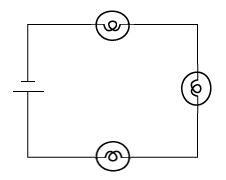
The picture shows an electrical circuit. This circuit is a series circuit because: 
a)
It has 3 light bulbs.
b)
The same current flows through all three light bulbs.
c)
It uses a single battery.
d)
The electrical current has more than one path to flow through
11.
In a Series circuit the more lightbulbs you add the brighter they get 
a)
False 
b)
True 
12.
What is a Parallel circuit? 
a)
Has only one path 
b)
Has more than one path 
c)
Allows energy to travel through easily 
d)
Has only one light bulb
13.
Which best describes a simple series circuit?
a)
Electricity flows along one pathway.
b)
The flow of electricity comes from the switch.
c)
Electricity flows along many pathways.
d)
The flow of electricity comes from the light bulb.
14.
The loads in a series circuit do not share the available voltage.
a)
True
b)
False
15.
Across all the paths in a parallel circuit the voltage is the same,
a)
True
b)
False
16.
If a p.d of 5V is across the combination, what is the total energy stored by the combination?
a)
68.8J
b)
1.71x10⁻³J
c)
8.59x10⁻⁴J
d)
4.00x10⁻³J
17.
An uncharged capacitor is connected to a battery.
a)
A
b)
B
c)
C
d)
D
18.
An uncharged capacitor is connected to a battery.
a)
A
b)
B
c)
C
d)
D
19.
A capacitor of capacitance C has a potential difference V across it and stores energy Z joules. A second capacitor has a capacitance of C/2 and a potential difference of 2V across it. What is the energy stored on the second capacitor?
a)
Z
b)
2Z
c)
4Z
d)
8Z
20.
If the charge on a parallel-plate capacitor is doubled:
a)
the capacitance is halved 
b)
the capacitance is doubled 
c)
the electric field is halved 
d)
the electric field is doubled
21.
In the capacitor, the dielectric can be made out of all sorts of ---------- materials and the plates are made of a -------------- material.
a)
conductive, insulating 
b)
conductive, conductive
c)
insulating, conductive
d)
insulating, insulating
22.
The symbol of capacitor to the right represents: 
a)
non-polarized fixed
b)
polarized fixed
c)
variable
d)
preset
23.
If the capacitance is 47μF, and the voltage difference across the capacitor terminals is 6V, then the energy stored in that capacitor is:
a)
846×10-6Joule
b)
7.23×10⁻³ Joule
c)
6.76×10⁻⁵Joule
d)
5.94×10⁻²Joule
24.
True or False:
You can increase the capacitance by increasing the charge stored in the   capacitor
a)
True
b)
False
25.
What happens to the current in the circuit during the charging process of a capacitor?
a)
Decreases over time
b)
Increases over time
c)
Remains constant
26.
What happens to the charge in a capacitor during the discharging process?
a)
Increases over time
b)
Decreases over time
c)
Remains the same
27.
Which is the Q vs t graph for the charging process of a capacitor?
a)
a
b)
b
28.
The following are factors affecting capacitance, except.
a)
Dielectric in between the metal plates
b)
Area  of the metal plates
c)
Distance of separation of the metal plates
d)
Voltage across the metal plates
29.
If the capacitor is CONNECTED to the battery, what remains constant if the area of the metal plates is increased?
a)
Voltage across the metal plates
b)
Capacitance
c)
Charge stored in the capacitor
d)
Energy stored in the capacitor
30.

A capacitor is charged by a 8.0 V battery and then disconnected from the battery. What happens to the voltage across the capacitor if the alligator clamps are not reconnected?

a)

0.0 V

b)

2.0 V

c)

4.0 V

d)

8.0 V

31.

A capacitor is charged by a 8.0 V battery and then disconnected from the battery. The capacitor is immediately connected to a light bulb and discharged. What is the voltage across the capacitor?

a)

0.0 V

b)

2.0 V

c)

4.0 V

d)

8.0 V

32.

How much charge is stored on a 4.0 nF capacitor when connected to a 12.0 V battery?

a)

3.0 x 10⁻⁹ C

b)

24 x 10-9 C

c)

16 x 10-9 C

d)

48 x 10-9 C

33.

How much voltage was used to store 24 x 10-9 C on a 4.0 nF capacitor when connected to the battery?

a)

3.0 V

b)

0.16 V

c)

6.0 V

d)

0.32 V

34.

A capacitor was connected to a 6 V battery. The time for the light to stay was recorded after the battery was removed from the circuit. Then the same capacitor was connected to a 12 V battery and time was then the time for the light to remain on was remeasured. What happened to the time that the light remained on in 12 V battery vs. the 6 V battery?

a)

The time that the light was on was lesser.

b)

The time that the light was on was the same.

c)

The time that the light was on was greater.

d)

The light didn't come on in either situations.

35.

When capacitors is arrange in series (3 capacitors), the equivalent capacitance C is

a)

C = C1 + C2 + C3

b)

1/C = 1/C1 + 1/C2 + 1/C3

c)

C = QV1 + QV2 + QV3

d)

C = CR1 + CR2 + CR3

36.

When capacitors in parallel (3 capacitors), the equivalent capacitance is

a)

C = C1 + C2 + C3

b)

C = 1/C1 + 1/C2 + 1/C3

c)

C = QV1 + QV2 + QV3

d)

C = QV1 + QV2 + QV3

37.

1. A ____________ connection has 2 or more components connected so that there is more than one path for current to flow.

a)

series

b)

parallel

c)

series/parrallel

d)

polarized

38.

2. A ____________ connection has 2 or more components connected so that there is only 1 path for current to flow

a)

perpendicular

b)

parallel/series

c)

polarized

d)

series

39.

6. The total capacitance of two capacitors connected in series is _____________ the lowest value capacitor

a)

equal to

b)

opposite

c)

greater than

d)

less than

40.

7. Electrical prints use standard symbols and abbreviations to show ___________ operation and device use.

a)

battery

b)

circuit

c)

switch

d)

capacitor

41.
Each of the four capacitors shown is 500 mF.  The voltmeter reads 1000V.  The magnitude of the charge on each capacitor plate is:
a)
0.2 C
b)
0.5 C
c)
20 C
d)
50 C
42.
Two identical capacitors are connected in series and two, each identical to the first, are connected in parallel. The equivalent capacitance of the series connection is ________ the equivalent capacitance of parallel connection. 
a)
twice
b)
four times 
c)
half 
d)
one fourth
43.
Capacitors C1 and C2 are connected in parallel and a potential difference is applied to the combination. If the capacitor that is equivalent to the combination has the same potential difference, then the charge on the equivalent capacitor is the same as: 
a)
the charge on C1
b)
the sum of the charges on C1 and C2
c)
the difference of the charges on C1 and C2
d)
the product of the charges on C1 and C2
44.

If 4μF and 2μF capacitors are conneced in series, the equivalent capacitor is ___________.

a)

1.33μF

b)

0.75μF

c)

6μF

d)

2μF

45.

A 130 mF capacitor and a 150 mF capacitor are each connected across a 6 V dc source. The voltage

across the 330 pF capacitor is ?

a)

8 Volts

b)

6 Volts

c)

4 Volts

d)

2 Volts

46.

If the maximum amount of charge held by a capacitor at a voltage of 12V is 36C, what is the capacitance of this capacitor?

a)

0.33 Volts

b)

3 Volts

c)

24 Volts

d)

432 Volts

47.

Combined capacitance is equal to the ?

a)

sum of all capacitance of capacitors

b)

product of all the capacitance

c)

difference between the capacitors

d)

average between the capacitors

48.

If capacitors are connected in parallel, then potential difference across each capacitor is

a)

same

b)

zero

c)

different

d)

infinite

49.

When a 4 V battery is connected to a capacitor, what is the voltage across the capacitor after a long period of time?

a)

0.0 V

b)

2.0 V

c)

4.0 V

d)

3.0 V

50.
------------------------ is created out of two metal plates and an insulating material called a dielectric.
a)
An inductor
b)
A capacitor
c)
A fixed resistor
d)
A variable resistor
51.
In the capacitor, the dielectric can be made out of all sorts of ---------- materials and the plates are made of a -------------- material.
a)
conductive, insulating 
b)
conductive, conductive
c)
insulating, conductive
d)
insulating, insulating
52.
The figure to the right represents:
a)
Capacitor
b)
Diode
c)
Inductor
d)
Resistor
53.
--------------- is that property of a dielectric material that determines how much electrostatic energy can be stored per unit of volume when unit voltage is applied.
a)
Conductivity
b)
Resistivity
c)
Permeability
d)
Permittivity
54.
The dielectric constant is the:
a)
resistivity
b)
relative permittivity
c)
conductivity
d)
permeability
55.
------------ is the measure of permittivity in a vacuum and it is how much resistance is encountered when forming an electric field in a vacuum.
a)
Dielectric constant
b)
Static permittivity
c)
Absolute permittivity
d)
Relative permittivity
56.
----------------- is permittivity of a given material relative to that of the permittivity of a vacuum.
a)
Permittivity
b)
Static permittivity
c)
Absolute permittivity
d)
Relative permittivity
57.
The symbol for the relative permittivity is:
a)
 εr
b)
ε0
c)
εs
d)
εv
58.
The symbol for the absolute permittivity is:
a)
 εr
b)
ε0
c)
εs
d)
εv
59.
The symbol for the permittivity of a vacuum is:
a)
 εr
b)
ε0
c)
εs
d)
εv
60.
The symbol for the permittivity of the substance is:
a)
 εr
b)
ε0
c)
εs
d)
εv
61.
The dielectric material with a high dielectric constant enable ----------- values of capacitance to be achieved. •
a)
very low
b)
low
c)
high
d)
extremely low
62.
The dielectric constant of a vacuum is:
a)
1.0
b)
1.0006
c)
2.2
d)
3
63.
The dielectric constant of a vacuum is:
a)
1.0
b)
1.0006
c)
2.2
d)
3
64.
The symbol of capacitor to the right represents: 
a)
non-polarized fixed
b)
polarized fixed
c)
variable
d)
preset
65.
With respect to the capacitor, which relationship is true? •
a)
C = Q×V
b)
V = C×Q
c)
V = C×Q
d)
Q = C/V
66.
With respect to the capacitor, which relationship is true?
a)
C = Q/V
b)
V = C×Q
c)
Q = C/V
d)
Q = V/C
67.
With respect to the capacitor, which relationship is true?
a)
C = Q×V
b)
V = Q/C
c)
Q = C/V
d)
Q = V/C
68.
If C= 470μF, V=3V, then
a)
1.71mC
b)
1.51mC
c)
1.61mC
d)
1.41mC
69.
The formula for the energy stored in the capacitor is:
a)
W=(1/2)CV
b)
W=(1/2)C2V
c)
W=(1/2)CV2
d)
W=(1/2)2CV
70.
If the capacitance is 47μF, and the voltage difference across the capacitor terminals is 6V, then the energy stored in that capacitor is:
a)
846×10-6Joule
b)
7.23×10⁻³ Joule
c)
6.76×10⁻⁵Joule
d)
5.94×10⁻²Joule
71.
41nF =
a)
0.41uF
b)
0.041uF
c)
0.0041uF
d)
4.1uF
72.
0.7uF = 
a)
0.7nF
b)
7nF
c)
70nF
d)
700nF
73.
760pF = 
a)
0.0076uF
b)
0.076uF
c)
0.00076uF
d)
0.76uF
74.
In the capacitor, greater plate area gives: 
a)
greater capacitance
b)
less capacitance
c)
no change
75.
In the capacitor, closer plate spacing gives: 
a)
less capacitance
b)
no change
c)
greater capacitance
76.
In the capacitor, less permittivity of the dielectric gives:
a)
no change
b)
less capacitance
c)
more capacitance
77.
If C is the capacitance in Farads, ϵ permittivity of the dielectric, A area of plate overlap in square meters and d distance between plates in meters, then:
a)
C = ϵd/A 
b)
C = A/ϵd
c)
C = ϵA/d
d)
C = d/ϵA
78.
In the RC circuit, the time constant (τ) for the circuit is:
a)
τ = R × C
b)
τ = R / C
c)
τ = C × R
d)
τ = R2 × C
79.
In charging the capacitor in the RC circuit that has the time constant (τ), the capacitor is said to be fully charged after a time of:
a)
b)
c)
d)
80.
In the circuit to the right, if C= 10μF, R=3.3KΩ, then the time constant (τ) for the circuit is:
a)
τ = 0.064s
b)
τ = 0.021s
c)
τ = 0.033s
d)
τ = 0.042s
81.
In the circuit to the right, if C= 20μF, R=15KΩ, then the time needed for the capacitor to be fully charged is:
a)
0.8s
b)
1.0s
c)
1.3s
d)
1.5s
82.
In the RC discharging circuit to the right, what is the required time needed for the voltage of the capacitor to reach 37% of the initial maximum voltage if C = 15μF, and R= 50KΩ.
a)
1.5s 
b)
1.0s
c)
0.5s
d)
0.75s
83.
In the RC discharging circuit to the right, what is the required time needed for the capacitor to be fully discharged if C = 40μF, and R= 80KΩ.
a)
10s
b)
13s
c)
16s
d)
20s