wayground logo

Free Printable Worksheets

Font size

S
M
L
XL
Worksheets

Final Review 2023

Total questions: 105

Worksheet time: 5hrs 30mins

Name
Class
Date
1.
What is the formula of the ion that tells you there is a base present? 
a)

H+1

b)

H-1

c)

OH+1

d)

OH-1 

2.

What is the molar mass of Al2(CO3)3?

a)

144.0 grams/mol 

b)

210.0grams/mol

c)

280.0 grams/mol

d)

234.0 grams/mole

3.

Adding Aluminum and Copper II Chloride solution is an example of what type of reaction? 

a)
Single replacement 
b)
Double replacement 
c)
Synthesis 
d)
Combustion 
4.

How many particles are in 2 moles of anything 

a)

6.02x 10²³

b)

1.204X 1024 

c)

1.204 X 10²³

d)

4.18X1024

5.
Why would you not use an acid in your drain at home? 
a)
Not good for the drain 
b)
Reacts with metal 
c)
It is okay to use acid down the drain
6.
What type of reaction occurs between an acid and base? What is the product? 
a)
Chemical reaction/ Water 
b)
Synthesis/ Water 
c)
Neutralization/ Water 
d)
Neutralization/ NH3
7.
Ions are: 
a)
atoms with a positive or negative charge
b)
atoms with no charge
c)
atoms with ONLY a positive charge
d)
atoms with ONLY a negative charge
8.
How many electrons are in lithium?
a)
3
b)
7
c)
4
d)
6.941
9.
How many neutrons are in lithium?
a)
3
b)
7
c)
4
d)
6.941
10.
Write the formula for Aluminum Oxide
a)
AlO
b)
Al2O2
c)
AlO3
d)
Al2O3
11.
On the periodic table these run up and down aka vertical
a)

Group

b)

Row

c)

Period

d)

CHEESE !

12.

As we go DOWN a column/group what happens to the reactivity of metals?

a)
Stays the same
b)
More reactive
c)
Less reactive
d)
Goes down
13.
Classify
CH4 + O2 → CO2 + H2
a)
single replacement
b)
double replacement
c)
synthesis
d)
combustion
14.
For the formula:
 Q= m c ∆T
The  units for specific heat are:
a)
g /J C
b)
°C/g J
c)
kJ/g
d)
J/g°C
15.
The FULL electron configuration for Mn is: 
a)
1s22s22p63s23p64s23d5
b)
1s22s22p63s23p64s24d5
c)
1s22s22p63s23p64s24p5
d)
1s22s22p63s2
16.
Which pH below is the STRONGEST base? 
a)
pH = 12
b)
pH = 14
c)
pH = 6
d)
pH = 8
17.
Which pH below is the STRONGEST acid? 
a)
pH = 2
b)
pH = 4
c)
pH = 6
d)
pH = 8
18.

Which is NOT a diatomic molecule? 

a)
Iodine
b)
Sodium
c)
Hydrogen
d)
Chlorine
19.
CHis: 
a)
polar
b)
nonpolar
20.
How many electrons are shared in a SINGLE covalent bond? 
a)
1
b)
2
c)
3
d)
4
21.
Why are electrons shared in covalent bonds? 
a)

To become ions.

b)

To satisfy the octet rule and obtain a full noble gas configuration.  

c)

To neutralize their charges. 

22.
How many electrons must nitrogen GAIN to achieve a noble gas configuration? 
a)
1
b)
2
c)
3
d)
4
23.
What is the charge of an electron? 
a)
Positive
b)
Negative
c)
Neutral
24.
Calculate the mass of  5.0 mol of iron.
a)
8.3 x 10⁻²⁴ g
b)
0.090 g
c)
3.0 x 1024 g
d)
280 g
25.
How many grams are in
1.2 x 1024 atoms of C?
a)
28 grams
b)
24 grams
c)
6.02 grams
d)
1.2 grams
26.
How does the atomic radius (size) change as your move from top to bottom down the periodic table? 
a)
it decreases
b)
it increases
c)
it stays the same
d)
it increases then decreases after the transition metals
27.
How does the atomic radius (size) change as your move from left to right across the periodic table? 
a)
it decreases
b)
it increases
c)
it stays the same
d)
it increases then decreases after the transition metals
28.
Electronegativity is...
a)
how good an atom is at attracting electrons
b)
the ability of an atom to lose electrons
c)
the energy required to remove an electron from a specific atom
d)
how easy it is to make friends. 
29.
Which has the greater Electronegativity 
N or C?
a)
C
b)
N
30.

Given the reaction: 4Al + 3O2 --> 2Al2O3 How many moles of Aluminum oxide can be made if you have 2 moles of Al?

a)
3 mole
b)
2 mole
c)
1 mole
d)
0.5 mole
31.
Which of the following will have a larger radius than Zinc?
a)
Gallium
b)
Aluminum
c)
Magnesium
d)
Strontium
32.
What term is used to describe "A measure of the size of an atom"
a)
chemical reactivity
b)
atomic radius
c)
energy levels
d)
orbit
33.
Actual yield must be determined by
a)
experiments
b)
calculations
c)
theoretical yield
d)
estimation
34.
The limiting reactant
a)
slows the reaction down
b)
is used up first
c)
is the reactant that is left over
d)
controls the speed of the reaction
35.
B2H6 + 3O2 -->2 HBO2 + 2 H2O
 What mass of O2 will be needed to burn 36.1 g of B2H6?
a)
13.8 g O2
b)
3.86 mol of O2
c)
124 g O2
36.
What is the formula for copper (II) hydroxide?
a)
CuOH
b)
Cu(OH)2
c)
Cu2OH
d)
Cu2O
37.
What is the molarity of 4 grams of sodium chloride (NaCl) in 3,800 mL of solution?
a)
0.018 M
b)
0.018 m
c)
1.052 M
d)
1.052 m
38.
How many moles of NaCl are present in a solution with a molarity of 8.59M and 125 mL of solution?
a)

1074 mol

b)

1.07 mol

c)

.0687 mol

d)

68.7 mol

39.
How many grams of solute are dissolved in 125.0 mL of 5.00M NaCl?
a)
0.625 g NaCl
b)
36.52 g NaCl
c)
36.5 g NaCl
d)
0.625 mol NaCl
40.

Fill in the blanks with coefficient:

PCl5+_ H2O→_ HCl+H3PO4

a)

4, 5

b)

1, 6

c)

3, 8

d)

2,2

41.
Balance this equation
_Zn+_HCl-->_ZnCl+_H2
a)
1,1,2,1
b)
1,1,1,2
c)
1,2,1,1
d)
2,1,1,1
42.
Cl2 + 2 KBr → Br2 + 2 KCl
How many grams of potassium chloride can be produced from 356 g of chlorine and 356 g of potassium bromide?
a)
749 g
b)
223 g
c)
479 g
d)
814 g
43.

Calcium carbonate reacts with aqueous hydrochloric acid to form calcium chloride solution, water, and carbon dioxide gas in the following equation: CaCO3 (s) + 2 HCl --> CaCl2 (aq) + H2O (l) + CO2 (g) What volume (in mL) of 1.35 M HCl will be needed to completely react with 3.82 g of solid CaCO3?

a)

56.5 mL

b)

47.2 mL

c)

61.6 mL

d)

34.7 mL

e)

124 mL

44.

Aqueous solutions of sodium chloride and lead (II) nitrate react to form solid lead(II) chloride in the following balanced equation: 2 NaCl (aq) + Pb(NO3)2 (aq) --> PbCl2 (s) + 2 NaNO3 (aq) What is the theoretical yield of lead(II) chloride if 250.0 mL of 1.75 M sodium chloride reacts with excess lead(II) nitrate?

a)

78.5 g

b)

93.1 g

c)

45.5 g

d)

60.8 g

e)

59.4 g

45.

Give the result of this Beta Decay:
146C --> 0-1e + ________

a)

145B

b)

146C

c)

147N

d)

42He

46.

Give the result of this alpha decay.
88226Ra = ___ + 24He

a)

86222Rn

b)

89226Ac

c)

84224Po

d)

88225Ra

47.

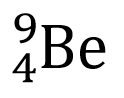
This isotope is also called

a)

Beryllium-4

b)

Beryllium-5

c)

Beryllium-9

d)

Beryllium-13

48.

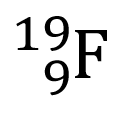
How many protons and neutrons are in the nucleus of the atom shown?

a)

9 protons and 19 neutrons

b)

19 protons and 9 neutrons

c)

10 protons and 9 neutrons

d)

9 protons and 10 neutrons

49.

The Alpha decay of Zinc-66 will produce

a)

Gallium-67

b)

Zinc-65

c)

Nickel-58

d)

Nickel-62

50.
If 10 mg of iodine 131 is given to a patient, how much is left after 24 days? The half-life of iodine-131 is 8 days.
a)
1.25mg
b)
1.25g
c)
10g
d)
10mg
51.
The half-life of strontium-90 is 25 years. How much strontium-90 will remain after 100 years if the initial amount is 4.0 g?
a)
3.0g
b)
0.25mg
c)
0.3g
d)
0.25g
52.

How many Electrons are in Lead?

(a)  

53.
Which technique is shown the diagram below
a)
seiving
b)
filtration
c)
decanting
d)
crystallization
54.

The separation technique that involves heating a solution until the liquid changes into a gas, leaving behind a solid is known as

a)

evaporation

b)

crystallization

c)

centrifuge

d)

chromatography

55.
Oil and water may be separated by using
a)
leibig condenser
b)
separating funnel
c)
centrifuge
d)
distillation
56.

Used to separate a mixture of compounds using affinity to stationary and mobile phases

a)

Chromatography

b)

Filtration

c)

Decantation

d)

Centrifuge

57.

What is the best and easiest way to separate a mixture of salt and water?

a)

Filter

b)

Distillation

c)

Chromatography

d)

Evaporation

e)

Magnet

58.

What is the best and easiest way to separate a mixture of sand and water?

a)

Filter

b)

Distillation

c)

Chromatography

d)

Evaporation

e)

Magnet

59.

The Rf value is calculated during a chromatography run in order to

a)

Determine the size of a component in a mixture

b)

Determine identify the component in a mixture

c)

Determine the distance the component moved during the run

d)

Determine the percentage of a component in a mixture

60.
All of these properties describe metals except...
a)
malleable
b)
conductors
c)
brittle 
d)
shiny
61.

This type of element loses its valence electrons easily.

a)

metal

b)

nonmetal

c)

metalloid

62.
Luster is ___________
a)
A.  the way light is reflected off a surface.
b)
A.  how well a piece of matter conducts electricity. 
c)
A.  the capability of being drawn out into thin wires or threads.
d)
A.  the capability of being hammered out thin.
63.

What is the oxidation number of N ?

a)

-3

b)

+4

c)

-2

d)

+3

64.
If electrons are shared equally then the bond is....
a)
Non-polar covalent
b)
Ionic
c)
Non-polar ionic
d)
Polar covalent
65.

What is the correct Lewis structure for NH3?

a)
b)
c)
d)
66.

Which is the correct molecular structure for carbon dioxide?

a)
b)
c)
d)
67.

what is the empirical formula for a compound that contains 34.43 % iron and 65.57 % chlorine?

a)

FeCl

b)

FeCl2

c)

FeCl3

d)

Fe2Cl3

68.

The empirical formula for a compound between nitrogen and oxygen is NO2. If the molar mass of the compound is 92g/mol, what is the molecular formula?

a)

NO

b)

NO2

c)

N2O3

d)

N2O4

69.
Choose the correct shape for this molecule:
a)
Trigonal planar
b)
Trigonal pyramidal
c)
Tetrahedral
d)
Linear
70.
Choose the correct shape for this molecule:
a)
Trigonal planar
b)
Trigonal pyramidal
c)
Bent
d)
Tetrahedral
71.

The geometry of a molecule with 4 bonded pairs of electrons and 0 lone pairs of electrons, AB4

a)

Tetrahedral

b)

Trigonal Planar

c)

Bent

d)

Trigonal Pyramidal

e)

Linear

72.
Choose the correct shape for this molecule:
a)
Bent
b)
Linear
c)
Tetrahedral
d)
Trigonal pyramidal
73.

A rock has a mass of 50 grams and a volume of 30 cm3. What is the density of the rock?

a)

0.6 g/cm3

b)

1500 g/cm3

c)

80 g/cm3

d)

1.67 g/cm3

74.

Find the mass of a soda can that has a volume of 380 cm3 and a density of 0.97 g/cm3.

a)

368.6 grams

b)

0.0026 grams

c)

391.8 grams

d)

None of the above

75.

Calculate the volume of a egg that has a density of 1.04 g/cm3 and a mass of 60 grams.

a)

0.017 cm3

b)

62.4 cm3

c)

60 cm3

d)

57.7 cm3

76.

What is the equation to measure solve for mass of a heated object

a)

m=QC∆t

b)

m=Q/C∆t

c)

m= C∆t/Q

d)

m=QC

77.

Water has a specific heat of 4.184 J/gºC. Wood has a specific heat of 1.760 J/gºC. What material needs more energy to raise the temperature 1ºC

a)

Wood

b)

Water

c)

Both are the same

78.
20 g of water. specific heat of water is 4.18 J/g°C.  temperature changes from 25° C to 20° Chow much heat energy (Q) moves from the water to the surroundings?
a)
418 Joules
b)
209 J
c)
83 J
d)
4.18 J
79.

The specific heat(c) of copper is 0.390 J/g °C. What is the temperature change(∆t) when 100.0 Joules of heat(Q) is added to 20.0 grams of copper?

a)

12.82°C

b)

24.1°C

c)

351 °C

80.
calcium phosphate
a)
CaPO4
b)
Ca2(PO4)3
c)
Ca3PO4
d)
Ca3(PO4)2
81.
phosphorus trichloride
a)
KCl3
b)
PCl3
c)
K3Cl
d)
P3Cl
82.
silver chromate
a)
AgCr
b)
AgCr2
c)
Ag2CrO4
d)
AgCrO4
83.
diphosphorus pentoxide
a)
P2O5
b)
PO5
c)
P5O2
d)
P2O6
84.
Ba3(PO4)2
a)
tribarium diphosphate
b)
barium diphosphate
c)
barium phosphate
d)
barium phosphide
85.
Fe(NO3)2
a)
iron nitrate
b)
iron dinitrate
c)
iron(II) nitrate
d)
iron(I) nitrate
86.
What is the name of Fe2O3
a)
Iron oxide
b)
Iron II oxide
c)
Iron III oxide
d)
Iron hydroxide
87.

Which is the electron configuration for an oxygen atom?

a)

1s22s22p63s23p4

b)

1s22s22p4

c)

1s22s42p2

d)

1s12s22p5

88.
Which element is pictured?
a)
neon
b)
fluorine
c)
magnesium
d)
argon
89.
What atom matches this electron configuration?
[Xe] 6s2 4f14 5d9
a)
Mercury
b)
Gold
c)
Platinum
d)
Thallium
90.

What is incorrect about this orbital diagram?

a)

Both arrows in the 2p box should be pointing up

b)

There is nothing incorrect with this diagram

c)

There should be 1 electron (arrow) in the first 2p box and one in the 2nd 2p box

d)

All the arrows should be pointing up.

91.

The ability of salt to dissolve into water is what type of property?

a)

Physical

b)

Chemical

92.

When water is heated to 212° F, it begins to boil. This is an example of a

a)

Physical Property

b)

Chemical Property

93.

Gasoline is flammable, meaning it has the ability to catch fire. This is an example of a

a)

Physical Property

b)

Chemical Property

94.

Sodium reacts with water and causes it to burn. This is an example of a

a)

Physical Property

b)

Chemical Property

95.

When you combine sodium hydroxide with silver nitrate, it forms a precipitate. This represents what kind of property?

a)

Physical

b)

Chemical

96.

Rusting, also known as oxidation, is an example of what type of property?

a)

Physical

b)

Chemical

97.
Which of the following is a sign that a chemical reaction has occurred?
a)
change in shape
b)
melting
c)
formation of a gas
d)
dissolving
98.

How many significant figures are in the following number? 100.05

a)

2

b)

3

c)

4

d)

5

99.

Solve and use the correct number of sig figs: 7.989 - 0.54

a)

7.45

b)

7.4

c)

7.447

d)

7.5

100.
Classify the Sample. 
a)
Pure Substance
b)
Mixture of Elements
c)
Mixture of Compounds
d)
Mixture of Elements and Compound
101.
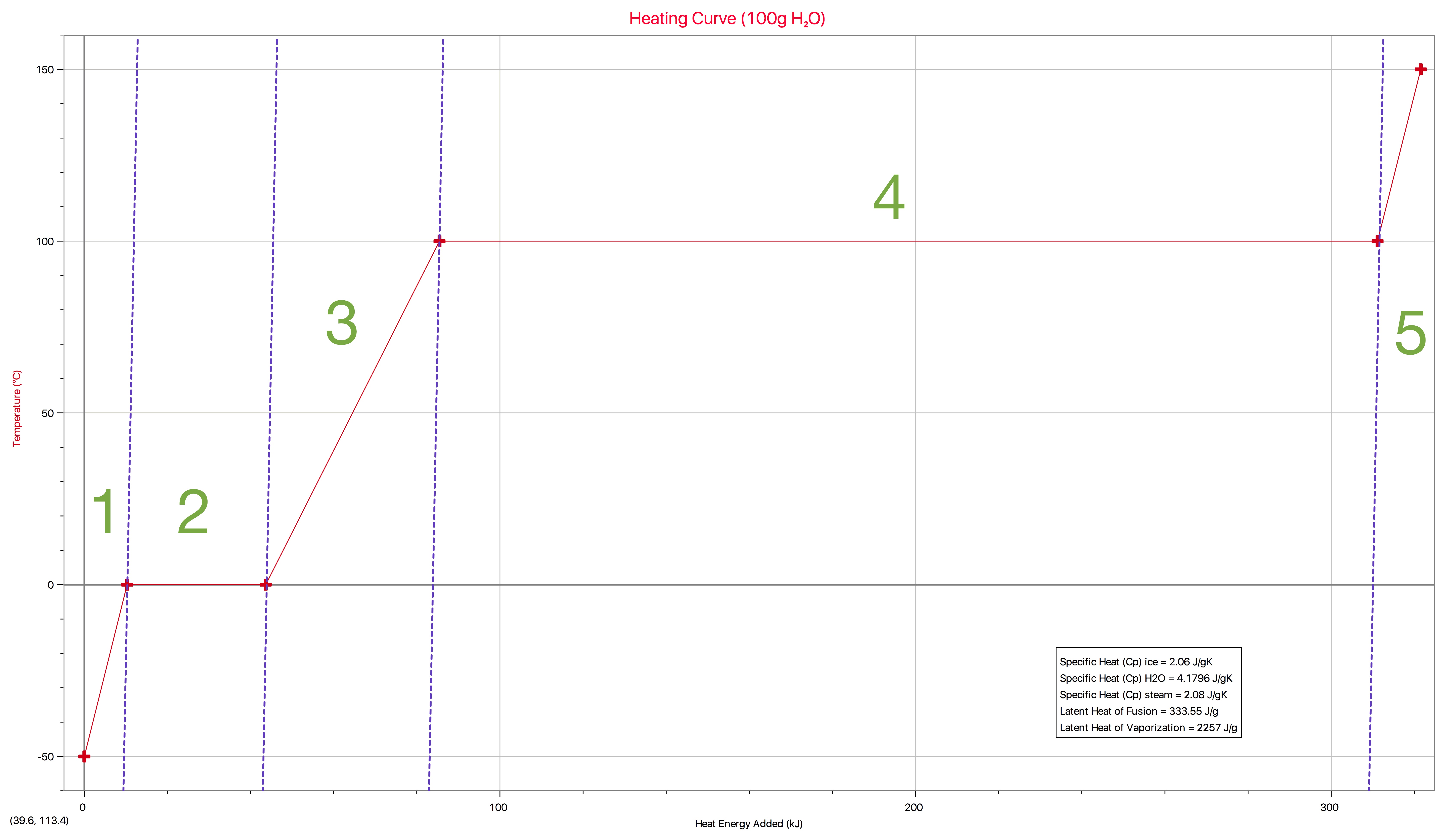
In which region(s) of the graph would the substance be a liquid only?
a)
Region 1
b)
Region 2
c)
Region 3
d)
Region 4
102.
In which region(s) of the graph does boiling take place?
a)
Region 2
b)
Region 3
c)
Region 4
d)
Region 5
103.
For an electron to change from ground state to an excited stated it must...
a)
Absorb energy
b)
Release energy
104.
Emission of light from an atom occurs when an electron
a)
drops from a higher to a lower energy level.
b)
   jumps from a lower to a higher energy level.   
c)
   moves within its atomic orbital.
d)
falls into the nucleus.
105.

Using the Line emission spectrum chart below, identify the elements present in the mixture measured by a spectrometer.

a)

Lithium and cadmium are in the mixture. Strontium is not in the mixture.

b)

Lithium and strontium are in the mixture. Cadmium is not in the mixture

c)

Cadmium and strontium are in the mixture. Lithium is not in the mixture

d)

All of the shown elements are present in the mixture.