
 Worksheets
Principles of Evolution and Evolution of Populations
Total questions: 27
Worksheet time: 18mins
Name
Class
Date
1.
What is another name for natural selection?
a)
survival of the smartest
b)
survival of the fastest
c)
survival of the biggest
d)
survival of the fittest
2.
What is a change in an organism that allows for it to survive in its environment?
a)
homologous
b)
vestigial
c)
variation
d)
adaptation
3.
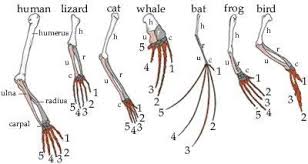
What is this an example of?
a)
vestigial structures
b)
embryology
c)
homologous structures
d)
fossil record
4.
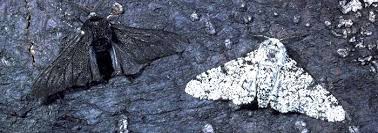
Predict which moth would increase in population
a)
light
b)
dark
5.
When individuals choose traits possessed by the opposite sex it is called…
a)
Mutation
b)
Gene Flow
c)
Genetic Drift
d)
Sexual Selection
6.
The cause of artificial selection is…
a)
The environment
b)
Humans
c)
Mutation
d)
Gene Flow
7.
The environment around Manchester, England, changed during the Industrial Revolution. How did this change affect peppered moths living in the area?
a)
Natural selection favored moths with dark wings because predators could not see them on the soot-colored trees.
b)
Natural selection favored moths with white wings that were easy for predators to see.
c)
Natural selection favored moths with white wings because predators could not see them on the soot-colored trees.
d)
Natural selection caused moths with white wings to become extinct.
8.
What characteristic did Darwin observe about the finches on the Galapagos Islands?
a)
Their feathers
b)
Genotypes
c)
Their beaks
d)
Their body sizes
9.
Genetic differences between organisms of the same species
a)
Variation
b)
Adaptation
c)
Behavior
d)
Environment
10.
What is the advantage of having different shaped beaks?
a)
To look different from other species.
b)
To be able to eat the food readily available in the environment.
c)
To protect itself against predators.
d)
To protect itself against prey.
11.

What increases genetic variation when animals move from one population to another
a)
genetic drift
b)
sexual selection
c)
bottleneck effect
d)
gene flow
12.

If an organism has a vestigial structure, that structure likely once had a function in a(n)
a)
close relative
b)
early ancestor
c)
unrelated organism
d)
embryological stage
13.
What is speciation?
a)
combining of tow species to form one with different traits
b)
isolation that affects mating behaviors
c)
timing of mating that prevents normal sexual selection
d)
divergence of two or more species from an existing one
14.

How would you describe these two features?
a)
Homologous structure
b)
Analogous structure
c)
Structural adaption
d)
Functional adaption
15.
A flash flood carried a raft of Amazon ants away from their original population. There is enough distance between the two groups, that they will never meet in nature again. What type of reproductive barrier is this?
a)
behavioral isolation
b)
temporal isolation
c)
gametic isolation
d)
geographic isolation
16.
When reproductive barriers separate a population of a species in nature, the species no longer share a...
a)
taxa
b)
gene pool
c)
phylogenetic tree
d)
species
17.
Different mating times
a)
temporal
b)
behavioral
c)
geographic
d)
other
18.
A scientists studies a population blue footed boobies on the Galapagos Islands and notices that one population has developed a unique song to attract mates that other populations of the same species do not use. This can lead to speciation from ________.
a)
behavioral isolation
b)
temporal isolation
c)
geographic isolation
d)
Tri Wizard Cup
19.

What type of selection is this?
a)
Directional Selection
b)
Stabilizing Selection
c)
Disruptive Selection
d)
Natural Selection
20.

What type of selection is this?
a)
Directional Selection
b)
Stabilizing Selection
c)
Disruptive Selection
d)
Natural Selection
21.

What type of selection is this?
a)
Directional Selection
b)
Stabilizing Selection
c)
Disruptive Selection
d)
Natural Selection
22.
The model that predicts evolution occurs at a slow, steady rate is called...
a)
gradualism
b)
punctuated equilibrium
c)
adaptive radiation
d)
convergent evolution
23.
The model that predicts evolution occurs in rapid bursts followed by long periods of no change is called...
a)
gradualism
b)
punctuated equilibrium
c)
adaptive radiation
d)
convergent evolution
24.
What is the bottleneck effect?
a)
Members of one sex choose mates with particular features
b)
The process in which humans select for or against particular features in organisms
c)
When an event
drastically reduces
population size and then the population rebounds
drastically reduces
population size and then the population rebounds
d)
A small sample of a population settles in a location separated from the rest of the population
25.
Genetic Drift is more likely to happen in...
a)
aquatic populations
b)
small populations
c)
terrestrial populations
d)
older populations
26.
Natural selection states that organisms are best suited for their environment if they ____________ and ____________.
a)
Survive and Reproduce
b)
Survive and Predate
c)
Survive and Parasitize
d)
Survive and Adapt
27.
According to the bead lab, Genetic drift (bottleneck or founder) tends to ___________ genetic variation (diversity)
a)
Increase
b)
Decrease
c)
Stabilize
d)
Exaggerate
100 %

