
NEW
Font size
S
M
L
XL
 Worksheets
World War I
Total questions: 75
Worksheet time: 1hrs 10mins
Name
Class
Date
1.
The building up of a nation's army is called...
a)
Militarism
b)
Nationalism
c)
Imperialism
d)
Alliances
2.
Information designed to influence opinion or persuade people of a particular point of view is called...
a)
Militarism
b)
Communism
c)
Propaganda
d)
Informationism
3.
What were the four long-term causes of WWI?
a)
Militarism, Alliances, Nationalism, Imperialism
b)
Militarism, Alliances, Nationalism, Isolationism
c)
Militarism, Association, Nationalism, Internationalism
d)
Militarism, Alliances, Nationalism, Impractical
4.
What "sparked" World War I?
a)
Assassination of Archduke Franz Ferdinand
b)
Sinking of the Lusitania
c)
Explosion of the U.S.S. Maine
d)
Germany's invasion of Belgium
5.
Russia, Great Britain, and France were all part of the...
a)
Allied Powers
b)
Central Powers
c)
Axis Powers
d)
Neutral Powers
6.
Germany, Austria-Hungary, and the Ottoman Empire were all part of the...
a)
Central Powers
b)
Allied Powers
c)
Axis Powers
d)
Neutral Powers
7.
What country remained neutral at the beginning of the war?
a)
France
b)
United States
c)
Russia
d)
Germany
8.
What type of fighting was used in WWI?
a)
Guerrilla warfare
b)
Conventional warfare
c)
Nuclear warfare
d)
Trench warfare
9.
What new technology sank allied and neutral supply ships?
a)
Dreadnoughts
b)
U-Boats
c)
Airplanes
d)
Automated cannons
10.
What nation did NOT sign the Treaty of Versailles?
a)
France
b)
Great Britain
c)
United States
d)
Germany
11.
Which nation did Germany invade, resulting in Britain joining the war?
a)
Belgium
b)
France
c)
Switzerland
d)
Luxembourg
12.
Which treaty ended World War I?
a)
The Treaty of Paris
b)
The Treaty of Versailles
c)
The Armistice of Versailles
d)
The Treaty of World Powers
13.
The United States joined the war in what year?
a)
1914
b)
1915
c)
1916
d)
1917
14.
Which of the following is the best example of militarism?
a)
England building a powerful navy.
b)
The French singing their national anthem.
c)
France's alliance with England.
d)
The British teaching English in India
15.
Which of the following is the best example of imperialism?
a)
France building a powerful navy.
b)
England's alliance with France.
c)
German schools teaching English.
d)
England and Germany competing for colonies.
16.
Prior to 1917, the policy of the U.S. can be best described by which of the following terms?
a)
Neutral, but traded mainly with the Allied Powers
b)
Neutral, but traded mainly with the Central Powers
c)
Complete neutrality with no involvement on either side
d)
Nationalist but traded with both sides
17.
Why did the U.S. did not want to join the League of Nations?
a)
There was fear that it would get the U.S. involved in another war
b)
Germany was allowed into the League of Nations
c)
The League of Nations would be too expensive for Americans
d)
The U.S. was preoccupied with difficulties at home
18.
The land between trenches was known as...
a)
No Man's Land
b)
Dead Space
c)
The Danger Zone
d)
Barbed Wire Zone
19.
The Zimmerman Telegram can best be described by which of the following?
a)
Great Britain promised the U.S. that they would help them gain territories in Europe
b)
Mexico vowed to help the U.S. and the Allies in World War I
c)
Germany asked Mexico to declare war on the U.S. to regain lost territories
d)
Russia withdrew from the war due to the revolution that was occurring in the country
20.
Which of the following was NOT one of the new technologies in World War I?
a)
chemical weapons
b)
airplanes
c)
submarines
d)
nuclear bomb
21.
What was the name of the British passenger boat that was sunk by German U-Boats?
a)
U.S.S. Maine
b)
Lusitania
c)
U.S.S. Admiral
d)
Titanic
22.
Which of the following choices is NOT a result trench warfare during World War I?
a)
stalemate
b)
higher casualties
c)
the war ended quickly
d)
horrible conditions for soldiers
23.
Which of these is NOT one of the reasons why the U.S. got involved in World War I?
a)
The Zimmerman Telegram
b)
Unrestricted German submarine warfare
c)
Close ties with Great Britain and France
d)
Assassination of Archduke Franz Ferdinand
24.
President Wilson's Fourteen Points...
a)
initiated U.S. involvement in World War I
b)
laid out his goals for peace
c)
ended World War I
d)
called for Germany to accept blame for the war
25.
Each of the following countries accepted the Treaty of Versailles EXCEPT...
a)
Germany
b)
France
c)
Britain
d)
United States
26.
All of the following are true about trench warfare EXCEPT...
a)
trenches provided protection to soldiers from gun fire
b)
trench warfare was uncommon in World War I
c)
each side built extensive networks of trenches
d)
soldiers were forced to live in terrible conditions
27.
Which document punished Germany after World War I?
a)
Treaty of Versailles
b)
Yalta Agreement
c)
Roosevelt Corollary
d)
Fourteen Points
28.

What was the land between two enemy lines called?
a)
No Man's Land
b)
His brother's land
c)
Auntie Anne's Land
d)
Pen Cattle
29.
In the Treaty of Versailles, Germany was subjected to reparations which are:
a)
Payments made for damage caused during the war
b)
An act on behalf of the League of Nations
c)
An agreement to end all fighting
d)
giving up land previously owned
30.
Which country was not a member of the Allied Powers?
a)
Bulgaria
b)
France
c)
Great Britain
d)
Russia
31.

The assassination of which leader was the spark that started a world war in Europe in 1914?
a)
Tsar Nicholas II of Russia
b)
Emperor Franz Josef of Austria-Hungary
c)
King George V of England
d)
Archduke Franz Ferdinand of Austria-Hungary
32.

What was the U.S. response to the outbreak of war in Europe in 1914?
a)
Immediate declaration of war against Austria-Hungary
b)
Immediate declaration of neutrality
c)
A statement that the US would join the side which paid the most
d)
A promise to join the war in a year
33.

World War I was not known as World War I at the time. It was called the...
a)
War to End All Wars
b)
Best War Ever!
c)
Great War
d)
Anglo-German War
34.
On November 11, 1918 the fighting stopped and Germany signed an armistice, or __________.
a)
peace treaty
b)
cease-fire
c)
reparations
d)
acknowledgement of guilt
35.
President Woodrow Wilson wanted to create a "general association of nations" called the ___________ to ensure peace after the war.
a)
League of Nations
b)
United Nations
c)
Triple Entente
d)
Allied Powers
36.
The U.S. government sold these to raise money for the war effort.
a)
stock options
b)
liberty bonds
c)
victory gardens
d)
selective service act
37.
The assassin who killed Franz Ferdinand and his wife Sophie was Gavrilo Princip, a member of the ______ nationalist group The Black Hand.
a)
German
b)
Serbian
c)
Russian
d)
American
38.
Germany invaded what neutral country to carry out its Schlieffen Plan?
a)
Switzerland
b)
Belgium
c)
Italy
d)
Spain
39.
The Schlieffen Plan was Germany's military strategy to achieve what goal?
a)
Avoid a two-front war with France and Russia
b)
Gain an alliance with Britain and France
c)
Knock Italy out of the war
d)
Keep the United States out of the war
40.
Why did the U.S. reject the Treaty of Versailles?
a)
They wanted Germany to pay reparations for the Lusitania
b)
They didn't want to join the League of Nations
c)
It was too lenient toward Germany
d)
Democrats didn't want to help out Woodrow Wilson
41.

Who was the American President during WWI?
a)
George Washington
b)
Woodrow Wilson
c)
Franklin Roosevelt
d)
Theodore Roosevelt
42.
What political party took over Russia during the Russian Revolution?
a)
Soviets
b)
Bolsheviks
c)
Serbs
d)
Slovenes
43.
Which of the following was NOT a cause of World War I?
a)
nationalism
b)
imperialism
c)
militarism
d)
isolationism
44.

Which of the following was NOT included in the peace treaty to end World War I?
a)
Germany had to pay reparations to the Allies
b)
The League of Nations was created
c)
Germany had to take responsibility for starting the war
d)
All European countries demilitarized
45.

After the war, the United States...
a)
refused to join the League of Nations reverted back to isolationism
b)
joined the League of Nations and continued to practice internationalism
c)
refused to join the League of Nations and focused on expanding through imperialism
d)
joined the League of Nations and worked with other countries to ensure peace through collective security
46.
Unrestricted submarine warfare, Zimmerman telegram, sinking of the Lusitania, propaganda, and close ties with Britain and France can all be categorized as...
a)
Wilson's Domestic Strategies
b)
1914 Causes of World War I
c)
Causes of America's entry in the Great War
d)
Terms of Wilson's 14 Points
47.
A new style of warfare where soldiers dug ditches to protect themselves from enemy fire. It led to a stalemate in Europe by late 1914.
a)
Guerilla Warfare
b)
Submarine Warfare
c)
Trench Warfare
d)
Jungle Warfare
48.

President Wilson's plan to promote world peace.
a)
Monroe Doctrine
b)
Treaty of Brest-Litvosk
c)
Fourteen Points
d)
Treaty of Versailles
49.
What was the "spark" that served as an immediate cause of World War I?
a)
The sinking of the Lusitania
b)
The assassination of Archduke Franz Ferdinand
c)
Explosion of the U.S.S. Maine
d)
The Zimmerman Telegram
50.
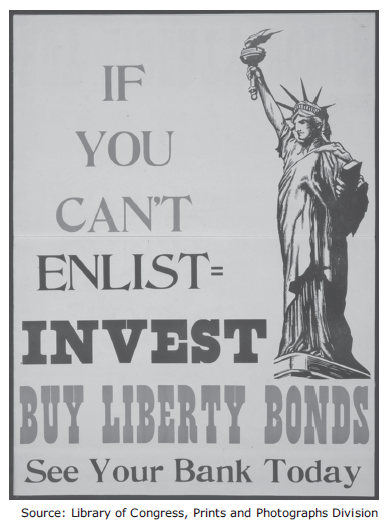
This World War I-era poster was intended to persuade...
a)
children to grow victory gardens
b)
women to work producing war materials
c)
men to enlist in the military
d)
Americans to help finance the war
51.
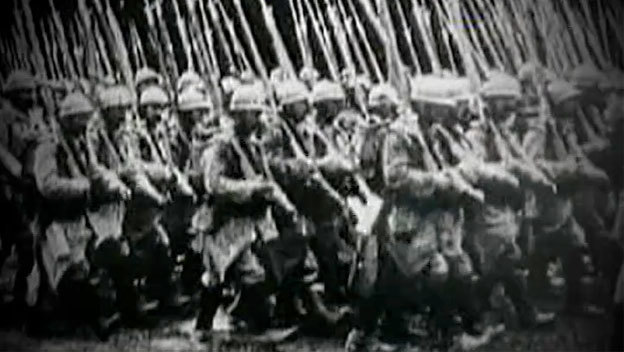
Upon entering World War I, the United States enlarged its military by...
a)
creating the Veterans Administration, which provided benefits for soldiers
b)
passing the Selective Service Act, which required men to enlist
c)
enacting the G.I. Bill, which rewarded veterans for their service
d)
establishing the Marine Corps, which served as an elite branch of the military
52.
What is the policy of building up armed forces in aggressive preparedness for war?
a)
Militarism
b)
Nationalism
c)
Imperialism
d)
Alliances
53.
During WWI, most battles were fought on the Western Front. Near what two countries was it located?
a)
England and France
b)
France and Germany
c)
Italy and France
d)
Russia and Germany
54.
Which of the following is a reason why the U.S. did NOT want to join the League of Nations?
a)
There was fear that it would get the U.S. involved in another war
b)
Germany was allowed into the League of Nations
c)
The League of Nations would be too costly for Americans
d)
The U.S. was preoccupied with difficulties at home.
55.
Which weapon was NOT a new technology introduced in WWI?
a)
atomic bomb
b)
submarine
c)
tank
d)
chemical weapons
56.
This was used during WWI to get people to believe or buy something.
a)
infomercials
b)
commercials
c)
propaganda
d)
yellow journalism
57.
The Treaty of Versailles angered Germany because...
a)
they had to pay reparations to the Allies
b)
their territory and military were significantly reduced
c)
they had to accept full blame for the war
d)
all of the above
58.
The Central Powers included...
a)
Germany, Austria-Hungary, Great Britain
b)
Germany, Austria-Hungary, Ottoman Empire, Bulgaria
c)
France, Russia, Ottoman Empire, Italy
d)
Russia, Italy, Great Britain, United States
59.
What was the purpose of the League of Nations?
a)
To punish Germany for starting World War I.
b)
To force Germans to pay reparations.
c)
To prevent future wars.
d)
To unite Europe.
60.
How did Germany utilize their navy during World War I?
a)
They bombed British battleships with airplanes.
b)
They posted U-Boats in German ports to keep out British ships.
c)
They posted U-boats in the Atlantic Ocean and destroyed supply ships.
d)
They posted U-Boats in the Pacific Ocean to destroy supply ships.
61.

Who was the man who assassinated Franz Ferdinand, sparking World War I?
a)
Vladimir Lenin
b)
Leon Trotsky
c)
Gavrilo Princip
d)
Joseph Stalin
62.

What condition did many soldiers develop from spending hours in waterlogged trenches?
a)
Trench Fever
b)
Trench Foot
c)
Lice
d)
Influenza
63.
What was a U-Boat?
a)
A German Battleship
b)
A British Battleship
c)
A German submarine
d)
A German Tank
64.
What is an alliance?
a)
Agreements between nations to provide aid and protect one another
b)
Organizations of countries created after WWI to prevent future wars
c)
When one country takes over another country economically and politically
d)
Group of nations who are controlled by the same power
65.
What was the League of Nations?
a)
An organization America joined after WWI
b)
An organization created to prevent future wars after WWI
c)
An organization of exclusively European nations
d)
An organization of the losing countries from WWI
66.
Which country switched sides to become a member of the Allied Powers?
a)
Italy
b)
Austria-Hungary
c)
Germany
d)
Bulgaria
67.

Identify country A
a)
Germany
b)
Austria-Hungary
c)
Great Britain
d)
France
68.
Identify country B
a)
Germany
b)
Austria-Hungary
c)
Great Britain
d)
France
69.
Identify country C
a)
Germany
b)
Austria-Hungary
c)
Great Britain
d)
France
70.
Countries B, C, D, and F are all part of the...
a)
Allied Powers
b)
Central Powers
c)
Axis Powers
d)
Neutral Alliance
71.
Identify country F
a)
Russia
b)
Italy
c)
Germany
d)
Great Britain
72.
Identify country E
a)
Russia
b)
Italy
c)
Germany
d)
Great Britain
73.
Identify country D
a)
Russia
b)
Italy
c)
Germany
d)
Great Britain
74.
Which of the following was NOT a result of the 1917 Russian Revolution?
a)
The Bolshevik Party took power over Russia
b)
Czar Nicholas and his entire family was killled
c)
Russia officially withdraws from World War I
d)
Vladimir Lenin is assassinated by a Serbian nationalist
75.
Under the Treaty of Versailles, Germany had to accept full blame for the war, pay reparations, reduce the size of their military, and...
a)
join the League of Nations
b)
restore the German monarchy
c)
give their colonial territories to Britain and France
d)
unite with Austria-Hungary
Reset

