
 Worksheets
y7 Ta2 js and CPU
Total questions: 75
Worksheet time: 1hrs 28mins
Name
Class
Date
1.

What is the purpose of the CPU?
a)
To process all the data and instructions.
b)
To turn the computer on.
c)
To create PowerPoint presentations.
d)
To provide power to the computer.
2.

What is the main function of the CPU?
a)
To carry out processing of the data.
b)
To help with playing games.
c)
To fetch instructions from memory, decode them and execute the instructions.
d)
To heat up the computer.
3.
What is the job of the control unit?
a)
It carries out calculations
b)
It stores information.
c)
It does nothing.
d)
It controls the input and output of data to make sure that it gets to the right place.
4.
What are the two other parts of the CPU that you learned?
a)
RAM & ROM
b)
Hard Drive & Motherboard
c)
The ALU and Cache
5.
What happens at the Decode step of the fetch-decode-execute cycle?
a)
The CPU makes sense of the instructions.
b)
The CPU fetches the information from RAM.
c)
The instructions are executed.
6.

What does CPU stand for?
a)
Control Processing Unit
b)
Central Processing Unit
c)
Central Power Unit
d)
Center Power Unit
7.
Which of the following is an example of 'main memory'.
a)
Hard Drive
b)
USB Drive
c)
RAM
d)
ROM
8.
Which of the following CPU's will have a better better performance:
A: 3 GHz Quad Core CPU
B: 3 GHz Duel Core CPU
A: 3 GHz Quad Core CPU
B: 3 GHz Duel Core CPU
a)
A
b)
B
9.
How does clock speed affect computer performance?
a)
The higher the clock speed the slower the computer will run.
b)
It improves the amount you can store on the computer.
c)
The higher the clock speed the better the performance.
d)
It will make loading program slower
10.
What is cache memory?
a)
A very large, temporary memory
b)
A very small but expensive memory
c)
It is used to store data and programs permanently
d)
It is a type of payment
11.
How can a bigger cache improve CPU performance?
a)
By being able to carry out more calculations
b)
By being able to store more recently used instruction inside the CPU for quicker access times
c)
By being able to
12.
The CPU does NOT
a)
Make decisions
b)
Check the type of hardware
13.
The CPU performs mathematical calculations
a)
TRUE
b)
FALSE
14.

Indicates how fast the CPU can run
a)
Cache size
b)
Core
c)
Intel
d)
Clock speed
15.

A CPU can contain one or more processing units. Each unit is called a ___.This is one of the key factors about CPU architecture that affect its performance.
a)
Core
b)
Intel
c)
AMD
d)
Megabite
16.
____ is a small amount of memory which is a part of the CPU - closer to the CPU than RAM.
a)
Cache
b)
Core
c)
Intel
d)
Clock speed
17.

It consists of two parts:
Arithmetic part and Logic part
Arithmetic part and Logic part
a)
RAM
b)
Clock speed
c)
ALU
d)
Cache
18.
A clock speed of 500Hz means...
a)
500 cycles per second
b)
5000 cycles per minute
c)
5 cycles per hour
d)
50 cycles per minute
19.

The hardware that defines a computer is the ___ and___. Without these a computer could not function.
a)
Mouse and keyboard
b)
Microsoft Word and Microsoft Excel
c)
Monitor and CPU
d)
CPU and memory
20.

Clock speed measures what?
a)
Speed at which instructions are fetched from main memory
b)
Time taken to perform a single Fetch-Decode-Execute cycle
c)
Number of Fetch-Decode-Execute cycles that can be completed in 1 sec
d)
Speed at which instructions are decoded
21.

Cache memory is...
a)
Faster than main memory but less expensive
b)
Faster than main memory and more expen
c)
Slower than main memory and less expensive
d)
Slower than main memory but more expensive
22.

Cache memory will speed up the computer because:
a)
It will process items in parallel, so more things can be processed at once
b)
It will process delete old items so the CPU isn't overflowing with data
c)
It will store frequently used items in the CPU so they are fast to access
23.
Stores the results of calculations made by the ALU.
a)
Program Counter
b)
Memory data register
c)
Accumulator
d)
Current Instruction register
24.
Carries out the calculations and logical decisions. The results of its calculations are stored in the accumulator.
a)
CPU
b)
Control Unit
c)
Arithmetic and Logic Unit
d)
Memory Address Register
25.
Often described as the ‘brain’ of the computer. This is slightly misleading as it doesn’t actually think, but it does carry out instructions given to it. Inside a processor there are billions of transistors.
a)
CPU
b)
Control Unit
c)
CUP
d)
Registers
26.
Sends out signals to co-ordinate how the processor works. It controls how the data moves around parts of the CPU and how it moves between the CPU and memory. Instructions are decoded in the control unit.
a)
Control Unit
b)
ALU
c)
Register
d)
CPU
27.
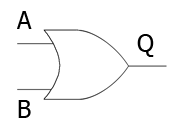
What logic gate is this?
a)
AND
b)
OR
c)
NOT
d)
TO
28.
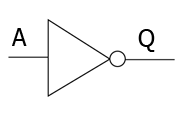
What logic gate is this?
a)
AND
b)
OR
c)
NOT
d)
THE
29.

What logic gate is this?
a)
OR
b)
NOT
c)
AND
d)
THE
30.
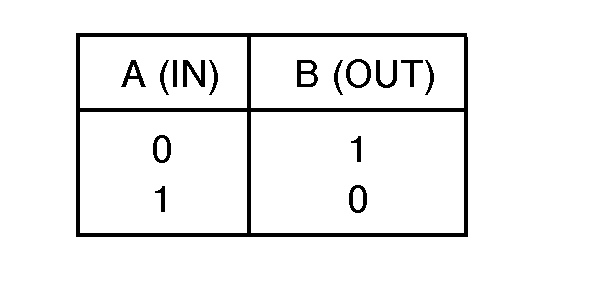
What gate is this truth table for?
a)
AND
b)
OR
c)
NOT
d)
THE
31.

Which logic gate is this?
a)
AND
b)
NOR
c)
NOT
d)
OR
32.
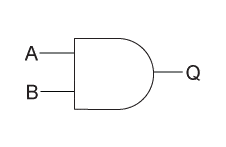
Which logic gate is this?
a)
AND
b)
OR
c)
XOR
d)
NOT
33.
AND Gate:
IF A and B are ON, the output would be...
IF A and B are ON, the output would be...
a)
ON
b)
OFF
34.
Which CPU is likely to process data the slowest?
a)
1.6 MHz
b)
2.6 MHz
c)
1.6 GHZ
d)
2.6 GHZ
35.
Describe what is meant by MHz for processor speed.
a)
Mhz means megahertz. A 1 megahertz CPU can follow approximately 1 million instructions per second.
b)
Both these things allow the CPU to process jobs faster and improve the performance of a CPU.
c)
The law that states that the clock speed of CPUs manufactured will double every two years.
d)
Increase number of cores – so that it can carry out more instructions at once
36.
Mary’s computer has an 800MHz CPU and 1GB of RAM. Explain three ways that Mary’s computer can be upgraded to improve its performance.
a)
Both these things allow the CPU to process jobs faster and improve the performance of a CPU.
b)
Increase size of cache, increase number of cores, and increase clock speed.
c)
Increase size of cache so that more regularly used data can be fetched quickly from cache rather than having to fetch it from RAM which is slower
d)
Mhz means megahertz and GHz means gigahertz.
37.
Explain how cache size of a CPU affect its performance.
a)
Increasing the size of cache means that more regularly used data can be fetched quickly from cache rather than having to fetch it from RAM which is slower.
b)
Increase size of cache so that more regularly used data can be fetched quickly from cache rather than having to fetch it from RAM which is slower
c)
The law that states that the clock speed of CPUs manufactured will double every two years.
d)
Clock speed is a measure of how many instructions a CPU can carry out per second.
38.
Describe the benefits of a dual core processor over a single core processor.
a)
Mhz means megahertz and GHz means gigahertz.
b)
Increase size of cache so that more regularly used data can be fetched quickly from cache rather than having to fetch it from RAM which is slower
c)
A duel core processor can carry out approximately twice the number of instructions per second than a single core processor. This is because each core can carry out instructions at the same time.
d)
Increase number of cores – so that it can carry out more instructions at once
39.
Describe what is meant by 2GHz CPU.
a)
The law that states that the clock speed of CPUs manufactured will double every two years.
b)
A CPU that can carry out approximately 2 billion instructions per second.
c)
Increase size of cache so that more regularly used data can be fetched quickly from cache rather than having to fetch it from RAM which is slower
d)
A duel core processor can carry out approximately twice the number of instructions per second than a single core processor.
40.
Describe what is meant by a single-core processor.
a)
A CPU with one core. A core is one unit that can run one program at a time.
b)
The law that states that the clock speed of CPUs manufactured will double every two years.
c)
Increase clock speed - so that it can carry out more instructions per second
d)
A duel core processor can carry out approximately twice the number of instructions per second than a single core processor.
41.

What gate is this table for?
a)
AND
b)
OR
c)
NOT
d)
NOR
42.
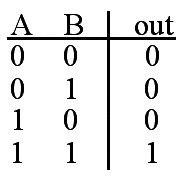
What gate is this table for?
a)
AND
b)
XOR
c)
OR
d)
NOT
43.
Logic gates are digital ...
a)
.. Switches
b)
.. Footprints
c)
.. Binary
d)
.. RAM
44.
OR Gate:
IF A is ON and B is ON, the output would be...
IF A is ON and B is ON, the output would be...
a)
ON
b)
OFF
45.
OR Gate:
If A is OFF and B is ON, the output would be...
If A is OFF and B is ON, the output would be...
a)
ON
b)
OFF
46.
NOT Gate:
If A is ON, the output would be...
If A is ON, the output would be...
a)
ON
b)
OFF
47.
NOT Gate:
If A is OFF, the output would be...
If A is OFF, the output would be...
a)
ON
b)
OFF
48.

A printer is computer hardware device used for ___________________.
a)
Input
b)
Output
c)
Storage
49.

What type of device is a monitor?
a)
Input
b)
Output
c)
Storage
50.

What type of device are these?
a)
Input
b)
Output
c)
Storage
51.

What type of device is this?
a)
Input
b)
Output
c)
Storage
52.

What type of device is this tablet?
a)
Input
b)
Output
53.

A keyboard in an __________________device.
a)
Input
b)
Output
54.
What command draws a rectangle?
a)
rec (10, 20, 100, 200);
b)
rect (10, 20, 100, 200)
c)
rect (10, 20, 100, 200);
d)
ellipse (10, 20, 40, 40)
55.
Which command colors the background of your canvas?
a)
background
b)
endShape
c)
var = color
d)
fill
56.
What command removes the outlines from shapes?
a)
noOutline ();
b)
noColor();
c)
noBorder();
d)
noStroke ();
57.
What command draws a perfect circle?
a)
ellipse (80, 60, 100, 105);
b)
ellipse(80, 60, 100, 100);
c)
circle (80, 60, 80, 60):
d)
ellipse (80, 60, 105, 100);
58.
What command colors a shape?
a)
color (43, 255, 0);
b)
bucket (43, 255, 0);
c)
fill (43, 255, 0);
d)
bucket (43, 255, 0);
59.
What command draws a perfect circle?
a)
ellipse (80, 60, 100, 105);
b)
ellipse(80, 60, 100, 100);
c)
circle (80, 60, 80, 60):
d)
ellipse (80, 60, 105, 100);
60.
What command draws a line?
a)
stroke (200, 220, 275, 220);
b)
line (200, 220, 275, 220);
c)
horizontal (200, 220, 60, 75);
d)
pencil (200, 220, 275, 220);
61.
What is at the end of a line of code?
a)
#
b)
;
c)
)
d)
>
62.
What kind of statement allows us to run a block code only if a certain condition is true?
a)
if statement
b)
break statement
c)
else statement
d)
for loop
63.
What is Phishing?
a)
When you take your pole and worms and try to catch some fishies.
b)
Using email to fish for private information online.
c)
What cats do for dinner
d)
Sending a text message to fish for dates.
64.
What is your digital footprint?
a)
A scanned image of your foot
b)
A photograph of your shoe
c)
All the information online about a person, either posted by that person or others
d)
Having a blog, facebook or twitter page
65.
Everything that is posted online is saved for how long?
a)
Until I remove it
b)
Forever
c)
Two weeks
d)
One year
66.
True or False?
Clearing your browsing history removes your digital footprint
Clearing your browsing history removes your digital footprint
a)
True
b)
False
67.
True or False?
After a picture on SnapChat disappears, it's gone forever.
After a picture on SnapChat disappears, it's gone forever.
a)
True
b)
False
68.
What information should you NOT share online?
a)
Your first and last name
b)
Your birthday
c)
The name of your school or city
d)
All of the above
69.
True or False? Once a picture is on the internet, it's easy to removed it
a)
True
b)
False
70.
What would be a good example of a screen name to use in an online game or app?
a)
Your name
b)
Your birthday
c)
Your address
d)
penguinfan13
71.

Which of the following is a good password?
a)
123456789 is a good password
b)
HsDpassword* is a good password
c)
Be@rs492 is a good password
72.

What should you have in your password?
a)
A. you should have letters, numbers, and symbols in your password
b)
Capitals, lower case, numbers, and symbols in your password
c)
You should have letters and numbers in your password
73.
You receive an email with an attachment that says 'Winner' but you don't remember entering any competition. What do you do?
a)
Reply to the message asking them to stop sending you mail.
b)
Open the attachment, you've won something!
c)
Delete the email without reading it.
d)
Forward the email to a friend, it will be funny to trick them too.
74.
You are using the web to find some information for a homework project. You find some really useful stuff. What should you do?
a)
Cut and paste it into your work. No one will know that you didn’t write it
b)
Believe what you read – everything on the web is true
c)
Check a second website to see if the information is true.
d)
Don't bother doing the homework, this is too hard.
75.
Someone sends you a nasty text message. What should you do?
a)
Tell my teacher/parents/carer and refuse to be upset by the message.
b)
Send them a mean message back.
c)
Text them a message asking them to stop.
d)
Delete the message and pretend you didn't get a nasty text.
100 %

