
 Worksheets
DNA Structure & Replication (H Bio)
Total questions: 35
Worksheet time: 31mins
In DNA replication, the lagging strand will form off of the parent strand that ENDS with
5'
3'
Which enzyme makes sure the bases pair up correctly during DNA replication?
Primase
Helicase
DNA polymerase
DNA ligase
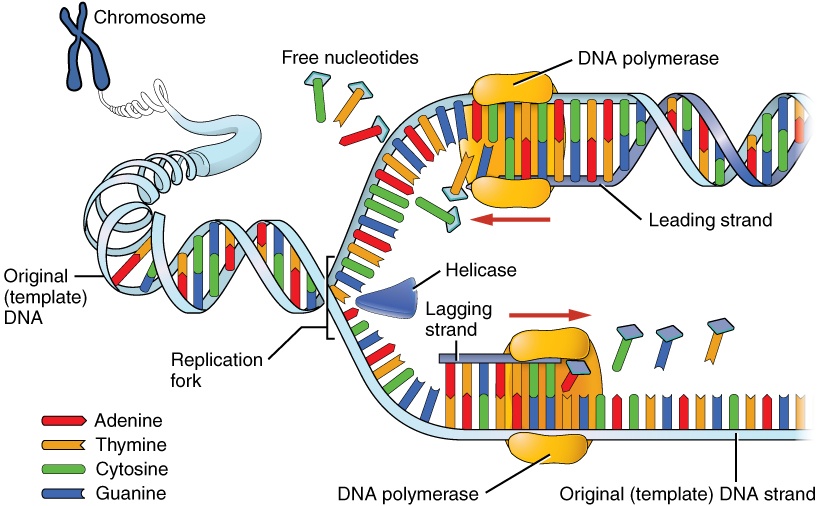
Which strand is synthesized continuously during DNA Replication?
Leading Strand
Lagging Strand
Which of the following enzymes are NOT involved in DNA replication?
RNA polymerase
Primase
DNA ligase
DNA polymerase
What enzyme is responsible for laying down the RNA primers during DNA Replication?
DNA Helicase
Primase
DNA Ligase
RNA polymerase
The bonds that hold the two strands of DNA together are
strong hydrogen bonds.
weak covalent bonds.
strong covalent bonds.
weak hydrogen bonds.
The leading strand is built__________ the replication fork, and the lagging strand is built ___________ the replication fork.
towards, towards
away from, away from
away from, towards
towards, away from

Small segments of DNA made on the lagging strand are called:
Okazaki Fragments
DNA primers
RNA primers
Telomeres
5'-ATGCCAT-3'
Most potential mistakes made during DNA replication are corrected by
helicase
DNA polymerase
primase
DNA ligase

The enzyme that unzips the DNA to prepare for replication ("The Unzipper")
Helicase
DNA ligase
DNA polymerase
RNA polymerase


On the diagram below, which number is the Okazaki fragment?
3
4
6
8
On the diagram below, which number represents the leading strand?
1
2
3
8
On the diagram below, which number is the RNA primer?
3
4
6
8
On the diagram below, which number is helicase?
3
4
5
6
TRUE / FALSE. Only the lagging strand contains primers.
TRUE
FALSE
Which enzyme is responsible for linking the nucleotides together?
DNA helicase
DNA ligase
DNA polymerase
Primase
DNA replication results in
2 completely new DNA molecules
2 DNA molecules that each contain a strand of the original
1 new DNA molecule and 1 old
1 new molecule of DNA
The new DNA strand formed after DNA replication is an exact copy of its parent strand
True
False

The picture below shows the steps of DNA replication beginning with step one and ending with step three.
Because you are reusing the old, or parent, DNA strand DNA replication is said to be
Semi- Conservative
Semi-discontinuous
Continuous
Anti-parallel

Which letter in the picture below depicts the leading strand in DNA replication?
A
C
B
None of the above
Which letter in the picture below depicts the replication fork in DNA replication?
A
C
B
None of the above
The directionality of DNA is said to be ___________, because it is side by side by goes in opposite directions.
leading
parallel
anti-parallel
semi-conservative
In which direction are new nucleotides synthesized on the new strand?
5' to 3' (new nucleotides added to the 3' end)
3' to 5' (new nucleotides added to the 5' end)
3' to 5' (new nucleotides added to the 3' end)
5' to 3' (new nucleotides added to the 5' end)
Why does DNA need to be replicated?
so mRNA can make a copy of it
so each cell that results from cell division has the exact DNA
so that new nitrogen bases can be synthesized
so that new amino acids can be synthesized


The term used to describe DNA Replication is
semi-conservative
conservative
anti-parallel
continuous

