
NEW
Font size
S
M
L
XL
 Worksheets
3 PreQuiz Transport
Total questions: 21
Worksheet time: 15mins
Name
Class
Date
1.
Which term means "Water Loving"
a)
Hydrophobic
b)
Hydrophilic
c)
Hydroelectric
d)
Hydroloric
2.
___________ have 2 functions in the cell membrane.
1.) They act like gatekeepers, only let certain things in.
2.) Enzyme receptors embedded in the membrane.
1.) They act like gatekeepers, only let certain things in.
2.) Enzyme receptors embedded in the membrane.
a)
Carbohydrates
b)
Proteins
c)
Phospholipids
d)
Cholesterol
3.

Identify this structure.
a)
cell wall
b)
cell membrane
c)
sap vacuole
d)
cytoplasm
4.
A solution with a pH of 7.0 would be...
a)
Acid
b)
Base
c)
Neutral
d)
Acid and Base
5.
The function of this chemical is to weaken strong acids into weak acids.
a)
Acetic acid
b)
KCl
c)
Buffers
d)
Electrolytes
6.
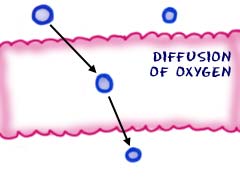
What type of transport is represented by the diagram?
a)
Passive Transport
b)
Active Transport
7.
Osmosis is a form of ______________.
a)
Passive Transport
b)
Active Transport
8.
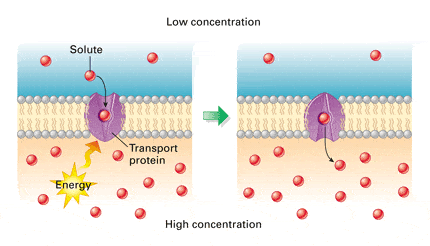
What type of transport is represented by the diagram?
a)
Passive Transport
b)
Active Transport
9.
Moving molecules from Low to High is this type of transport
a)
Passive Transport
b)
Active Transport
10.
What is it called when molecules move across the cell membrane from an area of high concentration to an area of low concentration through a carrier protein?
a)
Diffusion
b)
Osmosis
c)
Active Transport
d)
Facilitated Diffusion
11.
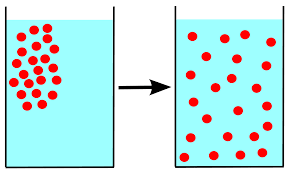
The picture below is an example of _________________.
a)
osmosis
b)
isotonic
c)
diffusion
d)
active transport
12.
During osmosis
a)
water moves from high to low concentration
b)
large or oddly shaped molecules move across a cell membrane
c)
water moves when energy is used
d)
proteins are built
13.
When both inside and outside of a cell have the same amount of water it is said that the cell has reached a state of
a)
Osmosis
b)
Diffusion
c)
Equilibrium
14.

Which way will the water molecules move during osmosis?
a)
Out of the cell, so the cell shrinks.
b)
Out of the cell, so the cell swells.
c)
Into the cell, so the cell shrinks.
d)
Into the cell, so the cell swells.
15.
Osmosis is the diffusion of _____ across a selectively permeable membrane.
a)
food
b)
air
c)
water
d)
oxygen
16.
All of the following require ATP energy EXCEPT
a)
facilitated diffusion
b)
pinocytosis
c)
exocytosis
d)
Na+/K+ pump
17.
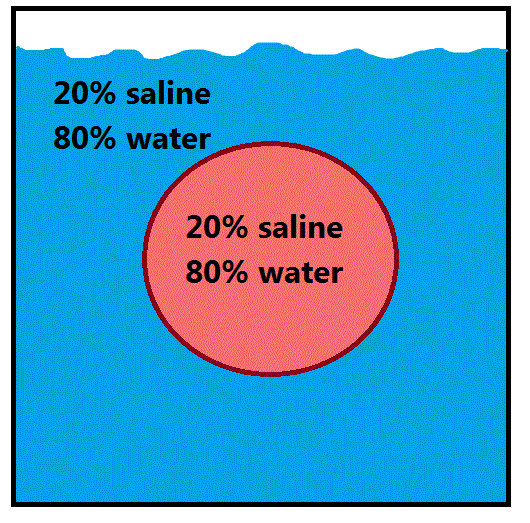
A blood cell is placed into the jar, as seen. Where will the water go?
a)
Into the cell
b)
Out of the cell
c)
Equally in & out - it's isotonic
d)
The water is a lie
18.

Mr. Slug was salted. Where was there more solute immediately after salting?
a)
Outside of the slug
b)
Inside of the slug
c)
There was no solute anywhere
19.
If there are six CO2 outside the cell and three inside. Which way will it move through this membrane?
a)
net inside
b)
net outside
c)
equal both in and out
20.
The pressure that develops in any cell due to osmosis (the pressure required to stop osmotic flow between a cell and pure solvent)
a)
turgor pressure
b)
hemolysis
c)
Osmotic pressure
d)
plasmolysis
21.
The swelling of a plant a cell in a hypotonic solution creates this (the amount of pressure inside a cell due solely to its water content)
a)
turgor pressure
b)
hemolysis
c)
Osmotic pressure
d)
plasmolysis
Reset

