
 Worksheets
Kepler and Big Bang
Total questions: 25
Worksheet time: 31mins
Name
Class
Date
1.
Planets orbit the Sun in a shape called a(n)
a)
circle
b)
ellipse
c)
focus
d)
perihelion
2.
An ellipse is drawn around two points called
a)
aphelion
b)
perihelion
c)
foci
d)
axis
3.
When a planet orbits the Sun, one of the foci of the elliptical orbit is
a)
the axis
b)
the perihelion
c)
the center
d)
the Sun
4.
The place where a planet is closest to the Sun as it orbits the Sun is called the
a)
perihelion
b)
aphelion
5.
The place where a planet is farthest away from the Sun in its orbit around the Sun is called the
a)
aphelion
b)
perihelion
6.
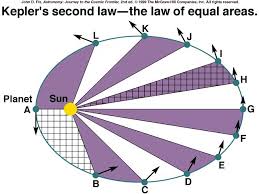
Where is the planet moving faster
a)
Position A to B
b)
Position B to C
c)
Position H to I
d)
Position I to J
7.
What has an eccentricity of zero
a)
a straight line
b)
a large ellipse
c)
a circle
d)
a small ellipse
8.
A planet moves __________ when it is farthest from the sun.
a)
faster
b)
slower
9.
Kepler's first law states that the orbits of the planets are oval in shape or
a)
ellipses
b)
perfect circles
10.
The farther away a planet is from the sun, the _______ it takes it to orbit the sun once.
a)
longer
b)
shorter
11.
If a planet is closer to the sun, its orbit will be _____ than one farther away.
a)
longer
b)
slower
c)
bigger
d)
shorter
12.
The measure of how stretched out an ellipse is, is referred to as
a)
Gravity
b)
Weight
c)
Mass
d)
Eccentricity
13.

The planet travels faster when it is closer to the sun and slower when it is farther away when it is closer to the sun and slower when it is farther away describes which of Kepler's Laws (see illustration)
a)
1st
b)
2nd
c)
3rd
d)
None of the above
14.
According to Kepler’s 3rd Law of Planetary Motion the farther a planet is located from the Sun...
a)
the shorter its period of revolution
b)
the longer its period of revolution
15.
What is the shape of the Earth's orbit around the Sun?
a)
a perfect circle
b)
a very eccentric ellipse
c)
an oblate spheroid
d)
a slightly eccentric ellipse
16.

The diagram to the left shows four positions of a planet in its orbit around the Sun. At which position would the planet’s speed be the greatest?
a)
A
b)
B
c)
C
d)
D
17.

Which diagram shows the least eccentric orbit?
a)
A
b)
B
c)
C
18.
Which statement best describes the geocentric model of our solar system?
a)
The Earth is located at the center of the model.
b)
All planets revolve around the Sun.
c)
The Sun is located at the center of the model.
d)
All planets except the Earth revolve around the Sun.
19.
The Big Bang Theory, describing the creation of the universe, is most directly supported by
a)
red shift of light from distant galaxies
b)
presence of volcanoes on Earth
c)
apparent shape of star constellations
d)
presence of craters on Earth's Moon
20.
Which color has the longest wavelength?
a)
Red
b)
Yellow
c)
Green
d)
Violet
21.
What can the spectrum of a star tell us?
a)
Age of the star
b)
Star's mass
c)
Star's distance from us
d)
Star's chemical composition & elements
22.
What is the apparent change in frequency of waves caused by the relative motions of the source and the observer?
a)
Doppler effect
b)
Microwaves
c)
Speed of light
d)
Infrared
23.
As a light source (star) is moving away from the observer, the light spectrum becomes __________
a)
brighter
b)
no change
c)
shifting to the red end
d)
shifting to the blue end
24.
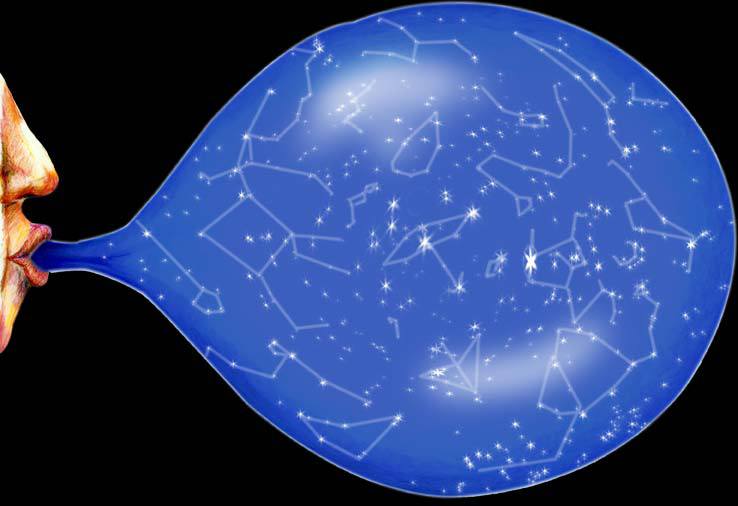
What does the Big Bang theory suggest?
a)
The universe stays still
b)
The stars stay still
c)
The universe is continually expanding
d)
The universe is collapsing in toward a single point
25.
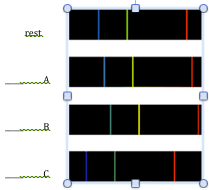
Based on
Hubble’s Law, which of the galaxies is farthest from Earth?
a)
A
b)
B
c)
C
100 %

