
 Worksheets
End of Year Review
Total questions: 30
Worksheet time: 22mins
Name
Class
Date
1.

How many generations are shown in this pedigree?
a)
1
b)
2
c)
3
d)
4
2.

How many kids did the mother and father from the first generation have?
a)
2
b)
4
c)
5
d)
6
3.
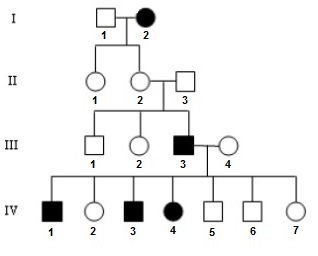
This pedigree represents the inheritance of hemophilia in this family. How many of the females have the hemophilia trait?
a)
8
b)
5
c)
2
d)
3
4.

What do half colored symbols represent?
a)
The individual is a carrier (heterozygous).
b)
The individual expresses the trait.
c)
The individual has both recessive alleles.
d)
The individual has both dominant alleles.
5.

In the second generation-how many people are carriers of the trait?
a)
2
b)
3
c)
5
d)
6
6.
Aa, DD, bB, yy are all examples of
a)
genotypes
b)
phenotypes
7.
AA and Aa always show up as
a)
dominant
b)
recessive
8.
Which of the following genotypes is homozygous dominant?
a)
A
b)
Aa
c)
AA
d)
aa
9.
Which of the following genotypes is heterozygous?
a)
Bb
b)
BB
c)
bb
d)
B
10.
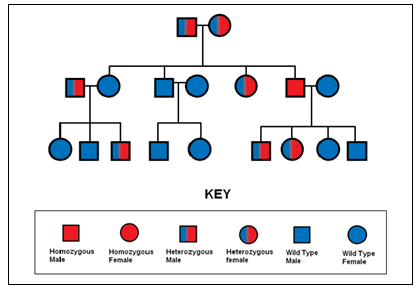
In a pedigree, what shape represents a male?
a)
circle
b)
square
c)
triangle
d)
diamond
11.
In a heterozygous genotype, the ___________ allele takes over in the phenotype.
a)
recessive
b)
dominant
c)
lower case letter
d)
both
12.
Where you will find the ozone layer.
a)
stratosphere
b)
thermosphere
c)
exosphere
d)
mesosphere
13.
Where weather occurs.
a)
stratosphere
b)
thermosphere
c)
troposphere
d)
mesosphere
14.
The hottest layer.
a)
troposphere
b)
thermosphere
c)
exosphere
d)
mesosphere
15.
The higher you go, the air becomes _____ _____.
a)
More dense
b)
Less dense
16.
This is the layer where meteors, or shooting stars, burn up.
a)
Troposphere
b)
Stratosphere
c)
Mesosphere
d)
Thermosphere
17.
What is the energy source for the water cycle?
a)
the sun
b)
the earth
c)
water
d)
the moon
18.
The most common gas in the atmosphere (78%).
a)
Nitrogen
b)
Oxygen
c)
Carbon Dioxide
d)
Trace gases
19.
What organelle is called the "powerhouse" of a cell?
a)
Endoplasmic Reticulum
b)
Nucleus
c)
Mitochondria
d)
Nucleolus
20.
What is the function of the vacuole?
a)
Sac that stores water, nutrients, and waste products
b)
Sac filled with digestive chemicals
c)
Jelly-like substance within the plasma membrane
d)
stack of membranes that packages chemicals
21.
Where does photosynthesis occur?
a)
mitochondria
b)
stomata
c)
xylem
d)
chloroplast
22.
What can only be found in plant cells?
a)
Cell membrane
b)
Vacuole
c)
Chloroplast
d)
Mitochondrion
23.

What cell part is NOT found in all cells?
a)
Cell Wall
b)
Cell Membrane
c)
Cytoplasm
d)
Genetic Material
24.

Which part of the cell is often called "the brain of the cell"?
a)
nuclear membrane
b)
endoplasmic reticulum
c)
nucleus
d)
mitochondria
25.

What does this organism use for movement?
a)
Pseudopod
b)
Cilia
c)
Flagella
d)
legs
26.

Which protist is this?
a)
Amoeba
b)
Euglena
c)
Water mold
d)
Paramecium
27.

Which protist is this?
a)
Amoeba
b)
Paramecium
c)
Plasmodium
28.

Which protist is this?
a)
Euglena
b)
Plasmodium
c)
Water mold
d)
Algae
29.
What would happen if the cell did not have the contractile vacuole?
a)
It would starve
b)
It would explode
c)
It could see
d)
It could not move
30.

What is the function of the eyespot, seen in the diagram of a euglena?
a)
Detects light
b)
Removes excess water
c)
Movement
d)
Photosynthesis
100 %

