wayground logo

Free Printable Worksheets

Font size

S
M
L
XL
Worksheets

Unit 1 Review

Total questions: 47

Worksheet time: 25mins

Name
Class
Date
1.
What is a hypothesis?
a)
A drawn conclusion
b)
An educated guess
c)
Gathered data
d)
A noneducated guess
2.
What is the first step of the scientific method?
a)
Form a hypothesis
b)
Design an experiment
c)
Define a problem
d)
Draw conclusions
3.
An independent variable is.....
a)
What YOU change in an experiment
b)
What depends on what changes
c)
The constants in the experiment
d)
The best way the solve the problem
4.
How did our solar system form?
a)
An asteroid belt collided with the sun
b)
A cloud of dust and gas spontaneously exploded
c)
Dust and gas spun rapidly into our solar system
d)
A supernova sent energy
5.
Which of the following is NOT one of Kepler's laws?
a)
The orbit of every planet is an ellipse with the sun at one focus.
b)
The square of the time taken for a planet to complete one orbit is proportional to the cube of its mean distance from the Sun.
c)
Every planet in the solar system rotates in a clockwise motion
d)
A line joining a planet and the sun sweeps out equal areas during equal intervals of time.
6.
The motion of precession is similar to what?
a)
The way a football moves when thrown
b)
The wobbling motion of a spinning top
c)
The motion of a pendulum
d)
When a wheel spins on an axle
7.
What does nutation lead to?
a)
Milder seasons
b)
More precipitation
c)
Less precipitation
d)
Harsher seasons
8.
Barycenter is referred to as.....
a)
Midpoint
b)
Center of masses
c)
Equality
d)
Unequal masses
9.

What causes the equatorial bulge around the Earth?

a)

The Coriolis effect

b)

The tides

c)

Centrifugal force from rotating about an axis

d)

The gravitational pull from mercury and venus

10.
Which of the following is an example of the law of inertia?
a)
An asteroid flying out into space
b)
Darts being thrown and stopping at their target
c)
Grass being cut
d)
A swimmer doing laps in a pool
11.
How long is Earth's orbit?
a)
365 days
b)
365.26 day
c)
366.26 days
d)
366 days
12.
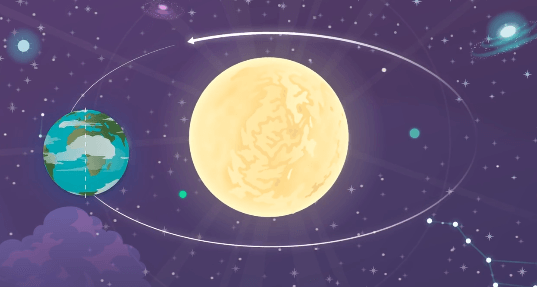
The orbit of the Earth follows an ____________ pattern.
a)
circular
b)
square
c)
round
d)
elliptical
13.
The Earth is closest to the sun during what?
a)
Aphelion
b)
Winter solstice
c)
Perihelion
d)
Summer solstice
14.
The Earth orbits the sun in a _________________ motion.
a)
Clockwise
b)
Counterclockwise
15.

Which of the following is NOT a reason we cannot feel the motion of the Earth

a)

It is constant

b)

The gravity from Mars

c)

The gravitational pull

d)

We are moving along with it

16.
What is evidence that the Earth is moving?
a)
A ball being thrown
b)
The foucault pendulum
c)
Waves in the ocean
d)
Earthquakes
17.
What direction do objects in the Northern hemisphere deflect to?
a)
right
b)
left
c)
north
d)
south
18.
What direction do objects in the southern hemisphere deflect to? 
a)
right
b)
left
c)
north
d)
south
19.
What degree is the Earth tilted?
a)
23.5
b)
23
c)
25.5
d)
22.5
20.
During the summer, the northern hemisphere is tilted _____________ the sun.
a)
Away from
b)
Toward
c)
behind
d)
in front of
21.
During the winter, the sunlight strikes the northern hemisphere........
a)
directly
b)
indirectly
c)
from afar
d)
from a closer distance
22.
On this image, the right picture represent what season?
a)
Summer
b)
Winter
c)
Spring
d)
Fall
23.
During what season is the sun in the sky for the longest amount of time?
a)
Winter
b)
Spring
c)
Summer
d)
Fall
24.
When the north pole experiences 6 months of daylight, the south pole experiences.....
a)
6 months of daylight
b)
6 months of darkness
c)
12 hours each of sunlight and darkness
25.
During a solstice the sun reaches it's ____________ and ________________ heights in the sky at noon. 
a)
furthest, closest
b)
highest, lowest
c)
eastern, western
d)
southern, northern
26.
What happens during an equinox?
a)
Earth is tilted towards the sun
b)
Earth is tilted away from the sun
c)
Earth is not tilted away from or towards the sun
d)
The earth is equal distant away from the sun
27.
Fill in the missing blank in the photosynthesis formula: water + carbon dioxide + sunlight= ____________ (sugar/food) + oxygen
a)
glucose
b)
sucrose
c)
sunlight
d)
water
28.
Which of the following is NOT a way the sun interacts with the atmosphere?
a)
Scattering
b)
Refraction
c)
Magnification
d)
Absorption
29.
Which of the following causes light to scatter?
a)
Mirrors
b)
Prisms
c)
Clouds
d)
Cloth
30.
Which of the following causes light to refract?
a)
Water
b)
Clouds
c)
Mirrors
d)
Cloth
31.
Which of the following is NOT a gas that absorbs solar energy?
a)
Oxygen
b)
Ozone
c)
Carbon dioxide
d)
Water vapor
32.

Why does land heat faster than water?

a)

Water is thicker than land

b)

Water has a higher specific heat than land and land absorbs solar energy

c)

Water is darker than land

d)

There is not a breeze

33.
Nuclear fusion is the....
a)
Combining of nuclei
b)
Division of nuclei
c)
Vibrating nuclei
34.
Nuclear fission is...
a)
Combining of nuclei
b)
Division of nuclei
c)
Vibrating nuclei
35.
This is an example of what kind of tide?
a)
Neap tide
b)
Spring tide
c)
High tide
d)
Low tide
36.
This image is an example of what kind of tide?
a)
Spring tide
b)
Neap tide
c)
High tide 
d)
Low tide
37.
What causes the tides?
a)
Gravity from the sun
b)
Gravity from the moon
c)
Gravity from meteors
d)
Gravity from the Earth
38.
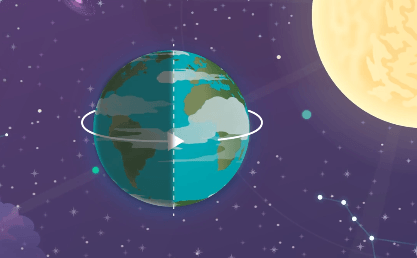
The Earth is rotating on its axis, creating _____
a)
the 12 months
b)
the years
c)
the seasons
d)
day and night
39.
The movement of the Earth around the Sun is called its _____
a)
revolution
b)
rotation
c)
precession
d)
gyration
40.
The red line in this image shows
a)
nutation
b)
precession
c)
barycenter
d)
elliptical orbits
41.
This image shows
a)
barycenter
b)
precession
c)
nutation
d)
elliptical orbits
42.

The diagram represents the Earth and the Moon. The X represents the Earth and Moon’s barycenter, why does the barycenter lie closer to the Earth?

a)

Because the Earth has a longer rotational period

b)

Because the Earth is closer to the sun

c)

Because the Earth is larger and therefore a stronger gravitational pull

d)

Because the Earth only has one moon

43.
The Coriolis Effect is caused by
a)
Earth rotating around the sun
b)
Earth rotating on its axis
c)
The tides
d)
Gravity
44.
Because of inertia, a moving object will keep ________.
a)
at rest
b)
moving
c)
in one spot
d)
inertia 
45.

During the summer solstice, what happens?

a)

Most hours of daylight

b)

Least hours of daylight

c)

Earth is closest to the sun

d)

Earth is furthest from the sun

46.

During the winter solstice, what happens?

a)

Most hours of daylight

b)

Least hours of daylight

c)

Furthest from the sun

d)

Closest to the sun

47.

What happens during an equinox?

a)

Earth is tilted toward the sun

b)

Earth is tilted away from the sun

c)

Earth is neither tilted away or toward

d)

12 hours of daylight and 12 hours of darkness