
 Worksheets
4th Six Weeks Review
Total questions: 31
Worksheet time: 3hrs 40mins
Name
Class
Date
1.
Which of the following molecular shapes would have a bond angle of 180 Degrees?
a)
Bent
b)
Trigonal Planar
c)
Tetrahedral
d)
Linear
2.
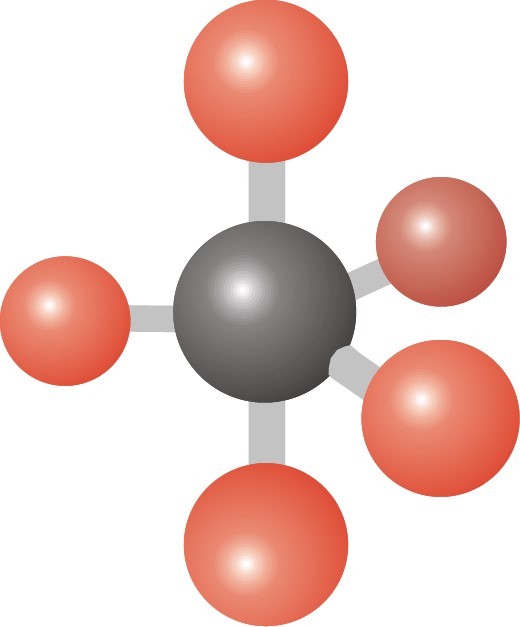
What molecular shape is this?
a)
Trigonal Planar
b)
Trigonal Bipyramidal
c)
Tetrahedral
d)
Pyramidal
3.
P2O5
a)
Phosphorus Oxide
b)
Pentaphosphorus Dioxide
c)
Diphosphorous pentoxide
d)
Phosphoric Oxygen
4.
Which of these has a double bond?
a)
Cl2
b)
H2
c)
N2
d)
O2
5.
Which of the following describes water?
a)
Linear structure, nonpolar
b)
Linear structure, polar
c)
Angular/bent structure, nonpolar
d)
Angular/bent structure, polar
6.
Which compound has the smallest molar mass?
a)
CO
b)
CO2
c)
H2O
d)
H2O2
7.
The number 6.02 x 10²³, which is the number of particles found in a mole.
a)
molar mass
b)
mole
c)
Avogadro's number
d)
hydrate
8.
How many moles are in 9.8 grams of calcium?
a)
0.20 moles
b)
4.1 moles
c)
1.0 mole
d)
392 moles
9.

How many grams of Hydrogen are there in 25 moles of water?
a)
25 g
b)
450 g
c)
18 g
d)
50 g
10.
What is the molar mass of Zn(C2H3O2)2
a)
392.8g/mol
b)
142.9g/mol
c)
361g/mol
d)
183.5 g/mol
11.
What is the molar mass of NaBr
a)
381.9g/mol
b)
102.9 g/mol
c)
213.6g/mol
d)
93.0g/mol
12.
How many grams are in 1.2 x 1024 molecules of CO?
a)
28 grams
b)
56 grams
c)
6.02 grams
d)
1.2 grams
13.
You are given the following percentages: 40.05% S and 59.95% O. Find the empirical formula for these elements. (keep two decimal places throughout calculations)
a)
SO
b)
SO2
c)
SO3
d)
SO4
14.
What is the molecular formula if the empirical formula is C2H5 and the molecular molar mass is 58.14 g/mol?
a)
C2H5
b)
C4H10
c)
C1H2.5
d)
C4H8
15.
What is the molecular formula if the empirical formula is CH2O and the molecular molar mass is 180.18?
a)
CH2O
b)
C2H4O2
c)
C4H8O4
d)
C6H12O6
16.
What is the percent by mass of magnesium in MgO?
a)
20%
b)
40%
c)
50%
d)
60%
17.
What is the percent by mass of chlorine in NaCl?
a)
39%
b)
61%
c)
35%
d)
65%
18.
In which compound is the percent composition by mass of Cl equal to 42%?
a)
HClO (gram formula mass = 52 g/mol)
b)
HClO2 (gram formula mass = 68 g/mol)
c)
HClO3 (gram formula mass = 84 g/mol)
d)
HClO4 (gram formula mass = 100 g/mol)
19.
How many molecules are in 2.5 mol of NaCl?
a)
1.51x10²³
b)
146
c)
4.15
d)
1.51x1024
20.

How many atoms are in a 3.56 g sample of Cu?
a)
3.37 x 10²² Cu atoms
b)
6.02 x 10²³ Cu atoms
c)
0.056 Cu atoms
d)
1 Cu atom
21.

What do you call the substances on the left side of a chemical equation?
a)
yield
b)
products
c)
reactants
d)
compounds
22.
How many atoms of carbon (C) are in C6H12O6?
a)
3
b)
6
c)
12
d)
24
23.
Balance this equation.
_CF4 + _Br2 -- _CBr4 + _F2
_CF4 + _Br2 -- _CBr4 + _F2
a)
2,1,2,1
b)
1,2,2,1
c)
1,2,1,2
d)
2,2,2,2
24.
What coefficient should be used to make the following equation balanced?
N2+O2--> _NO
N2+O2--> _NO
a)
1
b)
2
c)
3
d)
4
25.
Which of the following is an unbalanced equation?
(Check ALL answers)
(Check ALL answers)
a)
CaCO3 --> CaO + CO2
b)
PbO2 + 2H2-->2Pb + H2O
c)
2Na+ 2H2O-->2NaOH + H2
d)
CS2 + 2O2 --> CO2 + 2SO2
26.
_BaS + _PtF2
---> _BaF2 + _PtS
---> _BaF2 + _PtS
a)
1 BaS + 1 PtF2
--->
1 BaF2 + 1 PtS
--->
1 BaF2 + 1 PtS
b)
4 BaS + 2 PtF2
--->
1 BaF2 + 1 PtS
--->
1 BaF2 + 1 PtS
c)
1 BaS + 2 PtF2
--->
2 BaF2 + 2 PtS
--->
2 BaF2 + 2 PtS
d)
1 BaS + 3 PtF2
--->
1 BaF2 + 2 PtS
--->
1 BaF2 + 2 PtS
27.
What is the Law of Conservation of mass?
a)
Mass is created in a chemical reaction
b)
Mass is created in a physical change
c)
New chemicals formed from a chemical reaction have a larger overall mass than the original reactants
d)
Mass is never created or destroyed
28.
What type of reaction is:
NH4NO3 → N2O + 2 H2O
NH4NO3 → N2O + 2 H2O
a)
Synthesis Reaction
b)
Single Displacement Reaction
c)
Double Displacement Reaction
d)
Decomposition Reaction
29.
Balance the following equation:
Pb + H3PO4 → 3H2 + Pb3(PO4)2
Pb + H3PO4 → 3H2 + Pb3(PO4)2
a)
3,4,3,6
b)
1,4,2,3
c)
1,1,3,2
d)
3,2,3,1
30.
What type of reaction is:
P4 + 3 O2 → 2 P2O3
P4 + 3 O2 → 2 P2O3
a)
Synthesis Reaction
b)
Single Displacement Reaction
c)
Double Displacement Reaction
d)
Decomposition Reaction
31.
What type of reaction is:
Al2S3 → 2 Al + 3 S
Al2S3 → 2 Al + 3 S
a)
Synthesis Reaction
b)
Single Displacement Reaction
c)
Double Displacement Reaction
d)
Decomposition Reaction
100 %

