
 Worksheets
Quarter 3 Review
Total questions: 76
Worksheet time: 50mins
Name
Class
Date
1.
If you cut a block into smaller pieces, what happens to the density?
a)
decreases
b)
increaes
c)
remains the same
d)
doubles
2.
Compared to the density of liquid water, the density of an ice cube is
a)
always less
b)
always greater
c)
the same
3.
A pebble has a volume of 12 cm3 and a mass of 6.0g, what is its density?
a)
20 gm/cm3
b)
2 g/cm3
c)
.5 g/cm3
d)
72 g/cm3
4.
What are the 2 factors that can affect the density of an object?
a)
Size and Pressure
b)
Temperature and Shape
c)
Size and Shape
d)
Pressure and Temperature
5.
While walking on a glacier,an observer makes a few statements.Which statement is an inference?
a)
There are many cracks in this glacier.
b)
Some parts of this glacier will start melting this spring
c)
The rocks on this glacier are of different sizes
d)
Some of the snow on this glacier is powdery
6.
As pressure increases, density will always...
a)
increase
b)
decrease
c)
remain the same
d)
increase, then decrease
7.
What are the two most abundant elements by volume in the Earth's lithosphere?
a)
Silicon and Oxygen
b)
Oxygen and Potassium
c)
Oxygen and Sodium
d)
Oxygen and Calcium
8.
What is the Latitude and Longitude of Old Forge, NY to the nearest minute (')
a)
43°40'N, 75°50'W
b)
43°40'S, 74°50'E
c)
43°40'N, 74°50'W
d)
46°40'N, 77°50'W
9.
What connects points of equal elevation on a topographic map?
a)
contour lines
b)
map scales
c)
rivers
d)
pixels
10.
Contour lines on a topographic map that are close together tell you that...
a)
the slope is gradual or gentle
b)
the intervals are unequal
c)
there is no slope
d)
the slope is steep
11.
What is the eccentricity of a perfect sphere
a)
1
b)
0
c)
.1
d)
.05
12.
At what latitude will the Sun's rays be striking Earth most directly on June 21st?
a)
66.5 degrees North
b)
23.5 degrees North
c)
23.5 degrees South
d)
Equator
13.
What is the shortest day of the year
a)
June 21st
b)
September 23rd
c)
December 21st
d)
March 21st
14.
How does red shifting (doppler effect) confirm the Big Bang Theory
a)
It explains why the universe is getting closer
b)
It explains why the universe is so dark.
c)
It explains why Mars is red
d)
It explains why the universe is expanding
15.
Compared to the Jovian planets, the terrestrial planets are...
a)
Closer to the Sun and gas like
b)
further from the Sun and rocky
c)
smaller and more dense
d)
larger and less dense
16.
What is the luminosity of the star Rigel
a)
10,000
b)
100,000
c)
1
d)
.1
17.
Which objects are the best absorber's
a)
dark-colored, smooth surfaces
b)
dark-colored, rough surfaces
c)
light-colored, rough surfaces
d)
light-colored, smooth surfaces
18.
Which Earth material has the greatest specific heat
a)
solid lead
b)
gaseous air
c)
solid land
d)
liquid water
19.
What is the temperature of the atmosphere at 11 km
a)
- 55 degrees C
b)
30 degrees C
c)
- 30 degrees C
d)
55 degrees C
20.
t what altitude, in km, is the temperature of the atmosphere 50 degrees C
a)
100 km
b)
115 km
c)
110 km
d)
105 km
21.
Convert 29.10 inches to mb
a)
987.0 mb
b)
985.5 mb
c)
985.0 mb
d)
986.0 mb
22.
Winds are named for the direction they are blowing from?
a)
True
b)
False
23.
Warm air sinks, and cold air rises.
a)
True
b)
False
24.

What does this tool measure?
a)
Wind speed
b)
Wind direction
c)
Air pressure
d)
Temperature
25.
Which tool measures wind speed?
a)
Anemometer
b)
Hygrometer
c)
Barometer
d)
Wind Vane
26.

What is the dew point at this station?
a)
75 degrees
b)
61 degrees
c)
987 degrees
d)
11 degrees
27.
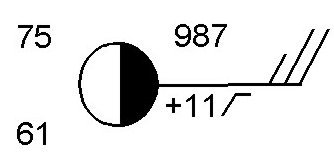
What is the temperature at this station
a)
75 degrees
b)
61 degrees
c)
987 degrees
d)
11 degrees
28.

What is the wind direction at this station?
a)
Wind is blowing from the north
b)
Wind is blowing to the East
c)
Wind is blowing from the East
d)
Wind is blowing to the North
29.
As you climb up a mountain what happens to the air pressure?
a)
decreases
b)
increases
c)
stays the same
30.
What causes winds?
a)
differences in precipitation
b)
differences in humidity
c)
differences in air pressure
31.

What is the Dew Point Temperature if the dry-bulb temperature on your sling psychrometer is 20ºC and the wet-bulb temperature is 15ºC?
a)
14ºC
b)
12ºC
c)
10ºC
d)
-18ºC
32.

If the dry point temperature is 20 °C and the relative humidity is 58 %, what is the dew point?
a)
5 degrees celsius
b)
12 degrees celsius
c)
15 degrees celsius
d)
38 degrees celsius
33.
Which weather instrument is useful in measuring relative humidity?
a)
barometer
b)
anemometer
c)
psychrometer
d)
wind vane
34.
what are isobars?
a)
lines connecting places of equal temperature
b)
lines drawn connecting places of equal pressure
c)
lines drawn to places of different temperatures
d)
lines drawn to places of different pressures
35.
_______ pressure systems are characterized by rising air.
a)
High
b)
Low
36.
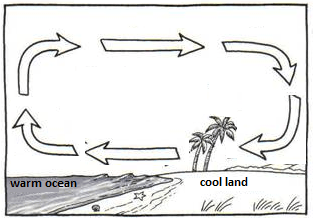
What kind of breeze is this and when would it form?
a)
Land breeze - daytime
b)
Land breeze - nighttime
c)
Sea breeze - daytime
d)
Sea breeze - nighttime
37.
The main factor that causes any wind to blow is ...
a)
a. Uneven heating of the Earth's atmosphere.
b)
b. Differences in air pressure and humidity.
c)
c. Warm air from the poles meeting the cold ait from the equator.
d)
d. The even heating of the Earth's atmosphere.
38.

What are the weather conditions at this station?
a)
rain
b)
snow
c)
fog
d)
hail
39.

What is the wind speed at this station
a)
3 knots
b)
15 knots
c)
25 knots
d)
30 knots
40.

What is the barometric pressure?
a)
914.7 mb
b)
1001.47 mb
c)
1014.7 mb
d)
1001.4 mb
41.
rapidly moving cold air mass runs into a warm air mass the cold air slides under the warm air. This is called a .....
a)
cold front
b)
warm front
c)
stationary front
42.
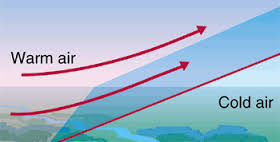
Which type of front is pictured?
a)
Cold front
b)
Warm front
c)
Occluded front
d)
Stationary front
43.
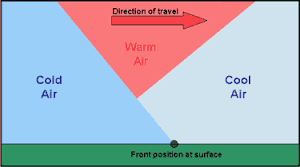
Which type of front is pictured?
a)
Cold front
b)
Warm front
c)
Occluded front
d)
Stationary front
44.
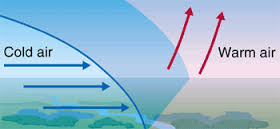
Which type of front is pictured?
a)
Cold front
b)
Warm front
c)
Occluded front
d)
Stationary front
45.

What symbol is this?
a)
warm front
b)
cold front
c)
stationary front
d)
occluded front
46.
Clouds that bring thunderstorms.
a)
cumulonimbus
b)
cirrus
c)
stratus
d)
fog
47.
How do we name air masses?
a)
Water and temperature
b)
Air pressure
c)
Humidity and temperature
d)
Cold and warm
48.
What types of air masses form over oceans?
a)
Maritime
b)
Continental
c)
Polar
d)
Tropical
49.
A wet and cold air mass would be a...
a)
Maritime polar
b)
Continental polar
c)
Maritime tropical
d)
Continental tropical
50.
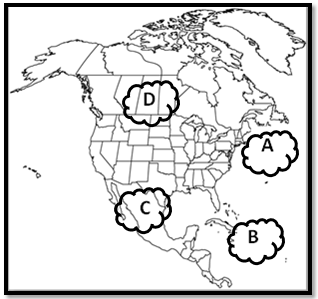
Which type of air would you find at air mass B?
a)
cold, dry
b)
warm, humid
c)
warm, dry
d)
cold, humid
51.
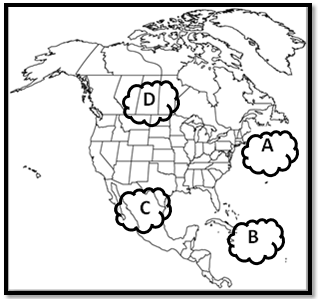
Which type of air would you find at air mass D?
a)
cold, dry
b)
warm, humid
c)
warm, dry
d)
cold, humid
52.
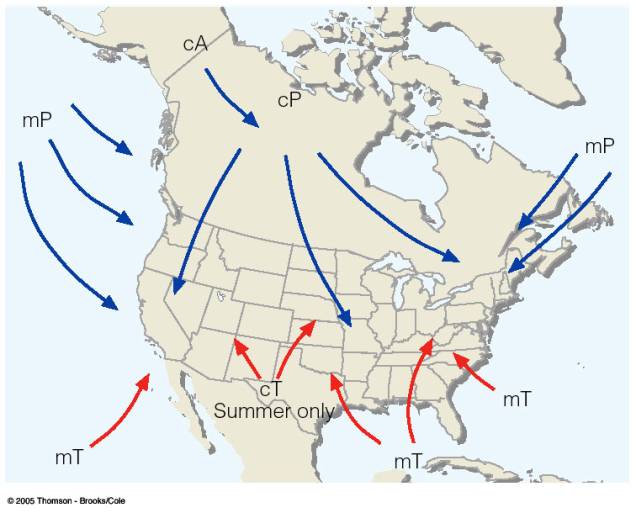
Which abbreviation of an air mass can be identified as dry and hot?
a)
cP
b)
mP
c)
cT
d)
mT
53.
Which abbreviation of an air mass can be identified as cold and moist?
a)
cP
b)
mP
c)
cT
d)
mT
54.

What kind of breeze is this & what time of day/night would it form?
a)
Land breeze - daytime
b)
Land breeze - nighttime
c)
Sea breeze - daytime
d)
Sea breeze - nighttime
55.
How does elevation affect a location's climate?
a)
high elevations are warmer than low elevations
b)
high elevations are colder than low elevations
56.
How does latitude affect a location's climate?
a)
low latitudes are warmer than high latitudes
b)
low latitudes are colder than high latitudes
57.
Distance above or below sea level is called ______.
a)
elevation
b)
latitude
c)
topogrphy
d)
wind pattern
58.
Which of these can help stabililze a location's temperature during the summer and winter?
a)
mountain ranges
b)
large bodies of water (ocean)
c)
a location near the Equator
d)
wind patterns
59.
As you go to the top of a mountain, what happens to temperature?
a)
Nothing
b)
It increases
c)
It decreases
d)
It goes up and down
60.
The sun’s rays are least direct __________.
a)
near the poles.
b)
in July.
c)
near the equator.
d)
far from the ocean.
61.
Which of the following will heat the fastest?
a)
water
b)
land
c)
both heat at equal rates
62.
What makes global winds curve rather than move in straight lines?
a)
the spinning of Earth
b)
changes in air pressure
c)
changes in temperature
d)
differences in latitudes
63.
The land on the ______ side of the mountain range is in the rain shadow.
a)
Cold
b)
windward
c)
Cloud covered
d)
leeward
64.
Climate is
a)
the further you get from the equator
b)
the higher you go, the colder it gets
c)
the conditions of the atmosphere at a certain place and time.
d)
the average weather conditions of an area over a long period of time.
65.
What is the windward side of a mountain?
a)
The wet side that is hit by the moist damp air.
b)
The dry side that is downwind of the mountain.
c)
The side of the mountain with the most people.
d)
The side of the mountain with the rain shadow.
66.
The El Nino is caused by
a)
cold water off the Atlantic coast of South America
b)
warm water in the Pacific off the coast of South America
c)
warm water in the Pacific off the coast of Mexico
d)
cold water in the Pacific off the coast of Mexico
67.
In which sequence are the celestial objects
correctly listed in order from the smallest mass to
the largest mass?
correctly listed in order from the smallest mass to
the largest mass?
a)
Saturn, solar system, Milky Way, universe
b)
Saturn, universe, Milky Way, solar system
c)
Milky Way, Saturn, solar system, universe
d)
Milky Way, universe, solar system, Saturn
68.
The best evidence of Earth’s rotation is provided by the
a)
Foucault pendulum and global warming
b)
Foucault pendulum and Coriolis effect
c)
Moon phases and global warming
d)
Moon phases and Coriolis effect
69.

**According to the diagram, where will high ocean tides and low ocean tides most likely be located?
a)
high tides at A and B; low tides at C and D
b)
high tides at B and D; low tides at A and C
c)
high tides at A and C; low tides at B and D
d)
high tides at C and D; low tides at A and B
70.
The barometric trend for the past three hours on a station model reads: +02\ This location has experienced a steady increase of
a)
0.2 mb
b)
0.002 mb
c)
2.0 mb
d)
0.02 mb
71.
Mount Kilimanjaro is located in eastern Africa at 3° S. Which climate factor best explains the presence of permanent snow on its peak?
a)
latitude
b)
prevailing winds
c)
elevation
d)
ocean currents
72.
Which factor causes the surface of Lake Ontario to cool at a slower rate than the surface of the land along the shore of the lake?
a)
Evaporating water releases more heat into the lake than into the land.
b)
Lake water has a higher specific heat than land.
c)
Water vapor cools the lake as it condenses.
d)
Sunlight passes through the top layers of the lake water.
73.
Summer monsoon rains normally occur in India when
a)
high pressure exists over land, pulling moisture in from the Indian Ocean
b)
high pressure exists over land, pushing moisture out to the Indian Ocean
c)
low pressure exists over land pulling moisture in from the Indian Ocean
d)
low pressure exists over land pushing moisture out to the Indian Ocean
74.
During which month does the Sun rise north of due east in New York State?
a)
February
b)
October
c)
July
d)
December
75.
Which change in the heat energy content of water occurs when water changes phase from a liquid to a solid?
a)
gain of 334 Joules of heat energy per gram
b)
release of 334 Joules of heat energy per gram
c)
gain of 2260 Joules of heat energy per gram
d)
release of 2260 Joules of heat energy per gram
76.
What is the primary source of energy for Earth’s weather systems?
a)
incoming solar radiation
b)
subtropical jet streams
c)
precipitation from clouds
d)
heat from Earth’s interior
100 %

