
 Worksheets
CP UNIT 6 Patterns of Inheritance
Total questions: 45
Worksheet time: 45mins
Name
Class
Date
1.
In
some cattle the genes for brown hair (B) and for white hair (W) are
co-dominant. Cattle with alleles for both brown and white hair, have both brown
and white hairs. This condition gives the cattle a reddish color, and is referred
to as Roan (BW). Construct a punnett square and give
phenotypic and genotype ratios of the offspring from a cross between a roan cow
and a white bull.
a)
genotype BW 100%; phenotype 100% roan
b)
genotype BW 50% WW 50%; phenotype roan 50% white 50%
c)
genotype BB 50% WW 50%; phenotype brown 50% white 50%
d)
geno BW 50% BB 25% WW 25%; pheno 50% roan 25% white 25% brown
2.

Two newborn babies were accidentally mixed up at the hospital. Determine the parents of the babies by blood type. (punnett square needed)
a)
Baby 1 Brown and Baby 2 Smith
b)
Baby 1 Smith and Baby 2 Brown
3.
Breeding a yellow dog with a brown dog produced puppies with both yellow and brown hairs intermixed. This is an example of:
a)
codominance
b)
incomplete dominance
c)
epistasis
d)
sex-linked
4.

If green is dominant over purple, then what is the genotype for this individual?
a)
Purple
b)
Green
c)
GG
d)
gg
5.

Brown fur color is dominant over black fur color. Which of the following is the actual genotype of ALL of the offspring in the next generation of this cross for fur color?
AA x aa
AA x aa
a)
AA
b)
Aa
c)
aa
d)
brown fur
6.
B - black, b - brown. Two black mice mate and have some black and some brown mice. What is the genotype of the parents?
a)
BB x Bb
b)
BB x bb
c)
Bb x Bb
d)
Bb x bb
7.
Which of the following terms refers to the different possibilities of a gene?
a)
chromosome
b)
DNA
c)
Punnett Squares
d)
allele
8.
If something is heterozygous, it is also...
a)
purebred
b)
hybrid
c)
dominant
d)
recessive
9.
True/False: Different genotypes can code for the same phenotype.
a)
True
b)
False
10.
Another word for homozygous is...
a)
purebred
b)
hybrid
c)
heterozygous
d)
dominant
11.
Why are sex-linked traits more common in males than in females?
a)
all alleles on the X chromosome are dominant
b)
all alleles on the Y chromosomes are recessive
c)
a recessive allele on the X chromosomes will always produced that trait in a male
d)
any allele on the Y chromosome will be codominant with the matching allele on the X chromosome
12.
Sex-linked genes are genes on
a)
the X chromosome only
b)
the Y chromosome only
c)
the X and Y chromosomes
d)
all 23 pairs of chromosomes
13.
Dominant alleles are-
a)
capital
b)
lowercase
c)
both
d)
neither
14.
Recessive alleles are-
a)
capital
b)
lowercase
c)
both
d)
neither
15.
Purple is dominant to white. A heterozygous purple flower is crossed with a white flower. What are the genotypes and phenotypes of the offspring?
a)
100% Pp (purple)
b)
50% Pp (purple); 50% pp (white)
c)
75% Pp (purple); 25% pp (white)
d)
25% PP, 50% Pp, 25% pp
75% purple, 25% white
75% purple, 25% white
16.
Which represents the genotype of a homozygous condition?
a)
Bb
b)
BC
c)
bb
d)
bc
17.
One reason for Mendel's success with genetic studies of peas was that he
a)
used only hybrid pea plants
b)
used peas with large chromosomes
c)
studied large numbers of offspring
d)
discovered the sources of variation in peas
18.
A cross of a red cow with a white bull produces all road offspring. This type of inheritance is known as
a)
codominance
b)
incomplete dominance
c)
multiple alleles
d)
"breed time:
19.
If an organism with a homozygous dominant trait was mated in a test cross, all the F1 offspring would be
a)
homozygous dominant
b)
homozygous recessive
c)
heterozygous
d)
50% homozygous;50% heterozygous
20.
A woman with blood genotype I(A)i marries a man with blood genotype I(B)i. What is the probability that they would have a child with type O blood?
a)
1/1
b)
1/2
c)
1/3
d)
1/4
21.
A cross between two tall garden pea plants produced 314 tall plants and 98 short plants. What genotypes are the parents?
a)
TT and tt
b)
TT and Tt
c)
Tt and Tt
d)
TT and TT
22.
If the four existing children in a family are all sons, what chance would there be that the next child would also be a son?
a)
75%
b)
50%
c)
25%
d)
20%
23.
A person with type O blood marries a person with type AB blood. Possible blood genotypes of their children are
a)
I(A)i and I(B)I(B)
b)
I(B)I(B) and I(A)I(A)
c)
I(A)i and I(B)i
d)
I(A)I(B) and ii
24.
Which of the following genotypes is homozygous recessive?
a)
RR
b)
Rr
c)
rr
d)
None of the Above
25.

In certain rats, black fur is dominant over white fur. If two rats, both heterozygous for fur color are mated, their offspring would be expected to have
a)
four different genotypes and two different colors
b)
two different genotypes and three different colors
c)
three different genotypes and two different colors
d)
three different genotypes and three different colors
26.

What percentage of the female offspring will be a carrier for this recessive disease?
a)
0%
b)
50%
c)
100%
d)
25%
27.

If this image were real, it would represent what type of inheritance?
a)
incomplete dominance
b)
codominance
c)
polygenic inheritance
d)
compete dominance
28.

A red flowered plant (RR) breeds with a White flowered plant (WW). The gene for petal color in these plants expresses incomplete dominance. What percentage of the offspring will have pink (RW) flowers?
a)
0%
b)
25%
c)
50%
d)
100%
29.

This type of inheritance pattern shows BOTH traits in possible offspring.
a)
complete dominance
b)
incomplete dominance
c)
co-dominance
d)
dominant pattern
30.
How many PAIRS of sex chromosomes do humans have?
a)
23
b)
46
c)
1
d)
2
31.

The range of human skin colors is caused by a variety of genes, each of which has at least 2 alleles. This is an example of:
a)
incomplete dominance
b)
codominance
c)
multiple alleles
d)
polygenic inheritance
32.
X-linked conditions are more common in men than in women because
a)
The genes associated with the X linked conditions are linked to the X chromosome, which determines maleness.
b)
Men need to inherit only one copy of the recessive allele for the condition to be fully expressed
c)
Women simply do not develop the disease regardless of their genetic composition
d)
The sex chromosomes are more active in men than in women
33.
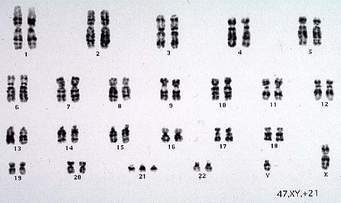
Based on the Karyotype shown, at which chromosome pair can we identify a genetic disorder?
a)
Chromosome pair 5
b)
sex chromosomes
c)
Chromosome pair 21
d)
There are no chromosomal disorders
34.
Which sex chromosomes would indicate a typical human male?
a)
XX
b)
X
c)
XY
d)
XXY
35.
Photograph of chromosomes grouped in ordered pairs is called a
a)
pedigree
b)
Punnett Square
c)
Venn Diagram
d)
Karyotype
36.
A carrier of a genetic disorder who does not show symptoms is most likely to be ___________ to transmit it to offspring.
a)
heterozygous for the trait and able
b)
heterozygous for the trait and unable
c)
homozygous for the trait and able
d)
homozygous for the trait and unable
37.

When an area of a chromatid is exchanged with the matching area on a chromatid of its homologous chromosome, _________________ occurs
a)
crossing over
b)
mutagenesis
c)
hybridization
d)
fertilization
38.
What kind of cells are made in MEIOSIS?
a)
Haploid Gametes
b)
Diploid Somatic Cells
c)
Skin Cells
d)
Liver Cells
39.

A human body (somatic) cell usually has how many chromosomes?
a)
6
b)
22
c)
4
d)
46
40.
If the Diploid number of Carrots is 18, the haploid number is
a)
18
b)
9
c)
27
d)
36
41.
Why do we need meiosis?
a)
To double the number of chromosomes going into sex cells
b)
To halve the number of chromosomes going into sex cells
c)
To triple the number of chromosomes going into sex cells
d)
To not change the number of chromosomes going into sex cells
42.
If a somatic (body) cell in a butterfly contains 24 chromosomes, a butterfly egg would contain
a)
3
b)
6
c)
12
d)
24
43.

What phase is represented?
a)
metaphase 1
b)
metaphase 2
c)
anaphase 1
d)
anaphase 2
44.

Meiosis makes sperm and egg cells. In humans, sperm and egg cells each have _____ chromosomes. Therefore a fertilized human egg cell (sperm and egg cell combined) would create a cell with _____ chromosomes.
a)
23, 46
b)
46, 23
c)
2, 4
d)
50, 100
45.

What is one of the advantages, why is it better to reproduce sexually versus asexually?
a)
survival of the fittest
b)
overproduction
c)
genetic variation
d)
cloning
100 %

