
 Worksheets
Earth B Midterm
Total questions: 80
Worksheet time: 2hrs 36mins
Name
Class
Date
1.
What is molten rock that has formed deep within the Earth?
a)
Hot Spot
b)
Magma
c)
Lava
d)
Volcano
2.
Why does magma tend to rise to the surface?
a)
It has large amounts of silica.
b)
It contains very little silica.
c)
It is denser than the surrounding material.
d)
It is less dense than the surrounding material.
3.
The volcanoes on the Hawaiian Islands form due to which of the following?
a)
Divergent Boundary
b)
Hot Spot
c)
Subduction Boundary
d)
Transform Boundary
4.
What type of volcano has steep slopes made of alternating layers of ash and silica rich lava?
a)
Caldera
b)
Cinder Cone
c)
Composite Volcano
d)
Shield Volcano
5.
Where are most volcanoes found?
a)
Southern Hemisphere
b)
Ring of Fire
c)
Mid-Atlantic Ridge
d)
Hot Spots
6.
Plate boundaries where plates slide past each other are called
a)
Transform
b)
Convergent
c)
Divergent
d)
Hot Spot
7.
When pressure from a transform boundary is released what occurs?
a)
Tsunami
b)
Earthquake
c)
Explosion
d)
Fire
8.
Plate boundaries where plates collide are called
a)
Transform
b)
Convergent
c)
Divergent
d)
Hot Spot
9.
Plate boundaries where plates are moving apart are called
a)
Transform
b)
Convergent
c)
Divergent
d)
Hot Spot
10.
What is the theory that states that the crust is broken into pieces that move around?
a)
Continental Drift
b)
Plates and Forks
c)
Plate Tectonics
d)
Pangea
11.
Volcano that has erupted in the Past 10,000 years
a)
Dormant
b)
Extinct
c)
Active
12.
Volcano that will never erupt again
a)
Active
b)
Dorment
c)
Extinct
13.
If geologists detect many small earthquakes in the area near a volcano, what can they infer about the volcano?
a)
It is dormant
b)
It is probably about to erupt
c)
It is extinct
d)
It is a good source of geothermal energy
14.
When the force on rocks is great enough, they break and produce vibrations called
a)
Stresses
b)
Strains
c)
Faults
d)
Earthquakes
15.
The farther a seismic station is from an earthquake, a person will notice that the time between P and S waves
a)
Increases
b)
Decreases
c)
Same
16.

Point A is the
a)
Epicenter
b)
Focus
c)
Scarp
17.
Point B is the
a)
Epicenter
b)
Focus
c)
Scarp
18.
The fastest earthquake wave is
a)
P
b)
S
c)
R
d)
L
19.
The SECOND fastest earthquake wave is
a)
P
b)
S
c)
R
d)
L
20.

What causes the up and down wiggles on the seismogram?
a)
Ground Vibrations
b)
Tsunami Waves
21.

What type of volcano is this?
a)
Composite Volcano
b)
Cinder Cone Volcano
c)
Shield Volcano
22.

What type of volcano is this?
a)
Composite Volcano
b)
Cinder Cone Volcano
c)
Shield Volcano
23.
Beneath a volcano, magma collects in a:
a)
magma chamber
b)
magma pocket
c)
vent
d)
hole
24.
Once magma reaches the earth's surface it is called.....
a)
Silica
b)
Rock
c)
lava
25.
The outside layer of the earth is called ______________________.
a)
core
b)
crust
c)
mantle
d)
outer core
26.
The huge pieces of the earth's crust are called ____________________________.
a)
crust
b)
plates
c)
directions
d)
seismos
27.
The youngest rocks on the seafloor are most likely found...
a)
closest to a mid-ocean ridge
b)
farthest from a mid-ocean ridge
c)
near the coastlines
d)
closest to a deep sea trench
28.
The theory that says Earth's continents once made up an ancient supercontinent, and have been drifting apart ever since, is called the theory of...
a)
Pangea
b)
Plate Tectonics
c)
Natural Selection
d)
Gravity
29.
Which of the following causes Earth's tectonic plates to move?
a)
Energy from the Sun
b)
Magnetic Pole Reversal
c)
Convection currents in the mantle
d)
Faults in Mountain Ranges
30.
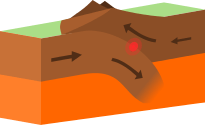
What type of plate boundary is this?
a)
Plate
b)
Divergent
c)
Convergent
d)
Transform
31.
A divergent boundary occurs when plates ....
a)
Pull apart
b)
Come together
c)
Slide past each other
d)
subducting
32.
Which of the following is the name of the ancient supercontinent formed 28 Million Years ago.
a)
Pangaea
b)
Gondwanda
c)
Laurasia
d)
Neverland
33.
Which of the following is NOT evidence to support the theory of plate tectonics?
a)
Fossils
b)
Mountains
c)
Glaciers
d)
Sand Erosion
34.
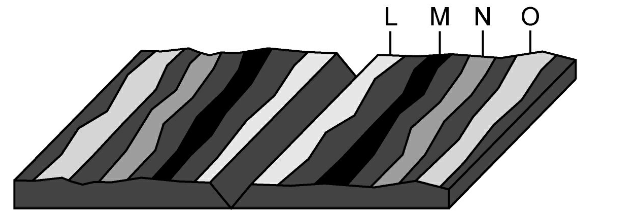
Where would the oldest rock be found?
a)
L
b)
M
c)
N
d)
O
35.
How is it possible for new crust to be formed without increasing the surface area of the Earth?
a)
Crust is destroyed at the same time it is created
b)
New crust is underwater where it sinks
c)
New crust breaks more easily than old crust
36.
Mountains are created when....
a)
Two continental plates collide
b)
Two oceanic plates pull apart
c)
An Oceanic plate subducts under a Continental Plate
d)
Two continental plates pull apart
37.
A possible explanation to a problem that has not yet been tested.
a)
data
b)
theory
c)
hypothesis
d)
fact
38.
This variable in an experiment is the one being deliberately changed by the scientist.
a)
dependent variable
b)
independent variable
c)
data
d)
control group
39.
The summary at the end of an experiment that explains the results.
a)
conclusion
b)
procedures
c)
materials
d)
responding variable
40.
A series of steps used by scientists to solve a problem or answer a question.
a)
scientific method
b)
recipe
c)
data collection
d)
metric system
41.
American Scientist who proposed the theory of Sea Floor Spreading
a)
Hess
b)
Hubble
c)
Richter
d)
Wegener
42.
Harry Hess used what kind of technology to map the bottom of the ocean?
a)
Boat
b)
Meter Stick
c)
Radar
d)
Sonar
43.
As you go from the center of the Earth to the surface, temperature _________
a)
Increases
b)
Decreases
44.
While studying the ocean floor, scientists found ____ bands of magnetism.
a)
plastic
b)
alternating
c)
no
d)
rectangluar
45.
Any trace of an ancient organism that has been preserved in rock.
a)
fossil
b)
rock
c)
pangaea
d)
plants
46.
In a "controlled" experiment, how many variables should you change at a time?
a)
4
b)
3
c)
6
d)
1
47.
Procedure
a)
Educated guess that can be tested
b)
Step by step plan of the experiment
c)
The purpose of the experiment; what is to be answered
d)
Variable that is to change on purpose
48.
The conclusion is based on the results of the _____.
a)
Information
b)
Hypothesis
c)
Experiment
d)
Problem
49.
The possible answer to the problem.
a)
Hypothesis
b)
Conclusion
c)
Data
d)
Experiment
50.
Data
a)
Conclusion or reason proposed to explain an observation
b)
Act of recognizing a fact
c)
Information organized for analysis
51.
The actual answer to the problem.
a)
Hypothesis
b)
Data
c)
Conclusion
d)
Information
52.
Observation
a)
Act of recognizing a fact using your senses
b)
Information organized for analysis
c)
Conclusion or reason proposed to explain an observation
53.
Recorded observations and measurements.
a)
Information
b)
Conclusion
c)
Hypothesis
d)
Data
54.
"All objects in the universe attract each other" is a scientific _______________
a)
law
b)
theory
c)
force
d)
method
55.
What is a law?
a)
Describes what happens
b)
Explains a process
56.
What is a theory?
a)
Describes what happens
b)
Explains a process
57.
This layer of Earth is solid Iron and Nickel
a)
Outer Core
b)
Mantle
c)
Inner Core
d)
Crust
58.
Which layer of Earth is LIQUID iron and nickel?
a)
upper mantle
b)
lower mantle
c)
outer core
d)
inner core
59.
What is the thickest layer of the Earth?
a)
the crust
b)
the mantle
c)
the outer core
d)
the inner core
60.
Wegener believed that the Earth's plates were once connected because of which of the following reasons?
a)
Fossils, common rock types, and the shape of the continents all supported his theory
b)
China and the USA seemed to fit together perfectly like a giant puzzle piece
c)
He noticed major shifts in the Earth's continents over a 50 year span
d)
He discovered historical writings from the people of Pangeae
61.
The Richter scale measures:
a)
the amount of radon gas released
b)
the movement of plates
c)
the strength of an earthquake
d)
the weight of tectonic plates
62.
Liquefaction is when...
a)
the soil behaves like liquid
b)
the ground becomes liquid
c)
magma rises to the surface
d)
buildings are damaged, crumbling like liquid
63.
How much bigger is a magnitude 8 earthquake compared to magnitude 7 one on the Richter Scale?
a)
1 time bigger
b)
10 times bigger
c)
100 times bigger
d)
1000 times bigger
64.
What is the minimum number of seismograph stations needed to locate an earthquake epicenter?
a)
1
b)
2
c)
3
d)
1 billion
65.
What two specific continents fit together most noticeably?
a)
Africa and North America
b)
South America and Europe
c)
South America and Africa
d)
Antartica and Africa
66.
What would happen to the convection currents if the heat from the inner core disappeared?
a)
They would stop.
b)
They would change directions.
c)
It would not change.
d)
They would speed up.
67.
Which crust is thicker
a)
ocean
b)
continental
c)
bread
d)
pizza
68.
This type of volcano has MOSTLY NONEXPLOSIVE eruptions
a)
composite
b)
cinder cone
c)
shield
69.
The Great Rift Valley in Africa and the Mid-Atlantic Ridge were both created by this type of plate boundary.
a)
divergent
b)
convergent
c)
transform
d)
subduction
70.
What are the two types of crust?
a)
continental and oceanic
b)
ocean and basin
c)
lower and upper
d)
thick and thin
71.
When one plate slides underneath another, it ____ and the magma _____.
a)
hardens; sinks
b)
melts; sinks
c)
hardens; rises
d)
melts; rises
72.
When an oceanic plate and a continental plate collide, which one will subduct?
a)
oceanic
b)
continental
c)
neither
d)
both
73.
How did scientists discover that rocks farther away from mid-ocean ridges were older than those near it?
a)
by observing eruptions of molten material on the seafloor
b)
by mapping rocks on the sea floor using sonar
c)
by determining the age or rock samples obtained by drilling on the seafloor
d)
by measuring how fast seafloor spreading occurs
74.
The best evidence that the continents were once connected is that they have matching
a)
Weather, fossils, and Rock Types
b)
Rock types, fossils, coastlines
c)
Coastlines, weather, rock types
d)
Coastlines, weather, fossils
75.
Earthquake waves are recorded by seismograph machines. What does an earthquake wave transmit?
a)
Energy
b)
Light
c)
Particles
d)
Speed
76.
Which is false about the continents of the world?
a)
They are all on much larger tectonic plates
b)
All are inhabited by humans
c)
They are all affected by weathering and erosion
d)
They have the same climate
77.
What could Wegener not correctly explain about his theory of continental drift?
a)
Connection of fossils
b)
Rock types aligning
c)
What it feels like to be in a weather balloon for 52 hours
d)
The force responsible for the continents moving
78.
What two specific continents fit together most noticeably?
a)
Africa and North America
b)
South America and Europe
c)
South America and Africa
d)
Antartica and Africa
79.
Which of the following is NOT a cause of an earthquake?
a)
Collapse of Cavern
b)
Eruption of Volcano
c)
Lightning Strikes
d)
Moving Tectonic Plates
80.
What is a break in the lithosphere along which movement in an earthquake has first occurred?
a)
Earthquake
b)
Epicenter
c)
Fault
d)
Focus
100 %

