
NEW
Font size
S
M
L
XL
 Worksheets
World War I PracticeTest
Total questions: 56
Worksheet time: 53mins
Name
Class
Date
1.

Imperialism especially in _________, led to competition and increased rivalries among European nations.
a)
North America
b)
South America
c)
Africa
d)
Asia
2.

Which of the following is NOT a cause of World War I?
a)
Nationalism
b)
Socialism
c)
Militarism
d)
Imperialism
3.

A military draft is also called?
a)
Conscription
b)
Mobilization
c)
Militarism
d)
Reparations
4.

How did industrialization affect the growth of the military in the nations of Europe?
a)
It caused nations to desire a bigger military presences
b)
It lengthened the amount of time needed to build a military
c)
It led to the building of dreadnoughts and new weapons
d)
It removed the need for a military in most nations
5.

The process of assembling troops and supplies for war is called?
a)
Conscription
b)
Mobilization
c)
Militarism
d)
Reparations
6.
Why were tensions heightened among countries in Europe after 1900?
a)
Socialists had seized power
b)
Some nations refused to trade with each other
c)
Nations began mobilizing for war
d)
People were joining the Black Hand
7.

Much of Europe was drawn into the war because of
a)
Japan’s invasion of Korea
b)
A stalemate near the river Marne
c)
A network of alliances and secret treaties
d)
The militarism of the United States
8.

Which event sparked World War I?
a)
The sinking of the USS Maine
b)
The German-French dispute of Alsace-Lorraine
c)
Russia’s quest for a warm-water port
d)
The assassination of Archduke Ferdinand
9.

Which nations were the first to get involved with the conflict between Serbia and Austria-Hungary based upon the alliance?
a)
Germany and Russia
b)
France and Belgium
c)
United States and Great Britain
d)
Italy and Bulgaria
10.

Great Britain declared war when Germany stormed through this neutral country...
a)
France
b)
Ottoman Empire
c)
Russia
d)
Belgium
11.

Which of the following was NOT related to the others?
a)
Kaiser Wilhelm II
b)
Tzar Nicholas
c)
Chancellor Bismarck
d)
King George V
12.

Imperialism led to competition and hostilities. How much of the land-area did the British Empire cover?
a)
10%
b)
15%
c)
20%
d)
25%
13.

Awful Governments: Which country was massively powerful, with the most modern industry in the world?
a)
Britain
b)
Germany
c)
France
d)
United States
14.
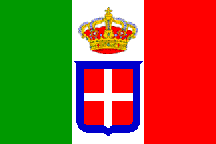
Awful Governments: Formed in 1866, it had a weak ruler, pathetic army, and was plagued with corruption.
a)
Germany
b)
Serbia
c)
Italy
d)
Turkey
15.
Which of the following is NOT one of the main causes of WW I?
a)
Alliances
b)
Militarism
c)
Nationalism
d)
Excellent Governments
16.
What is the acronym for the causes of WW I?
a)
M.A.N.I.A.C.
b)
M.A.N.I.C.
c)
M.A.N.I.A.
d)
M.A.N.T.A.
17.

Nationalism helped cause war in all of the following ways except:
a)
Made people more warlike
b)
Made minorities want independent sovereignty
c)
Desire to catch up through industrialization
d)
A strong military was needed to protect new empires
18.

Which Nation is NOT part of the Triple Entente
a)
France
b)
Italy
c)
Britain
d)
Russia
19.

Which country is considered 'the sick man of Europe'?
a)
Serbia
b)
Bosnia
c)
Turkey
d)
Yugoslavia
20.

Which one of the following is NOT part of the Central Powers?
a)
Germany
b)
Italy
c)
Russia
d)
Austria-Hungary
21.

What did trench warfare cause?
a)
Defeat of France at the start of the war
b)
Russia’s defeat on the Eastern Front
c)
Stalemate on the Western Front
d)
Troop movement on the Eastern Front
22.

Roughly how many miles of trenches were in Western Europe?
a)
200
b)
355
c)
475
d)
800
23.

What was the German rifle introduced during WW I with an improved charging system and could throw 35-45 rounds downrange a minute?
a)
FN-Mauser Model 1895
b)
MK III
c)
Mosin-Nagant Model 1891
d)
Fucile Modello 91
24.

The strip of territory that separated the troops from each other was known as
a)
No-man’s land
b)
The trenches
c)
The neutral zone
d)
At flats
25.

Why did both sides in the war want more allies to join the war?
a)
The war was rapidly changing
b)
Nobody was winning and they needed new supplies
c)
Both sides needed more skilled pilots
d)
Germany was eager for the United States to join
26.

Trenches were dug to protect the soldiers from
a)
Airplanes that were dropping bombs
b)
Artillery shells and machine gun fire
c)
Tanks
d)
Poison gas
27.

Poison gas caused all of the following except
a)
Blindness
b)
Death
c)
Vomiting
d)
Trench foot
28.
What industrialized weapon introduced into WW I strengthened the defense of trench warfare?
a)
Poisonous gas
b)
Tanks
c)
Machine gun
d)
submarines
29.

Propaganda is
a)
Brutal crimes of war
b)
War materials supplied by a neutral nation to a warring nation
c)
Ideas spread to influence public opinion
d)
A slow wearing down process in which each side tries to outlast the other
30.

A war based on wearing down the other side is called
a)
War of attrition
b)
Total war
c)
Guerilla warfare
d)
Naval warfare
31.

A war that mobilizes all of the nation's resources and people is called
a)
War of attrition
b)
Total war
c)
Guerilla warfare
d)
Naval warfare
32.

The United States entered the war largely over the issue of
a)
Serbian independence
b)
Trench warfare
c)
German use of zeppelins
d)
Unrestricted submarine warfare
33.

What did wartime governments during WW I do to expand their power over the economy?
a)
Maintained free-market prices
b)
Set wage and price controls
c)
Drastically increased the power of the executive branch
d)
Allowed businesses to increase the pay of their workers so they could buy more luxury goods.
34.

The war aided the women’s suffrage movement because
a)
Fewer men were at home to vote against it
b)
Women had worked outside the home
c)
Women’s salaries were reduced after the war
d)
More jobs were available after the war
35.

Which of the following is NOT a reason that Russia was unprepared for the start of WWI?
a)
Russia had no competent military leaders
b)
The Czar abdicated and left Russia without a government
c)
The military did not have enough guns
d)
The Czar had great leadership ability and training to lead the army
36.

What role did Rasputin play in the Russian Revolution?
a)
He led the military to victory over Germany
b)
He began to influence politics and the czar’s wife Alexandria
c)
He led the White Army
d)
He was the leader of the Bolsheviks
37.

Which of the following was NOT a reason Czar Nicholas stepped down during the March Revolution?
a)
Women were marching and demanding “Peace and Bread”
b)
Workers from factories went on a general strike
c)
Russia was winning WWI
d)
Czar Nicholas ordered the army to shoot the protesters
38.

The Russian Provisional government made the fatal mistake of
a)
deciding to
Continue the 300-year old Romanov dynasty
Continue the 300-year old Romanov dynasty
b)
signing a peace treaty with Austria
c)
assassinating the czar
d)
remaining in WWI
39.

The councils made up of representatives from workers and soldiers were called
a)
War communism
b)
Soviets
c)
White Army
d)
Kaiser
40.

Why did German military leaders return Lenin to Russia?
a)
They did not want Trotsky to become President of Russia
b)
They wanted to destroy capitalism through revolution
c)
They hoped Lenin would create disorder and have Russia drop out of the war
d)
They did not like the violent ways the Bolsheviks ran the country
41.

Which of the following was Lenin’s promise to the Russian people?
a)
Hope, wine and beef
b)
War, vodka and salad
c)
Peace, land and bread
d)
A return to normalcy
42.

Why did Russia fall into civil war?
a)
The factory workers were tired of waiting for land reform
b)
Many groups were opposed to the new Bolshevik government
c)
The Bolsheviks and Communists disagreed about how to run the country
d)
The czar led forces against the Bolshevik government
43.

A policy ensuring supplies for the Red Army was known as
a)
War communism
b)
Soviets
c)
White Army
d)
Kaiser
44.
Which of the following was NOT a factor in the Bolsheviks winning the Russian Civil War?
a)
The White Army was not organized
b)
The Russian press supported Czar Nicholas
c)
The Cheka destroyed all opposition
d)
The presence of the Allies in Russia united the people
45.

What areas were given up by Russia to Germany in the Treaty of Brest-Litovsk?
a)
Kars, Ardahan, and Batum
b)
Greece, Yugoslavia, and Croatia
c)
Poland, Lithuania, Latvia, and Estonia
d)
Prussia, Serbia, Finland, and Denmark
46.

What year did Russia become the U.S.S.R.?
a)
1919
b)
1920
c)
1921
d)
1922
47.

What does U.S.S.R. stand for?
a)
United States of Soviet Resistance
b)
Union of Soviet Socialist Republic
c)
Union of Soldiers and Sailors Republic
d)
United Socialists Soviets Rearmed
48.

The Bolshevik Revolution changed the political structure of Russia. The Bolsheviks were renamed the
a)
liberal party
b)
socialist party
c)
progressive party
d)
communist party
49.

How did the arrival of American troops in Europe change the attitude of those fighting?
a)
Allied forces were jealous of the Americans’ desire to fight
b)
Hardened German troops welcomed the new challenge
c)
Germany was convinced that it would win against the inexperienced soldiers
d)
Allied forces got a morale boost
50.

World War I ended on
a)
December 6, 1942
b)
September 19, 1919
c)
May 17, 1918
d)
November 11, 1918
51.
After William II abdicated the German throne, the country formed a
a)
Communist soviet
b)
Democratic republic
c)
Constitutional monarchy
d)
Military dictatorship
52.

Shortly after it was formed, the new German government faced challenges from
a)
The regular army
b)
The Kingdom of Serbs
c)
Emperor William II
d)
The German Communist Party
53.

US President Wilson argued at the Paris Peace conference most strongly for
a)
Forgiving Germany
b)
Restoration of Russia’s czar to end communism
c)
A League of Nations to prevent future wars
d)
The outright annexation of territories to the Allies
54.

The Treaty of Versailles focused mainly on
a)
Increasing German power
b)
Punishing Germany
c)
Increasing American influence
d)
Giving colonies their freedoms
55.

Under the terms of the Treaty of Versailles, Germany was forced to
a)
Run Italy as a mandate
b)
Pay heavy reparations
c)
Accept the United Nations
d)
Lose its entire military
56.

Arab states were promised independence but instead were
a)
Restructured under a new Hungarian government
b)
Placed under British and French Mandates
c)
Partitioned and placed under Saudi control
d)
Forced to pay reparations for the war
Reset

