
 Worksheets
5.7 ABDEF Review
Total questions: 39
Worksheet time: 26mins
Name
Class
Date
1.
In what kind of rock can fossils be found?
a)
Sedimentary Rocks
b)
Igneous Rocks
c)
Metamorphic Rocks
d)
Granite
2.
How are Sedimentary Rocks formed?
a)
Cooling and Hardening
b)
Heat and Pressure
c)
Compacting and Cementing
d)
Melting
3.
How are fossils created?
a)
Traces of organisms get turned into stone.
b)
Dead organisms are quickly buried for millions of years.
c)
Animals get trapped.
d)
All of the above
4.
Fossils give us evidence about which of the following?
a)
plants and animals that lived long ago
b)
how weathering and erosion break down rocks
c)
the other planets in our solar system
d)
the transfer of energy from one form to another
5.
Most sedimentary rock forms in the ocean. This is because oceans -
a)
emit much less pollution that other habitats
b)
receive the majority of the Sun's energy
c)
have fewer plants and animals than on land
d)
are where most bits of broken rock get deposited
6.
Which of the following describes a group of living things that is no longer living.
a)
fossil
b)
extinct
c)
mold
d)
cast
7.
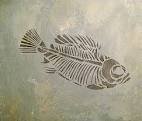
If scientists found this fossil, what could they infer?
a)
what fish are like today
b)
that this fish lacked oxygen
c)
what kind of animal ate this fish
d)
that water once covered the area
8.
Which of these must happen first for a fossil to form?
a)
A plant or animal is covered by sediment.
b)
Sediments fill a mold and form a cast.
c)
A plant or animal is eaten.
d)
Sediments are pressed together and harden.
9.
Why don't we know what many ancient plants looked like?
a)
They rotted away.
b)
Animals ate them all.
c)
Minerals destroyed them.
d)
They were trapped in tar.
10.
If an animal still looks like it did millions of years ago, what can you infer about its fossil.
a)
That the fossil of the animal that lived millions of years ago looks like the animal that is living today.
b)
That the animals has changed a lot!
c)
That the animal doesn't eat what the ancient one did.
d)
That they rotted away.
11.

People who study fossils are called ____.
a)
meterologists
b)
fossilologists
c)
paleontologists
d)
fossil hunters
12.
Which of the following is NOT something you could learn from a fossil?
a)
The size of the animal
b)
What the animal ate
c)
The color of the animal
d)
Where the animal lived
13.

_____ is any living thing, plant or animal, even you!
a)
A paleontologist
b)
An organism
c)
A fossil
d)
A rock
14.
In order for a fossil to form, which of the following events must happen FIRST?
a)
Slowly, minerals in the water replace the bone.
b)
Sediment covers the bone.
c)
An animal dies.
d)
The bone is no longer a bone, but a rock copy.
15.
What is Organic Material?
a)
Old fossils found at the bottom of the ocean
b)
Living things (organisms)
c)
Outer Layer of the Earth
16.

Magma can be found in the __________________.
a)
Crust
b)
Mantle
c)
Outer Core
d)
Inner Core
17.

The _____________ is the outer most layer of Earth.
a)
Crust
b)
Mantle
c)
Outer Core
d)
Inner Core
18.

The _____________ is located between the inner core and mantle.
a)
Crust
b)
Mantle
c)
Outer Core
d)
Inner Core
19.

The _____________ is found under the crust.
a)
Crust
b)
Mantle
c)
Outer Core
d)
Inner Core
20.

The ______ takes up 84% of Earth's volume and is the largest/thickest layer.
a)
Crust
b)
Mantle
c)
Outer Core
d)
Inner Core
21.

Oceans, plants, soil, and rocks make up the _____________.
a)
Crust
b)
Mantle
c)
Outer Core
d)
Inner Core
22.

The _____________ is the hottest layer at over 5000⁰C.
a)
Crust
b)
Mantle
c)
Outer Core
d)
Inner Core
23.

The _____________ is made of liquid iron and nickel.
a)
Crust
b)
Mantle
c)
Outer Core
d)
Inner Core
24.

The _____________ consists of solid iron and nickel.
a)
Crust
b)
Mantle
c)
Outer Core
d)
Inner Core
25.

The _____________ is made of solid rock and is the thinnest.
a)
Crust
b)
Mantle
c)
Outer Core
d)
Inner Core
26.
The type of plate boundary where two plates come together is a .....
a)
Convergent Boundary
b)
Divergent Boundary
c)
Transform Boundary
d)
Plate Boundary
27.
A divergent boundary occurs when plates ....
a)
Pull apart
b)
Come together
c)
Slide past each other
d)
subducting
28.

What type of event will occur at this boundary?
a)
Earthquake
b)
Volcano Eruption
c)
Tornado
d)
Mountain Building
29.
Which of the following is the name of the ancient supercontinent formed 28 Million Years ago.
a)
Pangea
b)
Gondwanda
c)
Laurasia
d)
Neverland
30.
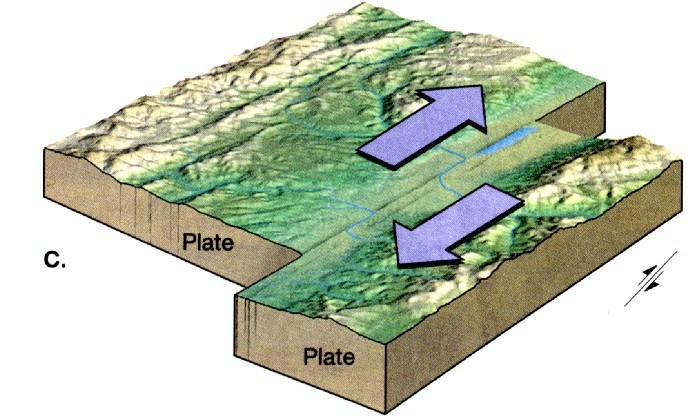
What type of plate boundary is this?
a)
Transform
b)
Convergent
c)
Divergent
d)
Plate
31.
Mountains form from ...
a)
plates sliding past one another
b)
collision of plates
c)
plates moving away from each other
32.
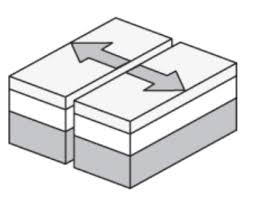
Name the boundary
a)
convergent boundary
b)
divergent boundary
c)
transform boundary
d)
sergent boundary
33.
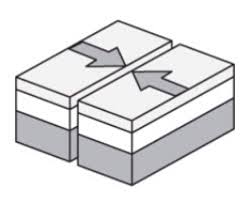
Name the boundary
a)
convergent boundary
b)
divergent boundary
c)
transform boundary
d)
sergent boundary
34.
Sedimentary rock is formed through the process of
a)
Cementation
b)
Stratification
c)
Erosion
d)
Foliation
35.
What is process in which water, wind, and heat break down rock?
a)
weathering
b)
exfoliation
c)
cementation
d)
composition
36.
During the rock cycle, what forms when the magma cools?
a)
igneous rocks
b)
sedimentary rock
c)
metamorphic rock
d)
foliated rock
37.
process in which sediment is dropped and comes to rest
a)
deposition
b)
erosion
c)
rock
d)
rock cyle
38.
process by which sediment is removed from its source
a)
deposition
b)
erosion
c)
rock
d)
texture
39.
The process by which rocks are formed and broken down
a)
The Rock Cycle
b)
Deposition
c)
Magma
d)
Lava
100 %

