
NEW
Font size
S
M
L
XL
 Worksheets
Natural Selection
Total questions: 35
Worksheet time: 24mins
Name
Class
Date
1.
Who is the father of evolution?
a)
Darwin
b)
Mendel
c)
Newton
d)
Einstein
2.
What is another name for natural selection?
a)
survival of the smartest
b)
survival of the fastest
c)
survival of the biggest
d)
survival of the fittest
3.
What is a change in an organism that allows for it to survive in its environment?
a)
homologous
b)
vestigial
c)
variation
d)
adaptation
4.
When all of the organisms of a species have died it is called
a)
evolution
b)
extinction
c)
adaptation
d)
natural selection
5.
What is the study of organisms at the early stages of development?
a)
DNA studies
b)
embryology
c)
extinction
d)
fossil record
6.
What is an organism that has similar characteristics and can reproduce?
a)
species
b)
organism
c)
embryology
d)
vestigial
7.
When the DNA of an organism is altered it is referred to as…
a)
Mutation
b)
Gene Flow
c)
Genetic Drift
d)
Sexual Selection
8.
The cause of artificial selection is…
a)
The environment
b)
Humans
c)
Mutation
d)
Gene Flow
9.

Darwin wrote that organisms with traits that are best suited to the environment will ________________
a)
increase in number
b)
become extinct
10.
Which of the following is NOT an example of natural selection?
a)
People selectively breeding hamsters.
b)
Insect populations developing resistance to certain pesticides.
c)
Bacteria becoming resistant to antibiotics.
d)
Male birds of certain species developing colorful feathers to attract female mates.
11.
Which term refers to the process by which individuals that are better suited to the environment survive and reproduce therefore passing down their genes to their offspring?
a)
Evolution
b)
Variation
c)
Adaptation
d)
Natural Selection
12.

Which species’ DNA is most similar to the DNA of the toothed whale?
a)
Hippopotamus
b)
Baleen Whale
c)
Grazing Mammals
d)
Camels
13.
Inherited trait that helps an organism survive is a(n) __________.
a)
Fossil
b)
Adaptation
c)
Ancestor
d)
Natural selection
14.
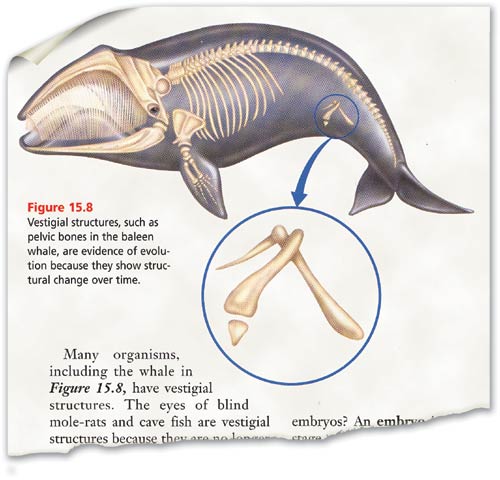
Which of the following is an example of a vestigial structure?
a)
the wings of a red-tailed hawk
b)
the hind limbs of a house cat
c)
the fins of sharks
d)
the tailbone of a human
15.
Why are advantageous traits more likely to be passed onto offspring?
a)
Because they are more likely to survive and reproduce.
b)
Because they come from dominant alleles.
c)
Because they come from recessive alleles.
d)
Because the trait is an acquired phenotype.
16.
What characteristic did Darwin observe about the finches on the Galapagos Islands?
a)
Their feathers
b)
Genotypes
c)
Their beaks
d)
Their body sizes
17.
The separation of a group of individuals from the rest of the population is referred to as
a)
genetic drift
b)
natural selection
c)
geographic isolation
d)
survival of the fittest
18.

Who was the naturalist that traveled the world to study plants and animals?
a)
Albert Einstein
b)
Charles Darwin
c)
Charles Barkley
d)
Isaac Newton
19.
The white feathers of a snowy owl allow it to blend in with its environment during the winter months (snow). This is an example of ________________
a)
Species
b)
Environmental Change
c)
Adaptation
d)
Variation
20.
Remains of ancient organisms are called
a)
Extinctions
b)
Fossils
c)
Mutations
d)
Variations
21.
A group of similar organisms that can mate with each other and produce fertile offspring is called a species.
a)
True
b)
False
22.
Over time, adaptions can lead populations to experience
a)
environmental changes
b)
genetic changes
c)
geological changes
d)
extinction
23.
In natural selection, the selective agent is the
a)
humans
b)
mutations
c)
breeders
d)
environment
24.

All rabbits living in a particular area would be an example of a(n)
a)
population
b)
species
c)
fossil
d)
individual organism
25.
What is suggested by the anatomical similarity of different species of vertebrates?
a)
no evolutionary relationships between the groups
b)
recent common ancestry
c)
similar environments in the past
d)
evolution from a distant common ancestor
26.
Mutations are important because they bring about
a)
death of the organism in which they develop
b)
genetic variation needed for a population to evolve
c)
benefits for the individual, not for the population
d)
Hardey-Weinberg equilibrium within a population
27.
What is speciation?
a)
combining of tow species to form one with different traits
b)
isolation that affects mating behaviors
c)
timing of mating that prevents normal sexual selection
d)
divergence of two or more species from an existing one
28.
asexual reproduction produces offspring with
a)
half of a single parent's genes
b)
the same genes as the parent
c)
a mix of genes from two parents
d)
lots of genetic variation
29.
What is the term for a feature that allows an organism to survive better in its environemtn?
a)
variation
b)
adaptation
c)
homologous structure
d)
vestigial structure
30.
When Darwin was studying the finches on the Galapagos, he hypothesized that they may have
a)
evolved from those found in nearby South America.
b)
always lived there in their current form.
c)
lived there for a few years and then moved away.
d)
been pets that escaped.
31.
What is evolution?
a)
Traits and organisms change slowly over a long period of time
b)
Humans select certain traits and breed for them
c)
Organisms never change based on their environments
d)
Humans originally came from monkeys
32.
Why might giraffes developed their long necks?
a)
Longer necks meant more food could be eaten, helping survival and reproduction
b)
To keep their heads/brains further from predators
c)
Longer necks matched their longer legs
d)
Males needed them to fight each other for females
33.
Why is the fossil record most important to scientists?
a)
It's our only record of dinosaurs
b)
It tells us that very few animals have gone extinct
c)
It suggests that species have evolved over time
d)
It proves that humans have always dominated the earth
34.
Woolly mammoths became extinct when the ice age ended. What might have been one reason?
a)
They evolved into elephants instead
b)
They were more adapted to the new warmer climate
c)
They were less adapted to the new warmer climate
d)
They were hunted by early humans
35.
What was Darwin's hypothesis about the various beak styles he saw on his finches?
a)
Different food sources selected for different beak styles
b)
Different breeding habits selected for different beak styles
c)
All the finches had always had different beak styles
d)
He saw no differences in their beaks
Reset

