
NEW
Font size
S
M
L
XL
 Worksheets
Earth's Structures and Processes Test 1 Review
Total questions: 73
Worksheet time: 3590secs
Name
Class
Date
1.
What would you be most likely to find at a transform boundary?
a)
Earthquakes
b)
Volcanoes
c)
Mountains
d)
Rift
2.
What would you be most likely to find at a convergent boundary between two pieces of oceanic crust?
a)
Mountains
b)
Rift
c)
Mid-Ocean Ridge
d)
Island Arc
3.
What would you be most likely to find at a convergent boundary between a continental and oceanic plate?
a)
Mountains
b)
Volcanoes
c)
Mid-Ocean Ridge
d)
Rift
4.
What would you be most likely to find at a divergent boundary between two pieces of oceanic crust?
a)
Rift
b)
Mid-Ocean Ridge
c)
Island Arc
d)
Flat land
5.
What would you be most likely to find at a divergent boundary between two pieces of continental crust?
a)
Mid-Ocean Ridge
b)
Mountain
c)
Rift
d)
Island Arc
6.
What would you be most likely to find at a convergent boundary between two pieces of continental crust?
a)
Volcano
b)
Mountain
c)
Rift
d)
Island Arc
7.
Which of the following statements is false?
a)
Oceanic crust is made of basalt
b)
Oceanic crust is thinner than continental crust
c)
Oceanic crust is less dense than continental crust
d)
Oceanic crust is younger than continental crust
8.
Which of the following statements is false?
a)
Continental crust is less dense than oceanic crust
b)
Continental crust is younger than oceanic crust
c)
Continental crust is made of granite
d)
Continental crust is thicker than oceanic crust
9.
A subduction zone is formed...
a)
when one tectonic plate sinks below another
b)
at every type of convergent plate boundary
c)
at every type of divergent plate boundary
d)
at transform boundaries
10.
Whenever a subduction zone is formed a ______ is formed.
a)
Mountain
b)
Island Arc
c)
Rift
d)
Volcano
11.
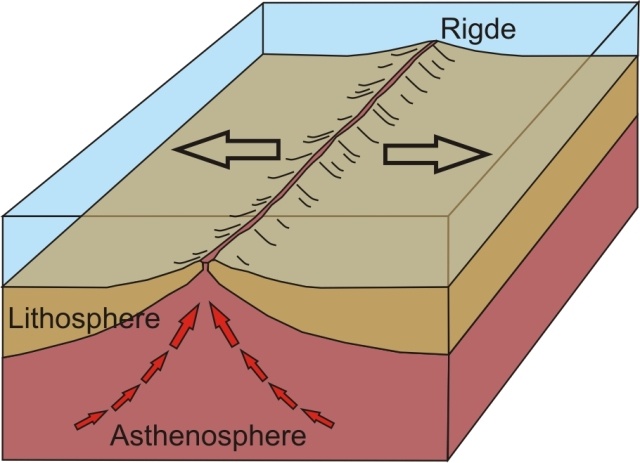
What kind of plate boundary is shown here?
a)
divergent
b)
convergent
c)
transform
d)
subducting
12.

What kind of plate boundary is shown here?
a)
divergent
b)
convergent
c)
transform
d)
submergent
13.

What kind of plate boundary is shown here?
a)
divergent
b)
convergent
c)
transform
d)
strike slip
14.
What geologic feature/event you be most likely to find at a transform boundary?
a)
Earthquakes
b)
Volcanoes
c)
Mountains
d)
Rift Valleys
15.
What geologic feature/event would you most likely to find at a divergent boundary between two pieces of oceanic crust?
a)
Rift Valley
b)
Mid-Ocean Ridge
c)
Island Arc
d)
Flat land
16.
What geologic feature/event would you most likely to find at a divergent boundary between two pieces of continental crust?
a)
Mid-Ocean Ridge
b)
Mountain
c)
Rift Valley
d)
Island Arc
17.
What geologic feature/event would you most likely to find at a convergent boundary between two pieces of continental crust?
a)
Volcano
b)
Mountain
c)
Rift
d)
Island Arc
18.
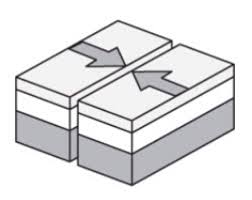
Name the boundary
a)
convergent boundary
b)
divergent boundary
c)
transform boundary
d)
sergent boundary
19.

Name the boundary
a)
convergent boundary
b)
divergent boundary
c)
transform boundary
d)
sergent boundary
20.
The area where two or more plates meet is called a __________________.
a)
fault
b)
plate boundary
c)
plate edge
d)
ring of fire
21.
The thinnest layer of the Earth is the ___________.
a)
mantle
b)
crust
c)
core
22.
Tectonic plates are made up of continental crust and ________ crust.
a)
continental
b)
oceanic
c)
plates
d)
mantle
23.
There are how many different types of crust?
a)
1
b)
2
c)
5
d)
3
24.
What is the core made of?
a)
steel
b)
iron
c)
aluminum
d)
iron and nickel
25.
What describes the outer core?
a)
solid
b)
liquid
c)
viscous
d)
gas
26.
Why is the inner core solid?
a)
its unknown
b)
what it's made of
c)
the pressure
d)
it is colder than the outer core
27.
Which layer of the Earth is the only liquid layer?
a)
Outer Core
b)
Inner Core
c)
Mantle
d)
Lithosphere
28.
Which layer(s) of the Earth make up the asthenosphere?
a)
Part of the mantle
b)
Crust, mantle, Core
c)
Crust and upper mantle
d)
Only the crust
29.
What is the correct order (starting from the surface) of Earth's layers?
a)
crust, outer core, inner core, mantle
b)
mantle, outer core, inner core, crust
c)
crust, mantle, outer core, inner core
d)
outer core, inner core, crust, mantle
30.
What layer is a semisolid and acts like a plastic?
a)
Lithosphere
b)
Mantle
c)
Asthenosphere
d)
crust
31.
The oceanic floor is made of?
a)
Granite
b)
Basalt
c)
Cookies
d)
Water
32.
The continental floor is made up of?
a)
Flowers and grass
b)
Basalt
c)
Granite
d)
Crust
33.
What happens to pressure as we move from the crust to the inner core?
a)
Pressure Decreases
b)
Pressure Increases
c)
Nothing
34.
What happens to temperature as we move from the crust to the inner core?
a)
Decreases
b)
Increases
c)
Nothing
35.
Which layer of Earth has the GREATEST density?
a)
crust
b)
mantle
c)
outer core
d)
inner core
36.
Which layer of Earth is made up of tectonic plates?
a)
outer core
b)
inner core
c)
asthenosphere
d)
lithosphere
37.
The layer underneath the crust that has magma.
a)
mantle
b)
crust
c)
inner core
d)
outer core
38.
A theory of how Earth's continents move over its surface.
a)
Pangea
b)
Contintntal Drift
c)
Yesterday
d)
Pandemonium
39.
Melted rock at Earth's surface is called
a)
lava
b)
the mantle
c)
the lithosphere
d)
magma
40.
A fracture in the crust of a planet is a
a)
mountain
b)
valley
c)
fault
d)
river
41.

Who is the person credited with developing the theory of continental drift?
a)
Harry Hess
b)
Galileo
c)
Alfred Wegener
d)
Newton
42.

What is this a picture of?
a)
plate tectonics
b)
continental drift
c)
pangea
d)
glacier scaring
43.
What two specific continents fit together most noticeably?
a)
Africa and North America
b)
South America and Europe
c)
South America and Africa
d)
Antartica and Africa
44.
How does fossil evidence support Wegener's hypothesis of continental drift?
a)
Similar fossils are found along continental margins that appear to join together.
b)
Fossils are found in areas where the present-day climate could not have supported the organisms that made the fossils.
c)
Similar fossils of giant, land-dwelling dinosaurs are found on continents separated by oceans.
d)
all of the above
45.
What is the force that moves the continents?
a)
Conduction
b)
Convection
c)
Radiation
d)
Conveyor belts
46.
Originally the Continental drift theory was not well received by other scientist. Why?
a)
There was a competing theory at the time that was more believable.
b)
There was no data showing the continents ever moved.
c)
The scientists did not know the force responsible for moving the continents.
d)
The scientist presenting the data was unreliable.
47.
Why did no one believe Wegener's thoery?
a)
He could not explain HOW the continents moved
b)
He didn't have evidence
c)
His data was wrong
d)
He didn't use the right technology to gather data
48.
Which of the following occurs because of convection currents?
a)
Tectonic plates on the crust move.
b)
The mantle increases in size.
c)
Pressure in the crust increases.
d)
Pressure in the crust decreases.
49.
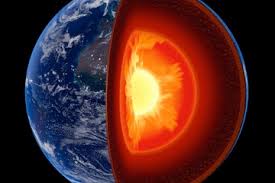
As you travel from the inner core to the crust, how would temperature, pressure and density of the material change?
a)
The would all increase
b)
The would all decrease.
c)
They would stay the same.
d)
Temperature would decrease, but pressure and density would increase.
50.
What does the theory of continental drift state?
a)
The continents were once joined in a super-continent and have moved over time
b)
Continents are stationary and do not move
c)
The Earth is broken into lithospheric plates that move due to convection currents
d)
none of the above
51.
Which of the following is where one plate slides under another plate?
a)
submarine zone
b)
divergence zone
c)
subduction zone
d)
lower zone
52.
This land formation occurs at a divergent continental/ continental boundary.
a)
mid ocean ridge
b)
deep ocean trench
c)
pacific hot spot
d)
rift valley
53.
Mountains form from ...
a)
plates sliding past one another
b)
collision of plates
c)
plates moving away from each other
54.
Geologists obtain indirect evidence about Earth's interior by...
a)
measuring pressure at the surface
b)
studying seismic waves
c)
drilling through each layer
d)
estimation of temperature in the layers
55.

Which crustal feature is found at a subduction zone?
a)
Trench
b)
Mountains
c)
Earthquakes
d)
Rift Valley
56.

Where is the San Andreas fault located?
a)
Georgia
b)
Carolina
c)
Canada
d)
California
57.

India and Asia crashed about 55 million years ago. What mountain range was produced?
a)
The Rockies
b)
The Alps
c)
The Himalayas
d)
The Andes
58.
What are the two types of crust
a)
continental and oceanic
b)
ocean and upper
c)
lower and upper
d)
pizza and subway
59.
Earthquakes and volcanoes are most likely found in which locations?
a)
At plate boundaries
b)
in oceans
c)
in the middle of continents
d)
in the middle of plates
60.
When one plate sides underneath another, it _________ and the magma _________.
a)
hardens, sinks
b)
melts, sinks
c)
hardens, rises
d)
melts, rises
61.
The area where two tectonic plates meet.
a)
mantle
b)
focus
c)
plate boundary
d)
convection
62.
The process of adding more crust to the ocean floor while stripping away older rock is called
a)
sea floor spreading
b)
subduction
c)
ocean chaining
63.
The stress force that pushes the crust where two plates are moving together
a)
tension
b)
compression
c)
shear
64.
The stress force that pulls plates past one another sideways is called
a)
shear
b)
compression
c)
tension
65.
The stress force that pulls plates past one another sideways is called
a)
shear
b)
compression
c)
tension
66.
A fault caused by rocks moving together
a)
normal fault
b)
reverse fault
c)
slip strike fault
67.
a fault caused by rocks moving away from each other
a)
strike slip fault
b)
reverse fault
c)
normal fault
68.

What type of stress is this?
a)
compression
b)
shearing
c)
tension
69.

What type of stress is this?
a)
compression
b)
shearing
c)
tension
70.
What type of stress is this?
a)
compression
b)
shearing
c)
tension
71.

What type of stress causes these folds?
a)
compression
b)
shearing
c)
tension
72.

a)
normal fault
b)
reverse fault
c)
strike-slip fault
73.
How does a reverse fault form?
a)
The hanging wall moves upward relative to the footwall.
b)
Compression thrusts the fault into reverse.
c)
Blocks slide past each other.
d)
The hanging wall moves downward relative to the footwall.
Reset

