Wayground logo

Free Printable Worksheets

Font size

S
M
L
XL
Worksheets

Waves Unit Review

Total questions: 41

Worksheet time: 29mins
Name
Class
Date
1.
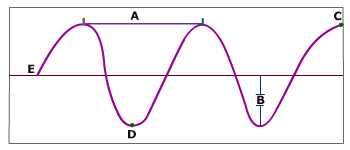
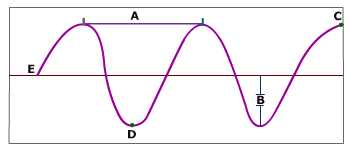
Which letter represents wavelength?
a)
A
b)
B
c)
C
d)
D
2.
What is measured from crest to crest or trough to trough?
a)
Frequency
b)
Amplitude
c)
Wavelength
d)
Origin
3.
What part of the wave is a rarefaction? 
a)
A
b)
B
4.
When the frequency of a wave increases, what happens to the wavelength?
a)
The wavelength is not directly affected by the frequency of a wave.
b)
The wavelength increases.
c)
The wavelength decreases.
d)
More specific information is needed to form a conclusion about the wavelength.
5.
What part of the wave is a compression? 
a)
A
b)
B
6.
Which letter represents the wave crest?
a)
A
b)
B
c)
C
d)
D
7.
If the distance represented by the letter A were increased, how would it change the way the sound was heard?
a)
The sound would be higher pitched. 
b)
The sound would be lower pitched. 
c)
The sound would be quieter in volume. 
d)
The sound would be louder in volume. 
8.
The distance from the resting point to the top of the crest is called the _________________.
a)
Frequency
b)
Amplitude
c)
Trough
d)
Volume
9.
High amplitude is quiet or loud?
a)
Quiet
b)
Loud
10.
Which letter represents the wave trough?
a)
A
b)
B
c)
C
d)
D
11.
This is the number of wavelengths that pass a point in 1 sec.  
a)
frequency
b)
pitch
c)
amplitude
d)
rest postion
12.
a wave that requires a medium through which to travel
a)
mechanical wave
b)
chemical wave
c)
electromagnetic wave
d)
microwave
13.
Where is a place a person would hear no sound?
a)
in a cave
b)
in a forest
c)
in space
d)
in water
14.
Another example of resonance is when a small force is ________ at the right frequency so that the amplitude of the wave increases. This is what caused the Tacoma Narrows bridge to collapse.
a)
stopped
b)
repeated
c)
decreased
15.
A tuning fork starts to vibrate when a certain note is played on the piano, This is an example of _______.
a)
resonance
b)
refraction
c)
diffraction
d)
reflection
16.
Which type of energy is sound?
a)
thermal energy
b)
radiant energy
c)
mechanical energy
d)
nuclear energy
17.

Which has the SHORTEST wavelength and, therefore, the highest frequency/most energy?

a)

Radio waves

b)

Ultraviolet Rays

c)

Gamma Rays

d)

X-rays

18.

Is this lens concave or convex?

a)

Concave

b)

Convex

19.

Which of the following (SELECT ALL THAT APPLY) diverge light?

a)

convex lens

b)

convex mirror

c)

concave lens

d)

concave mirror

20.

Which of the following (SELECT ALL THAT APPLY) converge light?

a)

convex lens

b)

convex mirror

c)

concave lens

d)

concave mirror

21.

This type of lens is thinner in the middle than on the edges. What type of lens does this describe?

a)

Concave

b)

Convex

22.

The bending of a wave around the edge of a barrier or as it passes through a tiny opening is called

a)

reflection

b)

diffraction

c)

interference

d)

refraction

23.

Which shows a converging lens?

a)

Top left

b)

Top right

c)

Bottom left

d)

Bottom right

24.

Water waves and light waves both move with the motion of what kind of waves?

a)

transverse

b)

longitudinal

25.
The bending of a wave as it travels from one medium to another and as a result changes speed is called
a)
reflection
b)
refraction
c)
diffraction
d)
interference
26.

A flat mirror is an example of a _______________.

a)

convex mirror

b)

concave mirror

c)

plane mirror

d)

none of the above

27.
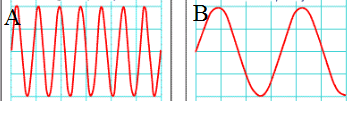
Which wave has a greater frequency?
a)
A
b)
B
28.

Mechanical waves can travel through all of the following EXCEPT _____.

a)

wood

b)

a vacuum

c)

water

d)

air

29.
Bats use ________ to locate mosquitoes and find their way around in the dark.
a)
solar
b)
ecology
c)
echolocation
d)
evolution
30.
Which letter represents amplitude?
a)
A
b)
B
c)
C
d)
D
31.

A scientist observed the following about a wave:


It moves through a medium.

It can also move through empty space.

Its particles move perpendicular to the wave direction.


What kind of wave did the scientist observe?

a)

transverse mechanical

b)

transverse electromagnetic

c)

longitudinal mechanical

d)

longitudinal electromagnetic

32.
Which of the following is NOT an application of sound waves?
a)
microwaving food to warm it up
b)
getting an ultrasound at the doctor
c)
sonar being used to find a crashed plane in the ocean
d)
bats locating food using echolocation
33.

Which interaction is occurring in the picture?

a)

Reflection

b)

Refraction

c)

Diffraction

d)

Interference

34.
What part of the wave is a compression? 
a)
A
b)
B
35.
What part of the wave is a rarefaction? 
a)
A
b)
B
36.

A disturbance that carries energy from one place to another is called _______.

a)

a medium

b)

a vacuum

c)

a force

d)

a wave

37.

Of the following, which has the highest frequency?

a)

visible light

b)

infrared light

c)

radio waves

d)

ultraviolet light

38.

Which visible light color has the highest frequency?

a)

red

b)

green

c)

blue

d)

violet

39.

An image doctors take of organs and tissues inside the body using ultrasound is called a ______.

a)

echo

b)

sonar

c)

sonagram

d)

radar

40.

Which wave has the greatest wavelength?

a)

red

b)

purple

c)

green

d)

blue

41.

Which of the following statements are correct concerning the electromagnetic spectrum? SELECT ALL THAT APPLY

a)

Radio waves have a longer wavelength than infrared waves.

b)

Gamma ray waves have lower frequency than x-ray waves.

c)

Visible light waves have a shorter wavelength than ultraviolet waves.

d)

Ultraviolet waves have a higher frequency than infrared waves.

e)

X-ray waves have a shorter wavelength than visible waves.