
 Worksheets
Quarter 3 Benchmark Review- Science 2018
Total questions: 57
Worksheet time: 48mins
Name
Class
Date
1.
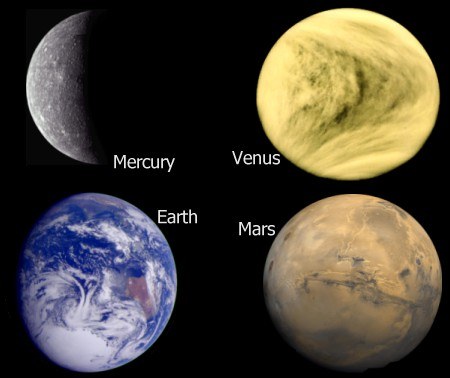
Earth and the other planets closest to the Sun are made mostly of _______
a)
gas
b)
metal
c)
water
d)
rock
2.

Earth's ________ on its axis causes day and night.
a)
rotation
b)
revolution
c)
phase
d)
comet
3.

One full orbit of an object around another object is called a ________.
a)
axis
b)
rotation
c)
revolution
d)
satellite
4.

The __________ has planets, moons, comets, and asteroids.
a)
solar system
b)
earth
c)
rotation
d)
United States
5.
One of the main differences between the outer and inner planets is __________.
a)
The inner planets all have water
b)
the inner planets are much bigger than the outer planets
c)
the outer planets are gas planets
d)
the outer planets have rings, and the inner planets don't
6.
Where is the asteroid belt found?
a)
between earth and mars
b)
Between Uranus and Neptune
c)
Between Mercury and Venus
d)
Between Mars and Jupiter
7.
Why does Earth have different seasons?
a)
because of the distance between Earth and the sun
b)
because of the speed of Earth as it rotates on its axis
c)
because of the amount of light blocked by the moon on its axis
d)
because of the tilt of Earth on its axis as it moves around the sun
8.
Day and night is caused by the _____________ of earth on its axis.
a)
revolution
b)
orbit
c)
rotation
9.
As the Earth travels around the sun, this tilt causes different areas of the Earth’s surface to get different amounts of daylight at different times of the year. The angle of the Sun’s rays to the surface also causes areas to have more or less of the Sun’s energy. This causes the ________.
a)
months
b)
day and night
c)
seasons
d)
years
10.
Which outer planets have rings?
a)
Just Saturn
b)
Saturn and Jupiter
c)
Jupiter, Neptune, and Saturn
d)
all 4 of them
11.

a pattern of stars that form an imaginary picture or design in the sky
a)
Orbit
b)
Rotate
c)
constellation
d)
Milky Way
12.
The pattern of stars in a constellation stays the same, but a planet can be seen in different locations at different times because _______________.
a)
Stars don't move; planets revolve and rotate
b)
Stars and planets revolve and rotate.
c)
Stars not planets move
d)
Planets don't move; Stars revolve and rotate.
13.
What medium does sound travel through slowest?
a)
gas
b)
solid
c)
liquid
d)
trees
14.
Sound is caused by....
a)
molecules
b)
vibrations
c)
people
d)
space
15.
Sound does not travel in space because
a)
Space is too far away.
b)
There is no matter in space.
c)
Space is the final frontier
d)
Space has planets.
16.
Sound is caused by?
a)
force
b)
vibrations
c)
instruments
17.
What is vibration?
a)
how loud a sound is
b)
the back and forth movement of matter
c)
how high or low a sound is
d)
the loudness or softness of a sound
18.

Measure of how high or low a sound is
a)
amplitude
b)
compression
c)
speed of sound
d)
pitch
19.
A longer string makes a _______ pitch than a short string.
a)
louder
b)
softer
c)
higher
d)
lower
20.
The highest pitch is made by the _______ instrument.
a)
biggest
b)
wooden
c)
smallest
d)
shiniest
21.
An object that does not vibrate cannot produce
a)
sound
b)
light
c)
heat
d)
electricity
22.
What is volume?
a)
how high or low a sound is
b)
the loudness or softness of a sound
c)
the number of vibrations per second
d)
vibrations
23.
What medium (solid, liquid, gas) does sound travel fastest through?
a)
solid
b)
liquid
c)
gas
24.

Sound is a form of?
a)
energy
b)
pitch
c)
volume
25.
Sound travels FASTEST through which of these materials?
a)
Air
b)
Empty space
c)
Metal
d)
Water
26.

Why is the school library covered with carpet?
a)
So everyone can make a lot of noise
b)
to help absorb sounds to keep it quiet
c)
because it looks good
d)
to help absorb sounds so it can stay noisy
27.
What is a PUSH or PULL of an object?
a)
Motion
b)
Force
c)
Friction
d)
Gravity
28.
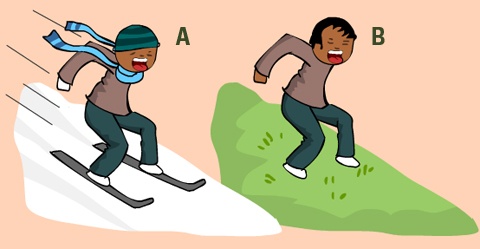
Why is it harder for the boy in Image B to get down the hill?
a)
Motion
b)
Friction
c)
Work
d)
Displacement
29.
Which force produces a change in motion?
a)
unbalanced force
b)
balanced force
c)
gravitational force
d)
frictional force
30.
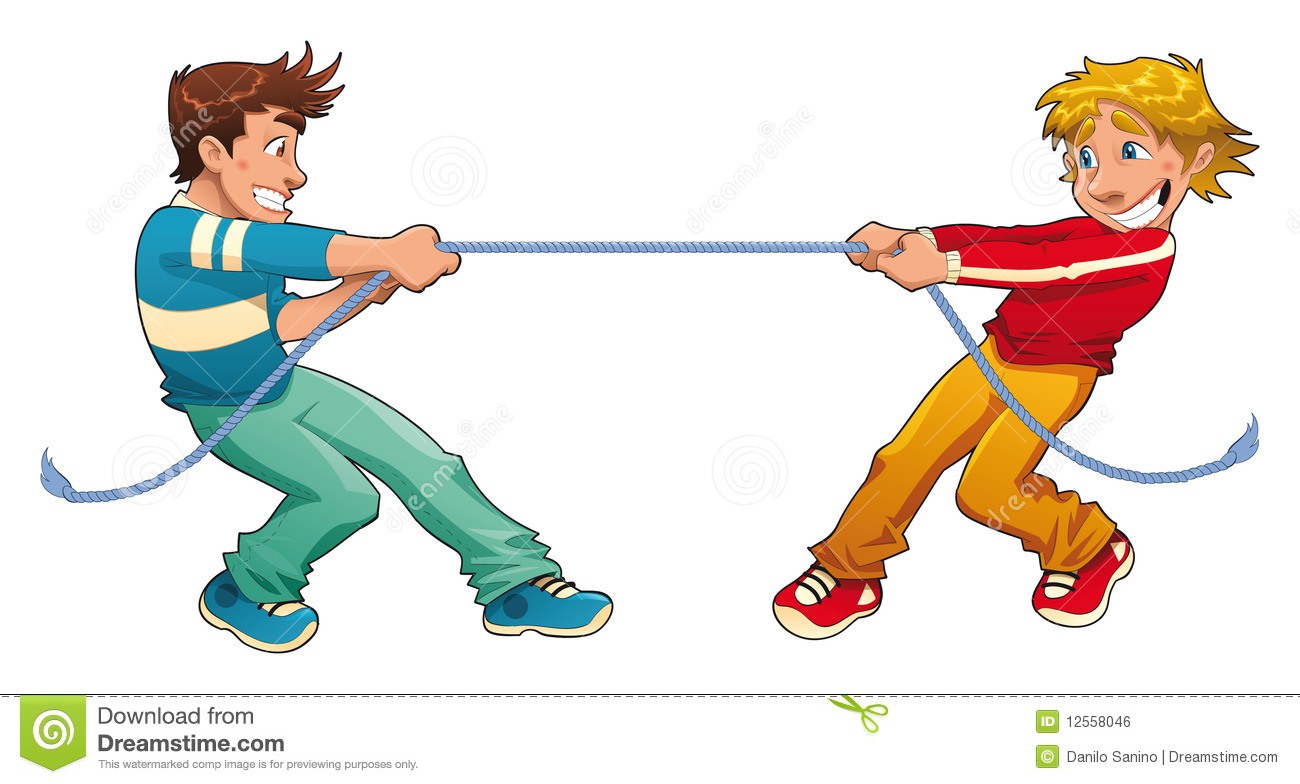
If these boys are pulling with the same amount of force. What will happen?
a)
The boy in blue will win.
b)
They will not move at all.
c)
The boy in red will win.
d)
Both will fall down.
31.
_______________ is how fast an object changes over time.
a)
speed
b)
velocity
c)
momentum
d)
acceleration
32.
Any time the forces are unbalanced, an object will remain at rest. True or false?
a)
true
b)
false
33.
Speed is equal to
a)
Distance/Time
b)
Time/Distance
c)
Time x Distance
d)
Acceleration
34.
About how many days does it take to moon to go through a complete cycle?
a)
7 days
b)
365 days
c)
29 days
d)
20 days
35.

When the visible (lit) portion of the moon is increasing, the moon is:
a)
waning
b)
full
c)
waxing
d)
new
36.

When the Earth is between the moon and sun, it is most likely a:
a)
new moon
b)
full moon
c)
waxing crescent
d)
waxing gibbous
37.
Changes in the moon's appearance are
a)
phases
b)
eclipses
c)
stages
d)
cycle
38.

How long does it take the moon to complete an orbit around Earth?
a)
23 days
b)
29 days (1 month)
c)
2 weeks (half a month)
d)
365 days (a year)
39.

The Moon orbits Earth in a ________________ direction
a)
clockwise
b)
counterclockwise
c)
upwards
d)
downwards
40.
Define Waxing
a)
Moon is increasing and light part appears to be growing
b)
Completely illuminated
c)
dark side is facing earth
d)
Moon is decreasing and light part appears to be shrinking
41.

Name the moon phase
a)
Waxing Gibbous
b)
Waxing Crescent
c)
Waning Crescent
d)
Waning Gibbous
42.

Name the moon phase
a)
Waning Crescent
b)
Waxing Crescent
c)
Waning Gibbous
d)
Waxing Gibbous
43.
The 1st Quarter moon is lit on the:
a)
Left Side
b)
Right Side
44.
T/F When the moon is waxing,the part that is lit by the sun is getting larger on the right side
a)
TRUE
b)
FALSE
45.
T/F The moon can be seen from Earth because it reflects the sun's light
a)
TRUE
b)
FALSE
46.
Which planet is closest in size to Earth?
a)
Mercury
b)
Pluto
c)
Venus
d)
Mars
47.

What causes droplets of water on the outside of a water glass?
a)
condensation
b)
precipitation
c)
evaporation
d)
run off
48.
What type of material allows all light to pass through?
a)
translucent
b)
transparent
c)
opaque
49.
What type of material does not allow any light to pass through?
a)
translucent
b)
transparent
c)
opaque
50.
What is the center of the solar system?
a)
the Sun.
b)
the North Star.
c)
Earth
d)
the Moon
51.
The next season in the Northern hemisphere after spring is ____.
a)
fall
b)
summer
c)
winter
52.
Object spinning on its axis.
a)
revolution
b)
rotation
53.
Object orbiting another object.
a)
revolution
b)
rotation
54.
Imaginary line that runes through Earth.
a)
orbit
b)
day
c)
tilt
d)
axis
55.
If its ____ in the Northern hemisphere, then its fall in the Southern hemisphere.
a)
spring
b)
summer
c)
fall
d)
winter
56.
If its ____ in the Northern hemisphere, then its summer in the Southern hemisphere.
a)
spring
b)
summer
c)
fall
d)
winter
57.
How can it be summer in Australia and winter in America?
a)
Because they are both in the southern hemisphere?
b)
Because Australia is in the southern hemisphere and America is in the northern hemisphere?
c)
They are both in the pacific ocean?
d)
Because the earth tilts and Australia is smaller?
100 %

