
NEW
Font size
S
M
L
XL
 Worksheets
Meteorology Quiz 2 Review
Total questions: 37
Worksheet time: 31mins
Name
Class
Date
1.

Which is the uppermost layer of the atmosphere?
a)
stratosphere
b)
thermosphere
c)
troposphere
d)
mesosphere
2.

Air pressure ________ as altitude increases.
a)
increases
b)
decreases
3.
Which layer is the lowest layer of the atmosphere?
a)
stratosphere
b)
thermosphere
c)
troposphere
d)
mesosphere
4.
Virtually all weather takes place in the...
a)
stratosphere
b)
thermosphere
c)
troposphere
d)
mesosphere
5.
Temperature decreases as altitude...
a)
increases
b)
decreases
6.
Clouds are found at various levels within the...
a)
stratosphere
b)
thermosphere
c)
troposphere
d)
mesosphere
7.
Meteoroids begin to burn up in the...
a)
stratosphere
b)
thermosphere
c)
troposphere
d)
mesosphere
8.
Most of the air that makes up the atmosphere is found in the...
a)
stratosphere
b)
thermosphere
c)
troposphere
d)
mesosphere
9.

Which layer does most weather occur in?
a)
thermosphere
b)
troposphere
c)
stratosphere
d)
ionosphere
10.

This is the layer where most airplanes fly.
a)
Troposphere
b)
Stratosphere
c)
Mesosphere
d)
Thermosphere
11.

The layers of the atmosphere are based on:
a)
Temperature
b)
Altutude
c)
Density
12.

In the Troposphere as altitude increases, temperature_____
a)
increases
b)
decreases
c)
stays the same
13.
In the atmosphere as altitude increases, air pressure _____
a)
increases
b)
decreases
c)
stays the same
14.

What symbol is this?
a)
warm front
b)
cold front
c)
stationary front
d)
occluded front
15.
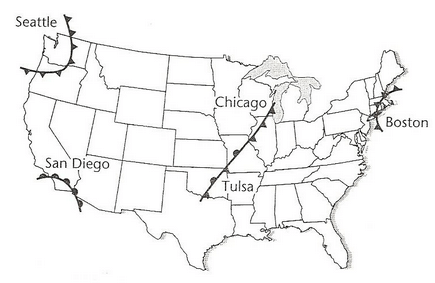
Which type of front is located near Boston?
a)
warm front
b)
cold front
c)
stationary front
d)
occluded front
16.
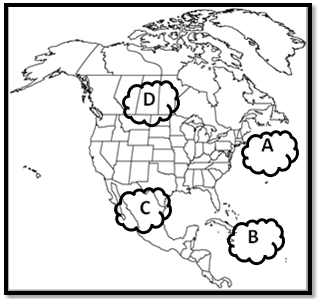
Which type of air would you find at air mass A?
a)
cold, dry
b)
warm, humid
c)
warm, dry
d)
cold, humid
17.
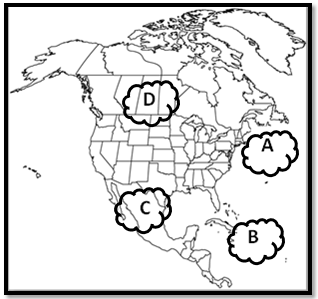
Which type of air would you find at air mass B?
a)
cold, dry
b)
warm, humid
c)
warm, dry
d)
cold, humid
18.
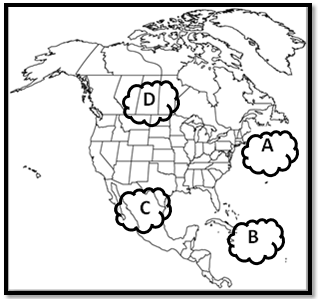
Which type of air would you find at air mass D?
a)
cold, dry
b)
warm, humid
c)
warm, dry
d)
cold, humid
19.
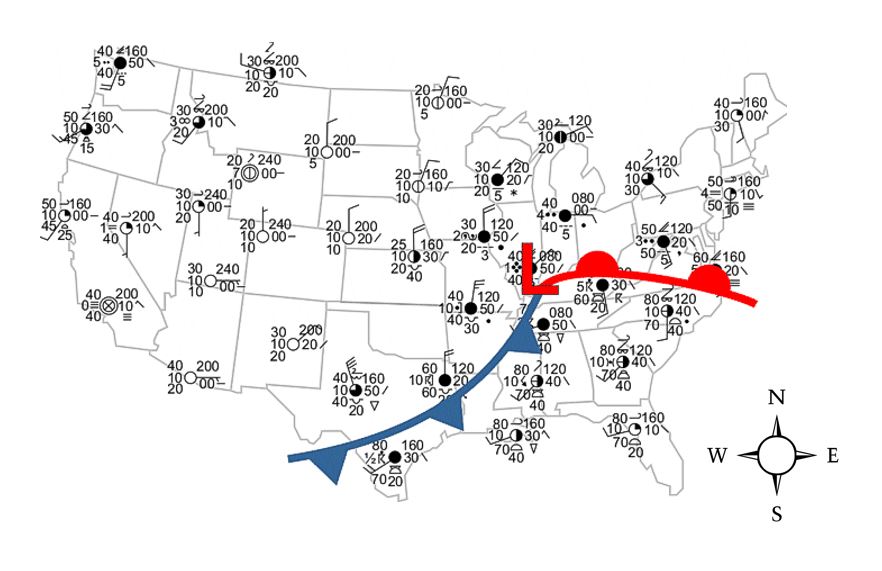
What direction is the warm front moving on the map?
a)
North
b)
South
c)
East
d)
West
20.
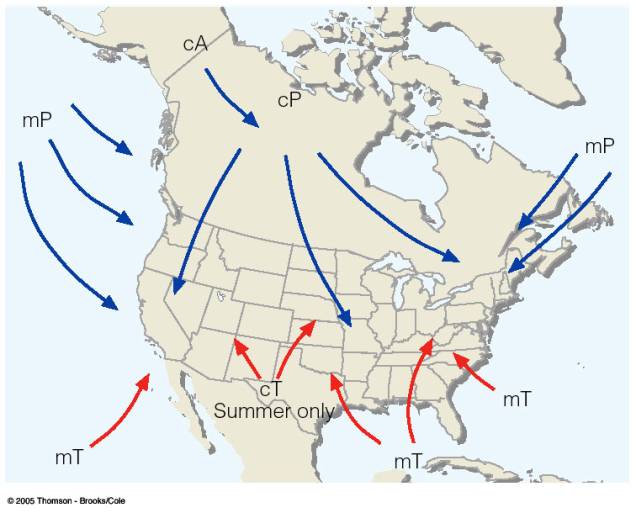
Which abbreviation of an air mass can be identified as dry and hot?
a)
cP
b)
mP
c)
cT
d)
mT
21.

Which abbreviation of an air mass can be identified as dry and cold?
a)
cP
b)
mP
c)
cT
d)
mT
22.

What does this symbol on a weather map indicate?
a)
High pressure system
b)
Low pressure system
c)
Cold front
d)
Warm front
23.

What does this symbol on a weather map indicate?
a)
High pressure system
b)
Low pressure system
c)
Cold Front
d)
Warm Front
24.
What kind of pressure predicts good weather?
a)
high
b)
low
c)
cold
d)
stationary
25.

Which type of front is displayed?
a)
Cold
b)
Warm
c)
Stationary
d)
Occluded
26.
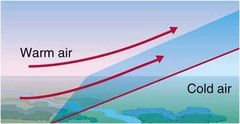
Which type of front is displayed?
a)
Cold
b)
Warm
c)
Stationary
d)
Occluded
27.
When two different air masses collide...
a)
A front forms
b)
They casually become one
c)
A new planet evolves
d)
Dinosaurs become extinct
28.
What type of front brings warm and humid weather to an area?
a)
cold front
b)
warm front
c)
stationary front
d)
occluded front
29.
What type of front brings cool, cold weather to an area?
a)
cold front
b)
warm front
c)
stationary front
d)
occluded front
30.

Which system results in rainy or stormy weather?
a)
high pressure
b)
low pressure
c)
hurricane
d)
weather system
31.

What type of air mass is the arrow showing?
a)
cold/dry
b)
cold/humid
c)
warm/dry
d)
warm/humid
32.
What would you expect from a Continental Polar air mass?
a)
moist, warm air
b)
dry, cold air
c)
dry, warm air
33.
What would you expect from a Maritime Tropical air mass?
a)
dry, warm air
b)
moist, cold air
c)
moist, warm air
34.
A wet, cold air mass would be -
a)
maritime tropical
b)
maritime polar
c)
continental tropical
d)
continental polar
35.
What type of weather would a continental tropical air mass bring?
a)
dry and cold weather
b)
wet and cold weather
c)
dry and warm weather
d)
wet and warm weather
36.
How do we name air masses?
a)
Water and temperature
b)
Air pressure
c)
Humidity and temperature
d)
Cold and warm
37.
When you are on a plane traveling to different altitudes why do your ear's "POP?
a)
Differences in air pressure outside and inside your ears.
b)
The air pressure is the same
c)
Air pressure never changes
d)
Temperature extremes
Reset

