wayground logo

Free Printable Worksheets

Font size

S
M
L
XL
Worksheets

UCEA CSI Ellesmere Port

Total questions: 42

Worksheet time: 26mins

Name
Class
Date
1.
What is a substance that is dissolved in another substance? 
a)
solution
b)
solute
c)
solvent
d)
compound
2.

What is a solvent?

a)

The substance that does the dissolving in a solution.

b)

The substance that is being dissolved in a solution.

c)

The mixing of different substances.

d)

The process in which neutral molecules lose or gain electrons

3.
What will allow more solute to be dissolved in a solvent.
a)
adding more solute
b)
stiring
c)
cooling solution
d)
heat
4.

When a solute dissolves into a solvent it is called a _____________.

a)

mixture

b)

solution

c)

element

5.
A solution is a kind of ________. 
a)
mixture 
b)
compound 
c)
element 
d)
stuff 
6.

Diffusion happened in which states of matter?

a)

Gases

b)

Liquids

c)

Solids

d)

All states of matter

7.
A leibeg condenser is used in
a)
Filtration
b)
Chromatography
c)
Evaporation
d)
Distillation
8.
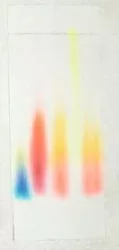
Dyes in water soluble markers may be separated by means of..
a)
crystallization
b)
sublimation
c)
chromatography
d)
sedimentation
9.
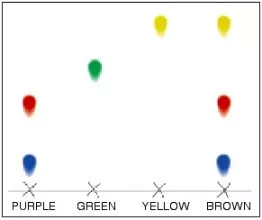
The diagram shows the chromatogram for three colouring dyes and that for a brown marker. What dye(s) are contained in the marker's ink?
a)
purple and green
b)
purple and yellow
c)
purple only
d)
green and yellow
10.
If a solid disappears when added to a liquid (like when sugar is stirred in water)... it is said to have...
a)
Formed a solute
b)
Dissolved
c)
Formed a solvent
d)
Become insoluble
11.
To separate a mixture of soil and water what separation method is used?
a)
Filtration
b)
Distillation
c)
Chromatography
d)
Evaporation
12.
To separate a mixture of salt and water what separation method is used?
a)
Filtration
b)
Distillation
c)
Chromatography
d)
Evaporation
13.
To separate rock salt what separation methods are needed?
a)
Evaporation and distillation
b)
Evaporation and filtration
c)
Evaporation and chromatography
d)
Evaporation and distillation
14.
The clear liquid which passes through the filter paper is called
a)
filt
b)
filter
c)
filtrate
d)
filtration
15.
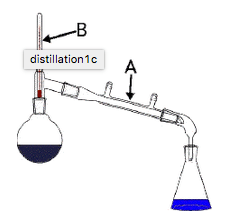
In the distillation apparatus shown, what are the parts labelled A and B?
a)
A = funnel, B = thermometer
b)
A = thermometer, B = funnel
c)
A = condenser, B = flask
d)
A = condenser, B = thermometer
16.
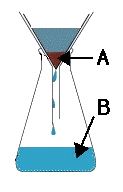
The diagram shows the apparatus for separating soil and water. What are the labelled parts?
a)
A = distillate, B = filtrate
b)
A = filtrate, B = residue
c)
A = residue, B = filtrate
d)
A = residue, B = distillate
17.
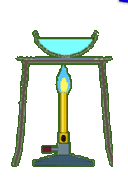
Which one of the following is the name for separation technique in the picture below
a)
distillation
b)
dissolving
c)
evaporation
d)
decanting
18.

If an acid is combined with an alkali of equal strength, the result will most likely be

a)

a neutral solution.

b)

a stronger acid.

c)

impossible to tell without testing the pH.

d)

a stronger base

19.

Holly has an unknown substance in a beaker. She wants to determine the relative pH of the unknown substance. She places a piece of blue litmus paper into the substance, and the litmus paper stays blue.

The substance in the beaker

a)

is an alkali

b)

has a neutral pH.

c)

is an acid.

d)

does not have a pH.

20.

Human blood has a pH between 7.35 and 7.45. Which of the following best describes human blood?

a)

strongly acidic

b)

slightly acidic

c)

strongly alkaline

d)

slightly alkaline

21.

Many cleaning solutions are alkalis. Which of the following is a property of most alkalis?

a)

feels slippery

b)

white color

c)

can only be liquid

d)

tastes sour

22.

Pure water has a pH of 7. Pure water _______.

a)

is an alkali

b)

is a neutral substance

c)

could be either an acid or an alkali

d)

is an acid

23.
Which is the stronger acid?
a)
pH 1
b)
pH 4
c)
pH 8
d)
pH 13
24.
What is the pH of a neutral substance?
a)
0
b)
5
c)
7
d)
10
25.

Which statement is true when acids and alkalis are mixed together?

a)

acids become stronger

b)

alkalis become stronger

c)

there is no change

d)

they neutralize each other

26.

What does the pH scale measure?

a)

the concentration of acids and alkalis

b)

the malleability of a metal

c)

the temperature of the water in a swimming pool

d)

the amount of phosphorus in a compound

27.

Ammonia has a pH of 12. Ammonia is __________.

a)

an acid

b)

an alkali

c)

an element

d)

a metal

28.

All of the following would indicate that a chemical is an alkali except:

a)

litmus paper turns blue

b)

it conducts electricity

c)

its pH is less than 7

d)

it is slimy to the touch

29.

pH less than 7

a)

Acid

b)

Alkali

c)

Neutral

d)

Indicator

30.

Tastes Sour

a)

Acid

b)

Alkali

c)

Neutral

d)

Indicator

31.

Turns blue litmus paper to red

a)

Acid

b)

Alkali

c)

Neutral

d)

Indicator

32.

Turns red litmus paper blue

a)

Acid

b)

Akali

c)

Neutral

d)

Indicator

33.
An indicator will ______________ when it is in contact with an acid or base
a)
Bubble
b)
Form a new substance
c)
Change color
d)
Stay the same color
34.

On the pH scale what numbers are alkali's?

a)

8-14

b)

0-7

c)

7

d)

1

35.
On the pH scale what numbers are acids?
a)
8-14
b)
0-7
c)
7
d)
1
36.

On the pH scale what colors are alkali's?

a)

Reds and oranges

b)

Blues, dark greens, and purples

c)

Yellows

d)

Green

37.

On the pH scale what colors are acids?

a)

Reds and oranges

b)

Blues, dark greens, and purples

c)

Yellows

d)

Green

38.

On the pH scale what colors are neutrals?

a)

Reds and oranges

b)

Blues, dark greens, and purples

c)

Yellows

d)

Green

39.
What numbers on the pH scale would indicate the strongest acid?
a)
11, 12, 13, 14
b)
8, 9, 10,
c)
4, 5, 6
d)
1, 2, 3
40.
What numbers on the pH scale would indicate the weakest acid?
a)
11, 12, 13, 14
b)
8, 9, 10,
c)
4, 5, 6
d)
1, 2, 3
41.

What numbers on the pH scale would indicate the weakest alkalis?

a)

11, 12, 13, 14

b)

8, 9, 10,

c)

4, 5, 6

d)

1, 2, 3

42.

What numbers on the pH scale would indicate the strongest alkalis?

a)

11, 12, 13, 14

b)

8, 9, 10,

c)

7

d)

1, 2, 3