

Wayground logo

Free Printable Worksheets

Font size

S
M
L
XL
Worksheets

Unit 6 Test: Depression, Totalitarian, WWII, and Holocaust

Total questions: 79

Worksheet time: 44mins
Name
Class
Date
1.
The President who was mostly blamed for worsening the Great Depression 
a)
Roosevelt 
b)
Eisenhower
c)
Hoover
d)
Jefferson
2.
After the Stock Market Crash, many people lost their life savings because _______________.
a)
banks closed
b)
banks gave away their money
c)
they couldn't remember where they put it
d)
someone stole it
3.
To make things worse during the Great Depression, there was a severe drought in the midwest.  Because the soil was so dry, wind caused dust storms that covered people's homes, and all of their belongings.  This was called the _______________
a)
Dust Bowl
b)
Dry Bowl
c)
Dirt Bowl
d)
Depression Bowl
4.
What was the "New Deal" of the 1930s?
a)
a government program that gave free land to homesteaders 
b)
a government program that spread civil rights throughout the country
c)
a government program designed to help people during the depression 
d)
a government program that helped women get the vote 
5.
The New Deal pulled America out of its economic mess!  Several New Deal agencies, such as the CCC, WPA, and the TVA, were important because ____________________.
a)
they built bridges, dams, and other useful projects
b)
they helped create jobs and put Americans back to work
c)
they offered assistance to farmers
d)
they provided electricity to a poor region
6.
Paying a small % of a stock's price & borrowing the rest is known as what?
a)
buying on margin
b)
speculation
c)
fiat money
d)
price supports
7.
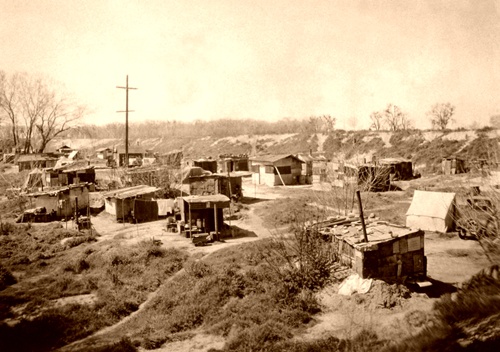
What were the villages full of shacks located in cities filled with unemployed Americans called?
a)
Hoovervilles
b)
Okies
c)
Bonus Army Bases
d)
Rooseveltowns
8.
Which cause of the Great Depression led to the decrease in the prices of goods and food?
a)
Stock Market Crash
b)
Overproduction
c)
Federal Reserve did not help failing banks
d)
High Tariffs 
9.
Which of the following is a term for buying something now and paying for it later?
a)
Credit 
b)
Debit
c)
Speculation 
d)
Investment 
10.
What caused increased unemployment during the Great Depression?
a)
Labor unions paid workers and gave them benefits even if they did not work.
b)
Life was so hard for many Americans that they simply did not want to work.
c)
Businesses did not have enough money to pay employees for their work.
d)
The federal government closed factories and put people out of work.
11.
What were the major goals of the New Deal?
a)
no gold standard and free coinage of silver
b)
abolition and suffrage
c)
relief, recovery, and reform
d)
expanding the size and economic influence of the United States
12.
What was the culminating event that brought the country out of the Great Depression?
a)
the Bonus Army
b)
the building of the Hoover Dam
c)
going off of the gold standard
d)
World War II
13.
Which of the following was "NOT" a cause of the Great Depression?
a)
Over speculation on stocks using borrowed money
b)
High tariffs discouraged international trade
c)
Unpaid debts from fighting World War I
d)
Too much debt from buying goods on installment plans
14.
controlling the messages and information shared with the citizens in your country is called
a)
indoctrination
b)
police terror
c)
propaganda
d)
censorship
15.
This President enforced both New Deals and saw America through the Great Depression and World War II. 
a)
Eisenhower
b)
Truman
c)
Hoover
d)
Roosevelt 
16.
What is Hyperinflation?
a)
Money loses value quickly
b)
property loses its value quickly
c)
stock loses its value quickly
d)
gold loses its value quickly
17.
Which country experienced hyperinflation?
a)
Germany
b)
France
c)
United States
d)
Britain
18.
How did the German people react to the Treaty of Versailles?
a)
They were ok with it because they realized that they lost the war
b)
They loved it because it was so favorable to them
c)
They hated it because it treated them severely
d)
Most Germans didn't really care
19.
-Overproduction
-Borrowing too much money
-Stock Market Speculation
a)
Causes of WWI
b)
Causes of the Great Depression
c)
Causes of the Civil War
d)
Causes of the Atlanta Race Riot
20.
The U.S. entered World War II as a result of the bombing of _____ on _____.
a)
Hiroshima / August 6, 1945.
b)
Pearl Harbor / December 7, 1941.
c)
Ellis Island / November 22, 1940.
d)
Staten Island / December 3, 1939.
21.
The U.S. entered WW II as a result of an attack by the
a)
Nazis.
b)
Italians.
c)
Japanese.
d)
Soviet Union.
22.
Great Britain was part of the ______ Powers during WW II.
a)
Allied
b)
Axis
23.
Germany was part of the ______ Powers during WW II.
a)
Allied
b)
Axis
24.
The Soviet Union was part of the ______ Powers during WW II.
a)
Allied
b)
Axis
25.
Italy was part of the ______ Powers during WW II.
a)
Allied
b)
Axis
26.
Japan was part of the ______ Powers during WW II.
a)
Allied
b)
Axis
27.
Products such as sugar, meat, canned goods, shoes, and rubber were ______ to ensure that there was enough of a supply for the war effort.
a)
outlawed
b)
rationed
c)
taxed
28.
What officially brings the war with Japan to an end? 
a)
A. Japan surrenders after losing at Pearl Harbor
b)
B. Japan surrenders after losing at Midway.
c)
C. Japan surrenders after one atomic bomb is dropped
d)
D. Japan surrenders after two atomic bombs are dropped. 
29.
A sociopolitical model wherein all property is publicly owned and workers are paid according to their abilities and needs.
a)
Communism
b)
Democracy
c)
Oligarchy
d)
Confederation
30.
What type of state aims to control all aspects of citizen's lives?
a)
socialist
b)
communist
c)
capitalist
d)
totalitarian
31.
How did the Enabling Act allow Hitler to to establish a totalitarian state?
a)
giving the government the power to ignore the constitution for four years
b)
establishing concentration camps for people who oppose the new regime
c)
dissolving trade unions
d)
abolishing the office of the President and declaring Hitler the sole ruler
32.
What was Kristallnacht
a)
a German concentration camp where thousands of Jews were executed
b)
a set of racial laws that excluded Jews from German citizenship
c)
a destructive Nazi rampage against the Jews
d)
Hitler's account of his movements and ideas
33.
excluded Jews from citizenship
a)
Nuremberg Laws
b)
New Economic Policy
c)
Dawes Plan
d)
lebensraum
34.
___________ was the dictator of Italy.
a)
Hitler
b)
Stalin
c)
Tojo
d)
Mussolini
35.
Who was the dictator of Japan?
a)
Hitler
b)
Tojo
c)
Stalin
d)
Mussolini
36.
__________ Stalin was the dictator of the Soviet Union.
a)
Adolf
b)
Hideki
c)
Joseph
37.
___________ is a warlike act by one country against another without just cause.
a)
Aggression
b)
Appeasement
c)
Fascism
d)
Communism
38.
__________ invaded the Rhineland, Austria, Sudetenland, and Poland.
a)
Italy
b)
Japan
c)
Soviet Union
d)
Germany
39.
___________ invaded Ethiopia and Albania.
a)
Italy
b)
Japan
c)
Germany
40.
_________ invaded many countries in the Pacific Region and Asia.
a)
China
b)
Japan
c)
Italy
d)
Germany
41.
The _________ invasion of _________ was the official start of World War II.
a)
German; Italy
b)
Italian; Poland
c)
Japanese; United States
d)
German; Poland
42.
Italy, Germany, Japan
a)
Axis
b)
Allies
43.
Great Britain, France, U.S.A. and Soviet Union (second half of war)
a)
Allies
b)
Axis
44.
What was Anschluss?
a)
The union of Germany and Austria-Hungary
b)
The union of Germany and Austria
c)
The union of Germany and Italy
d)
The union of Germany and the Rhineland
45.
Chamberlain agreed to what at Munich?
a)
No more wars
b)
To be Germany's ally
c)
To give Germany the Sudetenland
d)
To let Hitler have whatever he wanted
46.
lightning war
a)
blitzkrieg.
b)
sitzkrieg
c)
appeasement
d)
battle
47.
the policy of giving concessions in exchange for peace
a)
compromise
b)
agreement
c)
appeasement
d)
anschuluss
48.
7. The air battle between the German Luftwaffe and the British air force that began in June 1940 and lasted into the fall of 1940 became known as  
a)
sitzkrieg.
b)
the Munich Crisis.
c)
the Battle of Britain. 
d)
the “Miracle at Dunkirk.”
49.
Massive invasion of Europe planned and executed by Eisenhower. Normandy, France was where the invasion occurred. Largest land/sea attack in history.
a)
D-Day
b)
Battle of Midway
50.
Turning point of the war in the Pacific. Japan targeted Midway to get the whole US fleet to the island. US successfully attacked Japanese aircraft carriers
a)
Battle of Midway
b)
Operation Barbarossa
51.
They were removed from their homes and sent to internment camps for the duration of the war.
a)
What happened to Japanese Americans during the war
b)
Why American believed the Atomic Bomb was necessary
52.
What was the formal name for the extermination of all Jews in Europe?
a)
Judgement Day
b)
Final Solution
c)
D-Day
d)
German Rule
53.
Which term means prejudice against or hatred of Jews?
a)
semitism
b)
racism
c)
anti-semitism
d)
holocaust
54.
Which statement about ghettos is NOT accurate?
a)
Many families lived together in one small apartment.
b)
People were always hungry.
c)
Living conditions were unsanitary.
d)
The residents of the ghetto were free to come and go as they pleased.
55.
What number closest represent the number of Jews killed during the Holocaust
a)
6,000,000
b)
6,000
c)
600,000,000
d)
1,000,000
56.
____________ - the killing of an extremely large group of people such as an entire nation or entire ethnic/age group
a)
genocide
b)
persecution
c)
homicide
d)
suicide
57.
At the conclusion of WWI, the world entered into
a)
a worldwide depression that hit Germany especially hard
b)
A peace treaty that lasted until the Iraq war
c)
an economic agreement to supply food to poorer nations
d)
a building program to help European countries 
58.
How did Nazism in Germany end?
a)
The Axis Powers won
b)
Hitler commited suicide in 1945 and all symbols of Nazism were outlawed
c)
The Nuremburg Trials
d)
With the Treaty of Versailles 
59.
The United States dropped atomic bombs on these two cities:
a)
Berlin and Rome
b)
Hiroshima and Nagasaki
c)
London and Paris
d)
New York and Los Angeles
60.
Adolf Hitler, Benito Mussolini, and Josef Stalin can all be classified as
a)
fascist rulers
b)
communist rulers
c)
socialist rulers
d)
totalitarian rulers
61.

A form of government where the state (country) is glorified above the individual. Personal sacrifices have to be made for the betterment of the country.

a)

fascism

b)

totaliarianism

c)

communism

d)

Purge

62.

A form of government that ends all social class divisions and the ownership of private property.

a)

fascism

b)

communism

c)

Five-Year Plan

d)

collectivization

63.

Banning of all written, spoken, or visual material critical of the government.

a)

propaganda

b)

censorship

c)

Collectivization

d)

Nazism

64.

Stalin’s plan to combine small farms into large, factory-like farms run by the government

a)

Purge

b)

Communism

c)

Collectivization

d)

Anti-Semitism

65.

Stalin’s plan to change the Soviet Union from an agricultural to industrial country

a)

Anti-semitism

b)

Nuremburg Laws

c)

Collectivization

d)

Five Year Plans

66.

Forcibly remove someone or something. Stalin imprisoned or killed anyone opposed to him or his policies.

a)

Black Shirts

b)

Collectivization

c)

Purge

d)

Propaganda

67.

The name Hitler gave to Germans as a “master race”.

a)

Brown Shirts

b)

Black Shirts

c)

Gestapo

d)

Aryans

68.

Political party that Hitler belonged to. Stands for the National Socialist German Workers’ Party.

a)

Communism

b)

Socialism

c)

Fascism

d)

Nazism

69.

The government’s effort to influence public opinion or the way people feel about something

a)

censorship

b)

collectivization

c)

communism

d)

propaganda

70.
Saved Australia from Japanese invasion. 
a)
Battle of Coral Sea
b)
Battle of Midway
c)
Battle of Guadalcanal
d)
Battle of the Bulge
71.
Island Hopping was -
a)
Dropping atomic bombs on the cities of Hiroshima and Nagasaki
b)
Taking over China in order to weaken Japan's control of Asia
c)
The USA's strategy of moving their military closer to Japan one island at a time
d)
The USA's strategy of dropping napalm on Tokyo to force japan's surrender
72.
Which battle ended Hitler's final offensive in WW2?
a)
Battle of Midway
b)
Battle of the Bulge
c)
Battle of Stalingrad
d)
Invasion of Normandy
73.
How did the "cash and carry" program work?
a)
England would buy supplies from the US with cash and carry the supplies back to England with their own ships.
b)
England would buy supplies from the US with cash and then the US would carry the supplies to England on American ships.
c)
The United States would provide cash for England to purchase military supplies around the world, but England had to carry the supplies themselves.
d)
None of the above.
74.
This move by FDR likely resulted in the attack on Pearl Harbor?
a)
Oil embargo
b)
Economic support for China
c)
Four Freedoms Speech
d)
Direct aid to Britain
75.
What was the name of the program where President Roosevelt lent money and weapons to our allies to help them, but still kept the US neutral during the war? 
a)
Garden Hose Program
b)
Lend-Lease Program
c)
TARP Program
d)
Neutrality Acts
76.
Which of the following statements were causes of WWII?
a)
The failure of the League of Nations and the Treaty of Versailles
b)
the Great Depression
c)
The rise of Hitler and other fascist leaders in Europe
d)
All of the above WERE causes of WWII
77.
President Harry Truman’s decision to use atomic bombs against Japan was primarily based on his belief that 
a)
a.  An invasion of Japan would result in excessive casualties
b)
a.  Germany would refuse to surrender in Europe
c)
a.  An alliance was developing between Japan and the Soviet Union
d)
a.  Japan was in the process of developing its own atomic weapons
78.
Germany was unable to defend itself against attacks from the Allies occurring from the North, West and East. This ultimately led to what event?
a)
VJ Day
b)
VE Day
c)
D Day
d)
VN Day
79.
What event occurred the day after the second bomb was dropped on a Japanese city?
a)
VJ day
b)
VE Day
c)
D Day
d)
VN Day
