Wayground logo

Free Printable Worksheets

Font size

S
M
L
XL
Worksheets

B5 Evolution, Speciation, Fossils And Extinction

Total questions: 50

Worksheet time: 32mins

Name
Class
Date
1.
Who is the father of evolution?
a)
Darwin
b)
Mendel
c)
Newton
d)
Einstein
2.
What is another name for natural selection?
a)
survival of the smartest
b)
survival of the fastest
c)
survival of the biggest
d)
survival of the fittest
3.
What is a change in an organism that allows for it to survive in its environment?
a)
homologous
b)
vestigial
c)
variation
d)
adaptation
4.
When all of the organisms of a species have died it is called
a)
evolution
b)
extinction
c)
adaptation
d)
natural selection
5.
What is an organism that has similar characteristics and can reproduce?
a)
species
b)
organism
c)
embryology
d)
vestigial 
6.
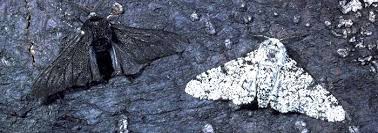
What is this an example of?
a)
diversity of species
b)
variation
c)
vestigial structures
d)
DNA studies
7.
Predict which moth would increase in population
a)
light 
b)
dark
8.
When the DNA of an organism is altered it is referred to as…
a)
Mutation
b)
Gene Flow
c)
Genetic Drift
d)
Sexual Selection
9.
Darwin wrote that organisms with traits that are best suited to the environment will ________________
a)
increase in number
b)
become extinct
10.
Which of the following is NOT an example of natural selection? 
a)
People selectively breeding hamsters.
b)
Insect populations developing resistance to certain pesticides.
c)
Bacteria becoming resistant to antibiotics.
d)
Male birds of certain species developing colorful feathers to attract female mates.
11.
Which term refers to the process by which individuals that are better suited to the environment survive and reproduce therefore passing down their genes to their offspring? 
a)
Evolution 
b)
Variation 
c)
Adaptation
d)
Natural Selection 
12.
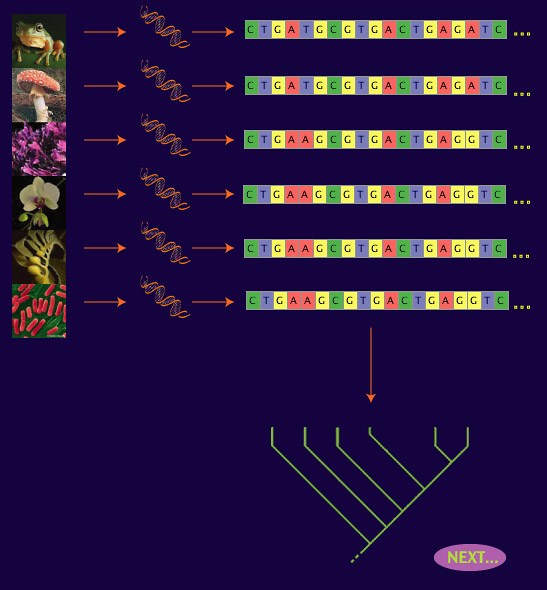
Which species’ DNA is most similar to the DNA of the toothed whale? 
a)
Hippopotamus 
b)
Baleen Whale
c)
Grazing Mammals
d)
Camels
13.
The environment around Manchester, England, changed during the Industrial Revolution.  How did this change affect peppered moths living in the area?
a)
Natural selection favored moths with dark wings because predators could not see them on the soot-colored trees.
b)
Natural selection favored moths with white wings that were easy for predators to see.
c)
Natural selection favored moths with white wings because predators could not see them on the soot-colored trees.
d)
Natural selection caused moths with white wings to become extinct.
14.
Two organisms that are closely related would have
a)
very similar DNA sequence
b)
exactly the same DNA sequences
c)
no proteins in common
d)
completely different DNA sequence
15.
Which of the following is a term for a group of similar organisms that can reproduce fertile offspring?
a)
individual
b)
population
c)
species
d)
fossil
16.
Why are advantageous traits more likely to be passed onto offspring?
a)
Because they are more likely to survive and reproduce.
b)
Because they come from dominant alleles.
c)
Because they come from recessive alleles.
d)
Because the trait is an acquired phenotype.
17.
The gradual change in species over time is...
a)
Evolution
b)
Nucleotide 
c)
Adaptation
d)
Natural Selection
18.
what did Charles Darwin observe in finch populations of the Galapagos Islands off the coast of South America?
a)
different species on different islands
b)
all species on one of the islands
c)
identical species on all the islands
d)
the same species as North America
19.

Which of the following describes natural selection?

a)

it acts on genetic material directly

b)

it acts on existing physical traits

c)

it forms new traits

d)

it forms new genetic material

20.

The more genetic variation a population has,

the more likely it is for some individuals to

a)

evolve

b)

migrate

c)

survive

d)

mutate

21.

The combined alleles of all individuals in a population is called the population's

a)

phenothype

b)

gene pool

c)

mutation rate

d)

allele frequency

22.
Evolutionary Similarities that can be seen in organisms by comparing their DNA is called-
a)
Biochemical Similarities
b)
Embryology
c)
Vestigial Structures
d)
Homologous Structures
23.
The opossum and kangaroo both incubate their young in a pouch. This provides evidence that they---
a)
are descended from a common ancestor
b)
Have very similar skeletal structures
c)
belong to the same species
d)
must range great distances to eat
24.
The DNA of an advanced species of grasshoppers contains---
a)
New types of bases, all formed from mutations in a primitive species of algae
b)
Different bases than the DNA of a primitive species of algae
c)
The same bases as the DNA of a primitive species of algae
25.
The table shows the survival rate of two types of beetles in the same environment over a period of three years.  

Which statement about the beetles in this environment is best supported by the data?
a)
Brown beetles have a shorter life cycle than green beetles have
b)
Green beetles are more fit for their environment than brown beetles
c)
 brown beetles are undergo more unfavorable mutations than green beetles
26.
Which two species are most related?
a)
B&C
b)
A&B
c)
A&C
d)
C&B
27.
What is the advantage of having different shaped beaks?
a)
To look different from other species.
b)
To be able to eat the food readily available in the environment.
c)
To protect itself against predators.
d)
To protect itself against prey.
28.
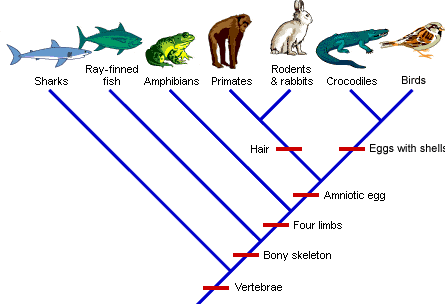
According to this cladogram, sharks are MOST closely related to which organism? 
a)
Amphibians
b)
Ray finned fish
c)
Crocodiles
d)
Birds
29.
On the cladogram, which number represents the common ancestor of organisms B & D?
a)
1
b)
2
c)
3
d)
A
30.
The __________ tells the history of life, past environments on Earth, and how different organisms have changed over time.
a)
fossil record
b)
law of superposition
c)
absolute age
d)
relative dating
31.
Fossils are preserved most often in which of the following substances? 
a)
Ice
b)
Sedimentary Rock 
c)
Asphalt
d)
Amber
32.
Related organisms have similar _______.
a)
Genetic Material
b)
Diet
c)
Behavioral Patterns
33.
Which is necessary for speciation to occur?
a)
adaptation
b)
mass extinction
c)
isolation
d)
acquired traits
34.
Why are advantageous traits more likely to be passed on to the offspring?
a)
Because parents with those traits can teach their offspring
b)
Because parents with those traits can surive and reproduce better
c)
Because parents with those traits care more about their offspring
35.

Based on the map, we can expect that the finches of the Galapagos originated...

a)

On the island closest to south america

b)

In south america

c)

On the island furthest away from the mainland

d)

In America

36.

How do fossils demonstrate common ancestry?

a)

Through comparing purposes of organisms

b)

Through evaluating similar functions of organisms

c)

Through demonstrating the species at once existed

d)

Through comparing different species structures

37.
The science of classifying organisms
a)
kingdom
b)
artificial classification system
c)
taxonomy
d)
domain
38.
A group of organisms that has one or more common characteristics; includes one or more species.
a)
genus
b)
phylum
c)
class
d)
family
39.
One of the six broad groups of organisms to which all species are assigned
a)
class
b)
phylum
c)
kingdom
d)
domain
40.
Cannot interbreed due to physical seperation
a)
geographic isolation
b)
behavioral isolation
41.
An original species from which all other species evolved.
a)
Fossil
b)
Natural Selection
c)
Descendant
d)
Common Ancestor
42.
Which statement is true about the fossil record?
a)
It is a record of all living things
b)
It shows how our climate has remained the same over time
c)
It provides evidence for history of life on Earth
d)
It does not support the theory of evolution
43.
Why don't we know what many ancient plants looked like? 
a)
They had too many soft parts.
b)
They were all eaten by dinosaurs.
c)
There weren't ancient plants.
d)
They had too many hard parts.
44.
What is hardened tree sap called?
a)
coprolites
b)
index fossils
c)
gastroliths
d)
amber
45.
Donna wants to make something that looks like a fossil. Which should she do?
a)
mix sand and clay and let it dry
b)
cover a seed with soil and water it
c)
push a shell into clay and pull it out
d)
wrap a leaf around a rock and freeze it
46.
Why do bones and teeth remain as part of some fossils?
a)
they are white
b)
bones are large
c)
the parts are hard 
d)
bones decay easily
47.
 These are dinosaur footprints. What is this a example of?
a)
All of the below!!!!!
b)
index fossil
c)
permineralized  remains
d)
trace fossil
48.
In which case, would a fossil hunter more likely find the animal perfectly preserved with its fur, skin, and organs?
a)
buried in sedimentary rock
b)
frozen in the tundra
c)
covered with volcanic dust
49.
A jellyfish is buried in mud. Will it fossilize? Choose the BEST answer.
a)
Yes, because it is buried in mud.
b)
Yes, because the jellyfish is protected from water with oxygen.
c)
No, because a jellyfish is made of soft body tissues.
d)
No, because the jellyfish isn't protected from water with oxygen.
50.
What sediment size is best for fossilization?
a)
sand
b)
coarse sand
c)
fine mud 
d)
gravel