

Wayground logo

Free Printable Worksheets

Font size

S
M
L
XL
Worksheets

Interim 3 Review

Total questions: 45

Worksheet time: 59mins

Name
Class
Date
1.

The Law of conservation of mass applies to photosynthesis.

a)

True

b)

False

2.

What is source of Carbon in Glucose, a product of photosynthesis?

a)

The atmospheric Carbon dioxide

b)

Carbon dioxide obtained from cellular respiration

c)

Carbon dioxide released when coal is burned

d)

Carbon dioxide stored in oceans

3.

Where would photosynthetic rates be highest?

a)

Where there is both enough rainfall and the temperature is around 40 oC

b)

Where rain is limited and temperature goes above 40 oC

c)

Where the climate is cooler and rainfall is limited

d)

Where there is enough Carbon dioxide and temperature goes below 0oC

4.

2 AlCl3 + 3 H2O(ℓ) → Al2O3 + 6 HCl (g)

How many grams of HCl will be produced when 249 g of AlCl3 are reacted ?

a)

5.6

b)

31.3

c)

2.33

d)

56

5.

How many grams of Al2O3 will be produced when 23.9 g of H2O are reacted according to this chemical equation?

2 AlCl3 + 3 H2O (ℓ) → Al2O3 + 6 HCl (g)

a)

45

b)

0.442

c)

1.233

d)

36.8

6.

How many grams of Mg will be produced when 86.4 g of K are reacted?

MgCl2(s) + 2 K(s) → Mg(s) + 2 KCl(s)

a)

32

b)

15.8

c)

26.87

d)

2.32

7.

When a Hydrogen and an Oxygen atom bonds together, sharing electron pairs,what kind of bond is it?

a)

Covalent

b)

Ionic

c)

Polar

d)

Hydrogen

8.

Electronegativity increases from left to right on the Periodic Table and decreases from top to bottom. Of Na and Cl, which atom is more electronegative?

a)

Sodium

b)

Chlorine

9.

Surface tension of water is due to

a)

The force of adhesion and cohesion between water molecules at the surface

b)

The hydrogen bond between the positive and negative ends of the water molecules

c)

The intramolecular force between the Hydrogen and Oxygen atoms in a water molecule

d)

The polar bonds in a water molecule

10.

Sodium and Chlorine atoms form what kind of bond together, if one is more electronegative than the other?

a)

Polar

b)

Ionic

c)

Covalent

d)

Hydrogen

11.

How many valence electrons in a neutral Carbon atom?

a)

3

b)

4

c)

1

d)

6

12.

What is the mole ratio of the reactants?

a)

1:2

b)

1:1

c)

2:1

d)

2:2

13.

Select the true statement

a)

The amount of Carbon dioxide throughout the Carbon Cycle stays the same

b)

More Carbon dioxide is produced by cellular respiration than consumed by plants through photosynthesis

c)

Less carbon dioxide is produced by animals than used by plants to produce glucose

d)

More glucose is produced than the Carbon dioxide taken up by plants from the atmosphere

14.

Cellular respiration is the opposite to photosynthesis where glucose is broken down in presence of Oxygen to release carbon dioxide and water. What kind of reaction is it?

a)

Exothermic

b)

Combustion

c)

Decomposition

d)

Endothermic

15.
The formula below represents the most common carbohydrate known as glucose. Which information can be determined from the chemical formula?
C6H12O6
a)
The structural arrangement of the atoms in a glucose molecule
b)
The color of a glucose molecule
c)
The size of a glucose molecule
d)
The number of atoms of each element in a glucose molecule
16.

For the Balanced Reaction: 3 Mg + 1 Fe2O3 → 3 MgO + 2 Fe; What is the Ratio of moles of MgO to moles Fe?

a)

3mol Mg / 2 mol Fe

b)

2 mol Mg/ 3 mol Fe

c)

1 mol Fe/ 2 mol Fe

d)

3 mol MgO / 2 mol Fe

17.

Cl2 + 2KBr → Br2 + 2KCl

How many grams of potassium chloride (KCl) can be produced from 356 g of potassium bromide (KBr)?

a)

749 g

b)

223 g

c)

479 g

d)

814 g

18.
If a chemist calculates the maximum amount of product that could be obtained in a chemical reaction, he or she is calculating the
a)
theoretical yield
b)
mole ratio
c)
actual yield
d)
percentage yield
19.
In a lab, a scientist calculate he should produce 12.3 grams of product in his experiment. When he is finished collecting his product it weighs 10.1 grams. What is his percent yield?
a)
82%
b)
0.82%
c)
10.1 %
d)
100%
20.
What type of reaction produces carbon dioxide and water?
a)
Neutralization
b)
Synthesis
c)
Decomposition
d)
Combustion
21.

Molar Mass is....

a)

the mass of a substance

b)

the mass of a substance per one mole of that substance

c)

the mass of a substance per 22.41 L of that substance

d)

the mass of a substance per one hundred moles of that substance

22.
In an exothermic reaction, heat is ...
a)
taken in
b)
given out
23.
A chemical reaction that requires energy is a
a)
exothermic reaction 
b)
endothermic reaction 
c)
over reaction 
24.
To slow down a chemical reaction you will do one of the following:
a)
Place the reactants in hot water
b)
Place the products in ice bath
c)
Place the reactants in a ice bath
d)
Keep stirring the reactants with a stirring rod
25.
What kind of reaction is this?
a)
Endothermic
b)
Exothermic
c)
Cannot be determined
26.
Which factors increase the rate of a reaction.
a)
increasing temperature
b)
increasing concentration
c)
increasing surface area
d)
all of these
27.
Which of the options below does NOT affect the rate of a reaction? 
a)
Concentration
b)
Temperature
c)
Time
d)
Catalyst
28.

How many valence electrons are there in an Oxygen atom?

a)

8

b)

4

c)

6

d)

2

29.
A chemical reaction that produces energy is a /an
a)
endothermic reaction
b)
exothermic reaction 
c)
energy
d)
chemical reaction 
30.
A substance that increases speed of chemical reaction without being being used up is called:
a)
Catalyst
b)
Activated complex
c)
Activation Energy
d)
Enthalpy
31.
With the increase in temperature, the average kinetic energy of the molecules increases, leading to a decrease in number of collisions per unit time.
a)
True
b)
False
32.
The collisions which bring about a chemical reaction are called: 
a)
Consistent collisions
b)
 Normal collisions 
c)
Effective collisions 
d)
None of the above
33.
More collisions correspond to a: 
a)
Faster reaction rate  
b)
Slower reaction rate
c)
Constant reaction rate 
d)
None of the above
34.

According to the law of conservation of mass

a)

Matter cannot be created or destroyed

b)

Mass of reactants and products will be the same

c)

A balanced chemical equation is necessary

d)

Carbon cycles through the earth as gaseous CO2, Glucose, fossil fuel and organic matter
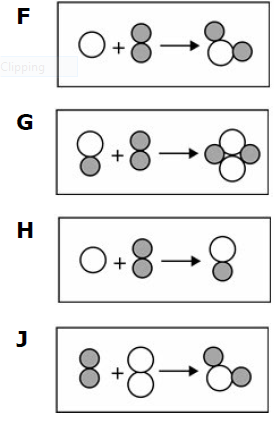
35.
Which of the following models best demonstrates a balanced chemical equation?
a)
F
b)
G
c)
H
d)
J
36.
Changes that involve the breaking of bonds and the formation of new substances.
a)
chemical changes
b)
physical changes
c)
state changes
d)
phase changes
37.
This equation is _________.
a)
balanced
b)
not balanced
38.

What kind of reaction is this:

4Fe + 3O2 → 2Fe2O3

a)

Synthesis of rust

b)

Oxidation

c)

Decomposition

d)

Neutralization

39.
An acid is a substance that produces _____________ when ______________. 
a)
hydrogen ions, dissolved in oil
b)
hydrogen ions, dissolved in water
c)
hydrogen atoms, dissolved in water
d)
hydrogen atoms, dissolved in oil
40.
Acid + base --> ?
a)
salt + hydrogen gas + water
b)
salt + carbon dioxide + water
c)
salt + water
d)
salt only
41.
If an atom gains an electron it is a(n)
a)
Positive ion
b)
Negative ion
c)
Isotope
d)
Neutral Atom
42.
Can an atom of Hydrogen have 2 protons?
a)
Yes, because it can be an ion
b)
No, because protons identify the atom
c)
Yes, because it can be an isotope
d)
No, because only neutral atoms exist
43.

What is the molar mass of Helium?

a)

4 g/mol

b)

4 g

c)

4 moles

d)

2 g/mol

44.

What is the molar mass of CH4?

a)

16

b)

18

c)

6

d)

132

45.

Formation of ground level ozone involves a series of reactions . What is the main source of the Carbon found in the byproduct ?

a)

Car exhaust

b)

Factory emissions

c)

Gaseous CO2

d)

Sunlight
