
 Worksheets
Science Benchmark #3- 031218
Total questions: 60
Worksheet time: 34mins


We investigated light using a _______. It is an object that separates white light into colors.
microscope
prism
shadow
telescope


This is an example of?
Absorbtion
Reflection
Refraction
Transmission
The number of waves that passes through a point in one second is called ________.
speed
frequency
wavelength
amplitude
What is faster than light?
A Ferrari
Usain Bolt
A microwave
nothing
How high or low a sound is called
pitch
patch
pihment
scream

The higher the_______ , the higher the ________ .
frequency, pitch
frequency, volume
sound, pitch
wavelength, decibels


Which of the following words describe the phases of the moon?
none, quarter, half, three quarters, full
new, crescent, quarter, gibbous, full
dark, light, half, quarter, blue
first quarter, second quarter, third quarter, fourth quarter
Phases of the moon in which the moon appears to be getting larger are referred to as _.
waxing
waning
new
eclipse
Changes in temperature from minute-to-minute, hour-to-hour, DAY to DAY
Climate
Weather
What is climate?
What's going on with the atmosphere at any particular time
The type of weather that occurs during a particular season
An area's pattern of weather over a LONG period of time
How much sunshine an area gets


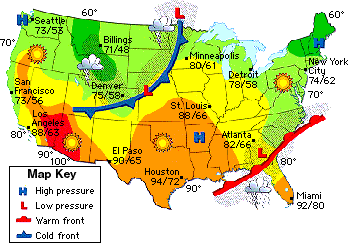

The picture represents the symbol for a _______________________Front.
Cold
Warm
Occluded
Stationary


What direction is the cold front moving?
Northwest
Southeast
Northeast
Southwest
A star is
Celestial body moving in an elliptical orbit around a star
Huge ball of super heated gas
The physical universe beyond Earth's atmosphere
A planet
How are stars and planets similar?
They are both made of gas and dust.
They rotate the same way.
They both move around the sun.
They make their own light.
How are stars and planets different?
Planets move around the sun, while stars do not revolve.
Stars are made of gas and dust, while planets are not.
Planets have hot cores, while stars have cool cores.
Planets are all the same size, while stars vary in size.
Why do stars look tiny in the night sky?
Stars are tiny because there are so many of them.
Stars are tiny because they come in many different sizes.
Stars are tiny because they move across the sky.
Stars look tiny because they are so far away.


An instrument that collects electromagnetic radiation from the sky and concentrates it for better observation:
telescope.
optical.
illusion.
reflection.

