
 Worksheets
Nuclear reactions
Total questions: 90
Worksheet time: 2hrs 12mins
Name
Class
Date
1.

Identify elements A and B and the process, C, in the illustration below.
a)
Deuterium, Tritium, Nuclear Fusion
b)
Deuterium, Tritium, Nuclear Fission
c)
Tritium, Hydrogen, Nuclear Fusion
d)
Deuterium, Hydrogen, Nuclear Fission
2.
Two reactions occur that do not obey the Law of Conservation of Mass. The first reaction involves light elements forming heavier ones. The second reaction has heavy elements forming lighter ones. Which statement describes these reactions?
a)
Both reactions may be nuclear fusion
b)
Both reactions may be nuclear fission
c)
The first reaction is nuclear fusion, and the second is nuclear fission
d)
The first reaction is nuclear fission, and the second is nuclear fusion
3.
A nuclear fission reaction occurs when a uranium-235 atom is bombarded with a neutron. This reaction is used to produce energy in a nuclear power plant. Why is it not possible to carry out a nuclear fusion reaction in a nuclear reactor?
a)
A fusion reaction releases harmful rays
b)
A fusion reaction is difficult to control
c)
A fusion reaction requires extremely low temperature and pressure
d)
A fusion reaction requires extremely high temperature and pressure
4.
In nuclear fusion, two positively charged nuclei must touch and bind together. This requires that the nuclei approach each other at.....
a)
low temperatures and low velocity
b)
low temperatures and high velocity
c)
high temperatures and high velocity
d)
high temperatures and low velocity
5.
Which of the following statements BEST describes nuclear fission?
a)
Nuclear fission inside stars can absorb or release energy
b)
Nuclear fission causes the reaction inside an atomic bomb
c)
Nuclear fission is usually present in endothermic reactions
d)
Nuclear fission cannot be used to produce power in nuclear energy plants
6.
Which of the following statements BEST describes nuclear fusion?
a)
Nuclear fusion is a common source of energy
b)
Nuclear fusion usually requires freezing temperatures
c)
Nuclear fusion usually requires a high-temperature environment
d)
Nuclear fusion releases a small amount of energy compared to most
chemical reactions
7.
The half life of iodine-131 is 8.040 days. What percentage of an iodine-131 sample will remain after 40.20 days?
a)
312.5%
b)
31.25%
c)
.3125%
d)
3.125%
8.
Has a mass of 4 and a charge of +2
a)
Alpha
b)
Beta
c)
Gamma
9.
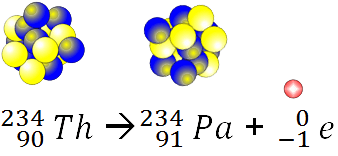
Which type of nuclear radiation is being emitted here?
a)
Alpha
b)
beta
c)
gamma
d)
none
10.

Has the symbol
a)
Alpha
b)
Beta
c)
Gamma
11.
This type of reaction occurs when light nuclei combine to form a larger, single nucleus.
a)
Fission
b)
Fusion
c)
single displacement
d)
double displacement
12.
Uses radiation to destroy targeted cancer cells
a)
nuclear reactor
b)
nuclear power
c)
nuclear medicine
d)
atomic bomb
13.
This type of reaction occurs on the sun and in stars.
a)
Fission
b)
Fusion
c)
synthesis
d)
decomposition
14.
This reaction quickly grows larger and larger if there is enough fissionable material available.
a)
Fission
b)
Fusion
c)
Chain
d)
Decomposition
15.
The amount of material required so that each fission reaction produces another fission reaction.
a)
Atoms
b)
critical mass
c)
energy
d)
particles
16.
At times, lost mass is converted into _________, during fission reactions.
a)
chain reactions
b)
energy
c)
critical mass
d)
fusion
17.
Nuclear reactions involve the particles in the ____.
a)
electron cloud
b)
neutrons
c)
nucleus
d)
half-life
18.
A form of radiation that carries energy and has no mass and no charge.
a)
Alpha particles
b)
Beta Particles
c)
Gamma Rays
d)
Daughter nucleus
19.
One way to initiate a fission reaction is to penetrate a large nucleus with a ___.
a)
Neutron
b)
Proton
c)
Electron
d)
critical mass
20.
The time required for half of the nuclei of an isotope to decay.
a)
Half-life
b)
radioactive dating
c)
critical mass
d)
critical point
21.
The nucleus left after an isotope decays.
a)
Gamma ray
b)
alpha particle
c)
beta particle
d)
daughter nucleus
22.
The process of changing one element to another through nuclear decay.
a)
Decomposition
b)
Radioactivity
c)
Transmutation
d)
Daughter nucleus
23.
Elements 93 and above that are not found in nature.
a)
Synthesis elements
b)
Synthetic elements
c)
Lanthanide Series
d)
Actinide Series
24.
The least penetrating type of radiation
a)
Alpha particle
b)
Beta particle
c)
gamma ray
25.

a)
Fission reaction
b)
Fusion reaction
c)
Decomposition reaction
d)
Combustion
26.
Fusion produces ____ nuclei.
a)
same-sized
b)
smaller
c)
larger
d)
all of the above
27.
Which of the following is an advantage of nuclear energy as a power source?
a)
Nuclear waste is not radioactive
b)
Nuclear plants are low in cost
c)
Nuclear energy does not produce air pollution
d)
Waste can be stored anywhere
28.
Which of the following is a disadvantage of nuclear energy as a power source?
a)
Nuclear energy produces less energy than the burning coal
b)
Nuclear energy produces air pollution
c)
Nuclear waste must be safely stored
d)
The fuel source is very limited
29.
Where does fusion occur naturally?
a)
Underwater
b)
All around us
c)
On the moon
d)
On the sun
31.
Where does fission occur naturally?
a)
Not naturally occurring
b)
All around us
c)
On the moon
d)
On the sun
31.
Where does fission occur naturally?
a)
Not naturally occurring
b)
All around us
c)
On the moon
d)
On the sun
32.
Nuclear power uses ____ for fuel.
a)
steel
b)
coal
c)
uranium
d)
hydrogen
33.
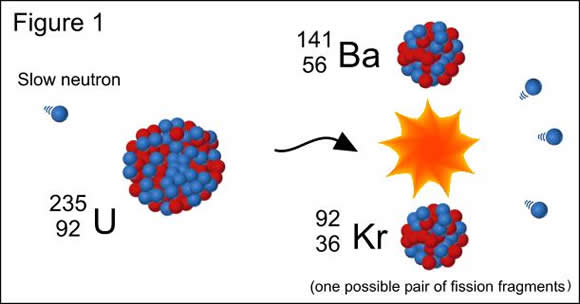
Which nuclear process is shown in the picture?
a)
fission
b)
fusion
c)
alpha decay
d)
beta decay
34.
Which element can be used to start nuclear fission reactions?
a)
helium
b)
hydrogen
c)
phosphorous
d)
plutonium
35.
Which s NOT a major concern over storing nuclear waste?
a)
it is expensive to store it safely
b)
it could contaminate the ground water
c)
it is dangerous
d)
it is stored in concrete containers
36.

This is an example of...
a)
Fission reaction
b)
Fusion reaction
c)
Decomposition reaction
d)
Combustion
37.
When nuclei decay, an element stays the same.
a)
True
b)
False
38.

The disintegration of an unstable nucleus into one or more different nuclides is called
a)
radioactive decay
b)
nuclear radiation
c)
chemical reaction
d)
ionization
39.

Positively charged particles that consist of two protons and two neutrons are called
a)
alpha particles
b)
beta particles
c)
gamma rays
d)
neutron emissions
40.

An electron that is emitted during radioactive decay is a
a)
neutron
b)
gamma ray
c)
alpha particle
d)
beta particle
41.

The process of splitting heavier nuclei into lighter nuclei is called
a)
nuclear fission
b)
nuclear fusion
c)
radiation poisoning
d)
chemotherapy
43.

The process in which lighter nuclei combine at extremely high temps and pressure, forming heavy nuclei and releasing energy is
a)
fission
b)
fusion
c)
decay
d)
the scientific method
43.
The process in which lighter nuclei combine at extremely high temps and pressure, forming heavy nuclei and releasing energy is
a)
fission
b)
fusion
c)
decay
d)
the scientific method
44.
What is Half-life?
a)
The amount of time it takes for some of the nuclei in a sample of the isotope to decay
b)
The amount of time it takes for half the electrons in a sample of the isotope to decay
c)
The amount of time it takes for half the nuclei in a sample of the isotope to decay
d)
the amount of time it takes to double the nuclei in a sample of the isotope to decay
45.

What percent of carbon-14 would be left after 5730 years?
a)
100%
b)
75%
c)
50%
d)
25%
46.
The half-life of strontium-90 is 25 years. How much strontium-90 will remain after 75 years if the initial amount is 100 grams?
a)
75
b)
50
c)
25
d)
12.5
47.
What is the best description of what occurs in a fission reaction?
a)
energy is absorbed, & more stable elements are formed
b)
light nuclei form into heavier nuclei
c)
energy is released, and less stable elements are formed
d)
heavy nuclei split into lighter nuclei
48.
What change takes place in a nuclear fusion reaction?
a)
matter is converted to energy
b)
energy is converted to matter
c)
ionic bonds are converted to covalent bonds
d)
Covalent bonds are converted to ionic bonds
49.
What is an advantage of nuclear-fission reactor?
a)
A large amount of energy can be produced from a small amount of uranium.
b)
The power plants are only expensive if they require radiation shielding.
c)
The nuclear waste generated has a very long half-life.
d)
The products of fission reactions are often radioactive isotopes.
50.
Nuclear fission occurs when:
a)
a nucleus divides spontaneously, with no apparent reason
b)
electrical forces inside a nucleus overpower nuclear forces
c)
we cut nuclei in two with a very small cutting device
d)
one nucleus bumps into another causing a chain reaction
51.
What makes something radioactive?
a)
elements with an atomic number above 81
b)
an unstable nucleus
c)
contaminated sewage
d)
It decays over time
52.
The amount of material left after TWO half lives is ____ of the original amount.
a)
1/2
b)
1/4
c)
1/8
d)
1/16
53.
What is emitted during Beta Radiation?
a)
A high-energy Electron.
b)
Protons.
c)
Neutrons.
d)
Nuclei
54.

Which type of radioactive decay is occurring in this equation?
a)
Alpha decay
b)
beta decay
c)
gamma decay
d)
positron emission
56.
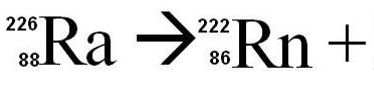
Complete the nuclear equation and determine the type of decay that is occurring in this reaction.
a)
alpha
b)
beta
c)
gamma
d)
none
56.
Complete the nuclear equation and determine the type of decay that is occurring in this reaction.
a)
alpha
b)
beta
c)
gamma
d)
none
57.
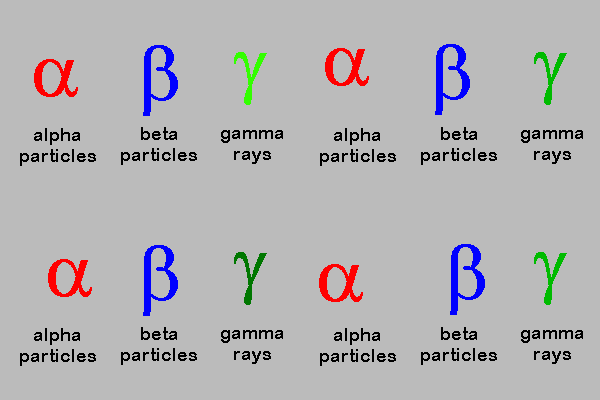
In order of most to least penetrating radiation we have
a)
Alpha , Beta, Gamma
b)
Beta , Gamma , Alpha
c)
Gamma, Beta, Alpha
d)
Gamma, Alpha, Beta
58.

What is this process?
a)
Fission
b)
Fusion
c)
Combustion
d)
Oxidation
59.

A star begins to "die" when elements stop fusing in its core.
a)
True
b)
False
60.
Nuclear Power's source comes from _________________.
a)
Uranium or Plutonium
b)
Coal
c)
Natural Gas
d)
Oil and/or Coal
61.
When moving neutrons hit the nuclei of certain other atoms thereby causing them to disintegrate, and this happens repeatedly, it is said to be a _______________________.
a)
nuclear chain reaction
b)
alpha radiation
c)
nuclear half-life
d)
control rod
62.

At a nuclear power plant, these are referred to as __________________.
a)
cooling towers
b)
reactor towers
c)
smoke stacks
d)
vapor chambers
63.
What product does a nuclear power plant produce for its customers?
a)
electricity
b)
a turbine
c)
hot water
d)
steam
64.
Two reactions occur that do not obey the Law of Conservation of Mass. The first reaction involves light elements forming heavier ones. The second reaction has heavy elements forming lighter ones. Which statement describes these reactions?
a)
Both reactions may be nuclear fusion
b)
Both reactions may be nuclear fission
c)
The first reaction is nuclear fusion, and the second is nuclear fission
d)
The first reaction is nuclear fission, and the second is nuclear fusion
65.
A nuclear fission reaction occurs when a uranium-235 atom is bombarded with a neutron. This reaction is used to produce energy in a nuclear power plant. Why is it not possible to carry out a nuclear fusion reaction in a nuclear reactor?
a)
A fusion reaction releases harmful rays
b)
A fusion reaction is difficult to control
c)
A fusion reaction requires extremely low temperature and pressure
d)
A fusion reaction requires extremely high temperature and pressure
66.
If a Radium-226 atom underwent an alpha decay, what atom would be left in its place?
a)
Radon-222
b)
Actinium-226
c)
Radon-224
d)
Francium-223
67.
If Thorium-234 undergoes a beta decay, What element will be left in its place?
a)
Actinium-234
b)
Thorium-233
c)
Protactinium-234
d)
Radium-230
68.
Radioactive particles that cause the most damage are known as:
a)
Alpha
b)
Beta
c)
Gamma
d)
Nuclear
69.
Strontium-90 has a half-life of 25 years. If you start with 25g, how many grams will remain after 100 years?
a)
1.56g
b)
2g
c)
12.5g
d)
0g
70.

Which radioactive isotope decays quicker?
a)
Carbon-14
b)
Plutonium-239
c)
Same
72.

After 32,000 years how much Plutonium-239 is left undecayed?
a)
32
b)
40
c)
5
72.
After 32,000 years how much Plutonium-239 is left undecayed?
a)
32
b)
40
c)
5
73.

Which type of nuclear radiation is being emitted here?
a)
alpha
b)
beta
c)
gamma
d)
none
74.

a)
42He
b)
0-1 e
c)
00Y
d)
178O
75.

a)
42He
b)
0-1 e
c)
00Y
d)
178O
76.
Solve this equation for alpha decay.
88226Ra = ___ + 24He
88226Ra = ___ + 24He
a)
86222Rn
b)
89226Ac
c)
84224Po
d)
88225Ra
77.
Solve this equation for alpha decay.
85209At = ___ + 24He
85209At = ___ + 24He
a)
83205Bi
b)
86209Rn
c)
81207Tl
d)
85208At
78.
Solve this equation for beta decay.
614C = ___ + -10e
614C = ___ + -10e
a)
410Be
b)
714N
c)
210He
d)
613C
79.
The process of nuclear change in an atom of radioactive material is called...
a)
nuclear decay
b)
nuclear mass
c)
isotopes
d)
radon
80.
In nuclear fusion, smaller atoms are forced together to create larger atoms. Does this process release, absorb or maintain energy?
a)
Absorb energy
b)
Maintain energy
c)
Release energy
81.
In this example of nuclear fusion, the products contain an expelled __________ which also contributes to the release of energy.
a)
helium
b)
neutron
c)
proton
d)
electron
82.
The product of nuclear fission includes
a)
neutrons and electrons
b)
several nuclei and neutrons
c)
several nuclei and electrons
d)
several nuclei and protons
83.
Which of the following is true about nuclear fission?
a)
The mass of the product is greater than the mass of the original nucleus
b)
The mass of the product is less than that of the original nucleus
c)
The mass of the product is the same as the mass of the original nucleus
d)
The mass of the product is 100 times greater than the original nucleus
85.
What is a chain reaction?
a)
When electrons travel are emitted causing electricity
b)
When a nuclear fission reaction occurs, the protons emitted can strike other nuclei in the sample, and cause them to split
c)
When a nuclear fission reaction occurs, the neutrons emitted can strike other nuclei in the sample, and cause them to split
d)
When a nuclear fission reaction occurs, the electrons emitted can strike other nuclei in the sample, and cause them to split
85.
What is a chain reaction?
a)
When electrons travel are emitted causing electricity
b)
When a nuclear fission reaction occurs, the protons emitted can strike other nuclei in the sample, and cause them to split
c)
When a nuclear fission reaction occurs, the neutrons emitted can strike other nuclei in the sample, and cause them to split
d)
When a nuclear fission reaction occurs, the electrons emitted can strike other nuclei in the sample, and cause them to split
86.
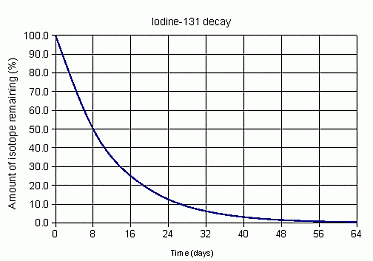
What is the half-life of iodine-131?
a)
32 days
b)
8 days
c)
16 days
d)
24 days
87.

What percent of carbon-14 would be left after 11,460 years?
a)
100%
b)
75%
c)
50%
d)
25%
88.

If a fossil is found to have one-eighth of Carbon-14 remaining then how old is the fossil?
a)
11,460 years
b)
5,730 years
c)
28,650 years
d)
17,190 years
89.

a)
Radioactive Decay
b)
Nuclear Fission
c)
Nuclear Fusion
90.

What machine is used to detect radiation?
a)
Geiger counter
b)
Richter counter
100 %

